When life gives you tape, make a W
Rowing tradition becomes part of Title IX 50th anniversary
Andy Baggot
3/15/2022
Bebe Bryans was preparing for one of her first races as the Wisconsin women’s openweight rowing coach when she noticed an odd project underway.
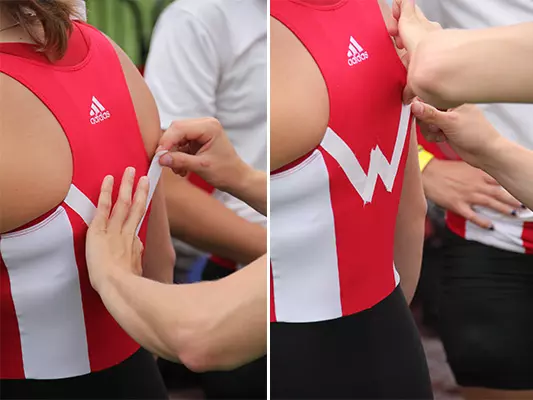
A handful of her student-athletes were tearing off pieces from a roll of white athletic tape and carefully applying them to the back of the bow seat on all the racing shells.
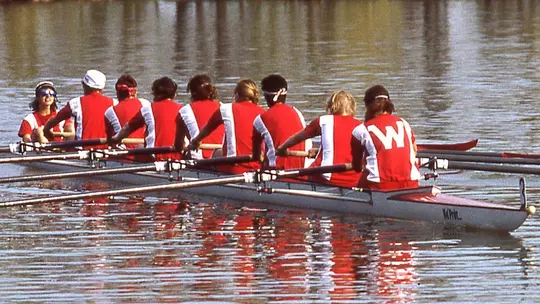
The strips created an unmistakable “W’’ that was large enough to be seen from the shoreline with the naked eye. Crew members assigned to the bow seats also had a white-taped “W’’ displayed on the backs of their red racing jerseys.
This was the fall of 2004 and Bryans had just left a burgeoning force at Michigan State – where she was the two-time Big Ten Conference Coach of the Year – to take the reins of the iconic program at UW, one that dates back more than a century.
Bryans knew the Badgers had layers of traditions – not a surprise given the first women’s race took place on the Madison campus in 1896 – but this one puzzled her.
“You’ve got to tell me the story why you’re doing this,’’ Bryans told her charges.
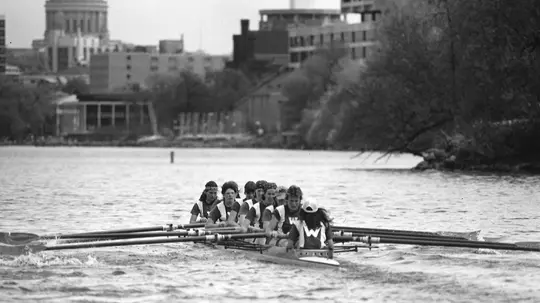
It’s a tale with many chapters and characters, one that dates back to the early 1970s and still endures today. It’s powerful enough that the image of a white-taped “W’’ is featured on the school’s logo celebrating the 50th anniversary of Title IX.
UW is staging a year-long celebration of Title IX, the federal civil rights law passed in June of 1972 that prohibits sex-based discrimination in any school or education program that receives funding from the U.S. government. It affected every aspect of society, but nowhere more so than in sports at all levels and nowhere more so than in the UW Athletic Department.
The transition from club sports to the awarding of varsity letters – from hand-me-down apparel and bare-bones travel budgets to shared facilities and full scholarships – took a while and women’s crew was on the leading edge.
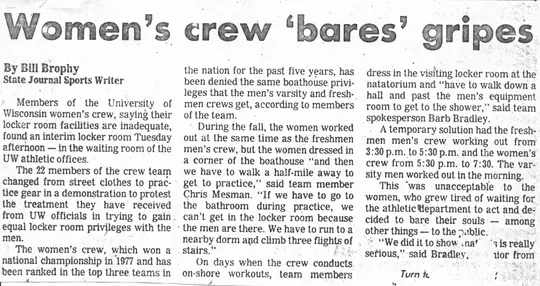
One of the more notable protests came during the 1978-79 school year when more than two dozen student-athletes, frustrated by the lack of progress in creating a suitable area for dressing and showers separate from the men, showed up in the waiting area outside Athletic Director Elroy Hirsch’s office and changed into their workout clothes.
The white-taped “W’’ project isn’t nearly as newsy, but its endurance is remarkable and its message is unmistakably loud. It came to life during the 1974-75 season, according to Sue Ela, the UW Hall of Fame inductee who rowed for the Badgers from ’72 to ’75 and coached them from ’79 to ’98.
A large white-tape “W’’ was put on the bow of each racing shell and one was attached to the back of the woman assigned the bow seat. Ela said UW rowers initially wore white shirts with a screen-printed rowing logo on the front from 1972 to ‘74. Red shirts were introduced in advance of the ’75 season, which enhanced the billboard effect.
“We wanted those watching from the shore to know that it was (Wisconsin) coming down the lake,’’ Ela said.
We wanted those watching from the shore to know that it was (Wisconsin) coming down the lake.
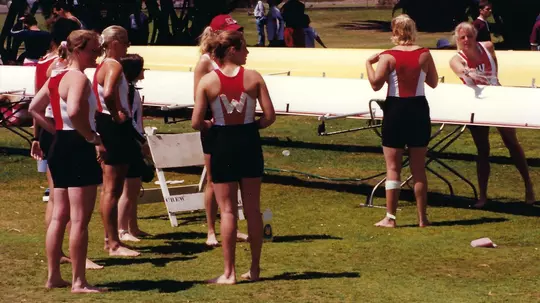
“In rowing, because you’re going backwards, they decided they needed a “W’’ on the back of the bow seat because that’s what crossed the finish line first,’’ Bryans explained. “That’s what everybody sees. So, before every race, they taped a “W’’ on the back of the bow seat on all the boats for every race.’’
Kris Thorsness, a 1984 Olympic gold medalist and UW Hall of Famer, remembers how it was explained to her.
“I was told at the time that (the white-taped ‘W’) was there so (opposing) crews would know who was about to pass them,’’ she wrote in a Facebook post.
That happened a lot back in the day. Despite being seen as a Midwestern upstart, lagging behind more well-funded programs on the east and west coasts, the Badgers won the national title with their varsity eight boat in 1975 and were the top collegiate crews in 1976, ’77, ’78 and ‘86.
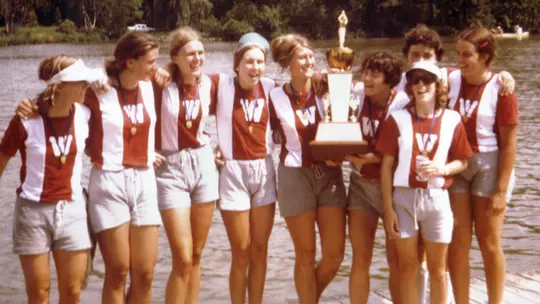
Bryans was an elite swimmer who got into rowing in the mid-1970s before graduating from San Francisco State in 1986. She called the white-tape “W’’ a “powerful symbol’’ because of all it portrays.
“You had extremely humble beginnings not only for Wisconsin rowing, but the whole sport had a very humble beginning,’’ she said. “When women started rowing, we had nothing in the early ‘70s. We were given men’s clothes to wear if we were lucky and it was a very begrudging beginning. Yet, there was a lot of school pride and team pride. And there was a lot of ‘Just out of my way because we’re going to do this.’”
When Bryans heard the story behind the white-tape “W’’ her reaction was immediate.
“Pride,’’ she said. “It wasn’t a surprise story to me because I go way back, too. I started rowing in ’75, so I understand what the scene was.’’
Bryans said Wisconsin was one of the leading-edge programs in women’s rowing.
“We’re something special in a special sport,’’ she said. “We were one of the pioneers and (the white-tape “W’’) was just one way that we showed who we were.’’
We were one of the pioneers and (the white-tape W) was just one way that we showed who we were.
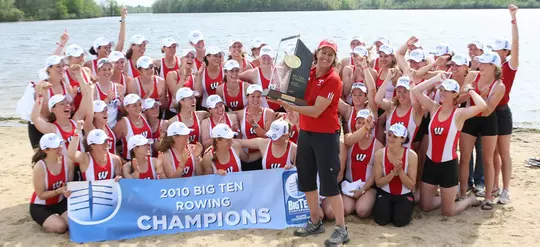
Bryans, who has led the Badgers openweights to the NCAA championships 14 times in the last 15 seasons, said UW had an enviable reputation back in the day. Despite a lack of consistent time on the water – winters in Wisconsin can be finicky – the team would show for marquee events like the Eastern Sprints and Head of the Charles ready to rock.
“Here was this scrappy, rowdy team with not a lot of technique, but really strong and prideful and really tough,’’ Bryans said.
Ela said the rolls of white athletic tape had other vital purposes in rowing.
“You’ve seen rowers’ hands, right? You get pretty bad blisters,’’ she noted. “Athletic tape was always available for wrapping an ankle or wrapping your hands. Heck, we used it to tie oars together in bundles to carry them on planes for a while.’’
Bryans added her own personal touch to the legend. During winter training, an old shell seat with a white-tape “W’’ on the back is used as an award. The winner is chosen by the latest recipient and her initials are scrawled on the tape. It’s given to the person judged to be doing the best job of supporting her team and improving as a rower.
“It’s one way that we keep that tradition of Wisconsin pride going,’’ Bryans said.