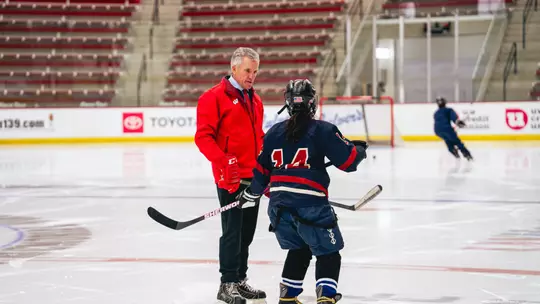
Mark Johnson: Still Enjoying the (Legendary) Ride
Andy Baggot
11/11/2025
Mark Johnson knew the question would be asked sooner or later, so he had a quality anecdote at the ready.
How long does the man who has authored a record eight NCAA championships and is closing in on a record 700 career victories with the Wisconsin women’s hockey team want to continue coaching his alma mater?
“Most times on Sunday morning at about 10:10 when church is over and I’m walking out, there’s Howie,’’ Johnson said, referring to Bill Howard, his old coach at Madison Memorial High School and UW Athletic Hall of Famer as a goaltending tutor for the Badgers.
“You’re going to be 70 pretty soon,’’ Howard would note. “You still going to be coaching?’’
Bear in mind that Johnson turned 68 in September. He once told a reporter, with emphasis, that he couldn’t see himself coaching into his 70s.
Now it looks as though Johnson can and will push that envelope.
“I still enjoy it,’’ he said simply.

Johnson will continue to oversee a program that has won an astounding 83 percent of its games since he took over in 2002 after UW extended his contract through June of 2030. He remains the highest-paid coach in women’s college hockey history.
“The part that keeps me going is I like it,’’ Johnson said. “I’m still connected with the players. I’m still enjoying driving down to campus. I’m still enjoying practices.
“The bottom line is if I get to the point where it’s hard going down there (to LaBahn Arena), that it’s work, then maybe it’s time for a younger person to come in and I’ll walk away with no regrets.’’
UW athletic director Chris McIntosh said Johnson, whose late father Bob led Wisconsin to three NCAA crowns and helped the Pittsburgh Penguins to a pair of Stanley Cups in the NHL, “is the model of consistency, humility and love for the game of hockey and his student-athletes. Few people in Badger history better represent excellence.
“For us, it is an honor to have him continue leading this program and truly a privilege to share this legendary journey with the greatest collegiate women’s hockey coach.’’
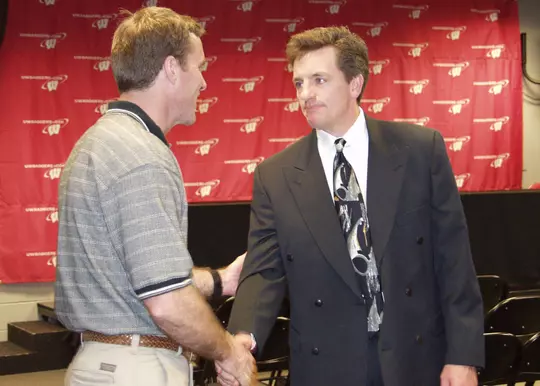
The defending NCAA champion Badgers are currently ranked No. 1 in the country heading into a Western Collegiate Hockey Association series at St. Cloud (Minn.) State on Friday and Saturday.
This latest journey to central Minnesota is especially poignant for Johnson. It was roughly a year ago that he was on a bus to St. Cloud when he got a jarring phone call. It was his wife Leslie, who told him that she had just been diagnosed with Parkinson’s Disease.
“My first thought,’’ Mark said, “was to have the bus driver take me to the airport and I’d rent a car and come back (to Madison) and I would retire.
“I don’t need to do this,’’ Johnson thought aloud. “I need to help her.’’
The Johnsons wound up doing their due diligence researching PD, a progressive neurological disorder that affects movement, balance and coordination. It’s caused by the gradual loss of dopamine-producing nerve cells in the brain.
There’s no cure for Parkinson’s and there’s no singular cause, but it’s believed to be a combination of genetic and environmental factors. Every case is different, but, with treatment, most people with PD can live full and active lives.
As of now, Mark said Leslie is handling her situation well although she tends to tire more easily and her appetite is a work in progress.
“Over the course of the next short period of time, it’s like, “OK, what are you going to do? What changes do you have to make? What’s the plan?’ “ Mark said. “You put the plan together and you execute the plan.’’
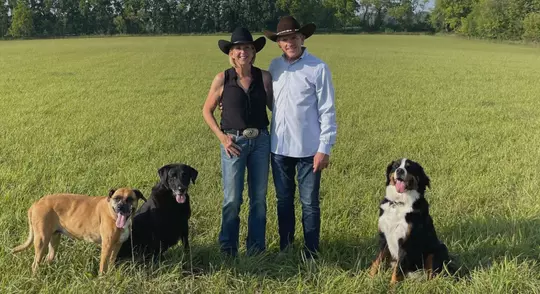
The Johnsons have spent the better part of the last decade planning, designing, creating and funding Agape Ranch, a 20-acre farm on the outskirts of Verona that, according to the facility’s website, “exists to encourage children to experience the healing power of God’s love through animals, land and people.’’
In Christianity, agape means “the highest form of love and charity.’’ It’s long been Leslie’s dream – her mission – to combine faith and love that creates hope for children and their families in search of healing for whatever reason.
“I love horses, I love kids, I love God,’’ she once declared. “How would I incorporate the three?’’
A new barn is at the epicenter of the ranch, where horses, dogs and other critters roam. Mark said Leslie is so hands-on that she noted the lack of a swinging cat door in the barn and moved to have that oversight rectified. With the help of a couple from Milwaukee, she also put 150 plants in the ground to help address potential runoff.
Mark said the whole the operation should be up and running by the end of the month.
“If her health is still good, (PD) is manageable and she’s doing what she loves to do, it’s going to put a smile on my face,’’ he said of Leslie.
The part that keeps me going is I like it. I’m still connected with the players. I’m still enjoying driving down to campus. I’m still enjoying practices.Mark Johnson
Mark said he’s prepared to coach into his 70s, but would step down if his family’s circumstances call for it.
“If I need to be around more, that’s what I’ll do,’’ Johnson said.
Now 45 years removed from his signature moment as an athlete – leading the Miracle on Ice crew to the Olympic gold medal in 1980 – Johnson has collected so much hardware that his office at LaBahn Arena looks like the makings of a fun rummage sale. Coach of the year awards, trophies and various treasures are either waiting on the floor or stashed on book shelves.
During a two-hour chat over coffee last week, Johnson, a remarkable 678-121-55 as coach of the Badgers, was asked a simple question: What are you chasing? His reply went to the heart of who Johnson is.
“I don’t think I’m chasing anything,’’ he said. “It’s more about serving people. Mentoring them. Teaching them life lessons. Teaching them, obviously, how to be better hockey players, but more importantly, how to be a role model, doing things the right way all the time.’’

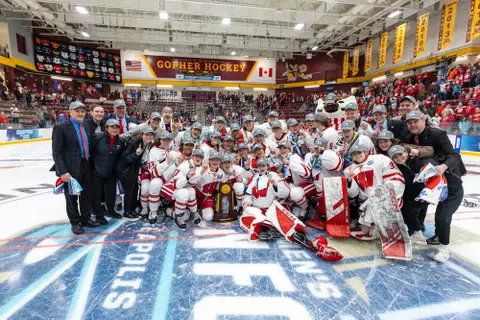

Brianna Decker, who won an NCAA title, an Olympic gold medal and is one of six former Wisconsin players to win the Patty Kazmaier Award as the best women’s player in college hockey in 2012, became the first UW women’s player to be named to the Hockey Hall of Fame during a ceremony Monday night in Toronto.
“It’s hard for me to put into words how much of positive impact he had on the lives of his players,’’ she said of Johnson.
“One of the best things about playing for Mark is that there was always a family feel. It stemmed from how much he cared about his own family and how much he cares about his kids and grandkids and all that seemed to rub off on us. I was never playing for Mark; I played with Mark. That’s how I felt every single game.’’
Johnson was asked how he might be a better coach now than he was when he was tabbed to guide the UW women’s program in 2002. He launched into a series of moments far removed from outcomes, recruiting pitches or X’s and O’s.
Like getting a letter from a former player, now married with kids, thanking him for the example he set. Or watching Carla MacLeod, a former UW defender, become a rising star as a coach at the professional and Olympic levels. Or seeing Laila Edwards, a current Olympic hopeful and co-captain of the Badgers, thoroughly embrace her platform as a role model.
“To me, that’s more important than winning the next game,’’ Johnson said.