
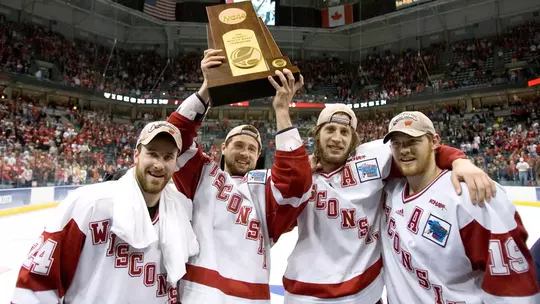
Reminiscing about the 2006 NCAA championship
National championship team returns on Saturday for the 20th anniversary of their run to the title
1/23/2026
BY ANDY BAGGOT
They arrived for duty within a 10-minute span earlier this week, exchanging fist bumps and hugs as they shed their winter gear.
Since they all live in the Madison area, Adam Burish, Robbie Earl, Brian Elliott, Tom Gilbert and Joe Pavelski weren't giddy as much as they were clearly happy to be in one another's company.
They spent the next 90 minutes or so sitting at a table in the Krantz Club, located on the ground floor of the Kohl Center, reminiscing about that moment 20 years ago when they helped the Wisconsin men's hockey team secure the sixth NCAA title in program history.
Against a backdrop of video highlights – including their first outdoor game experience at Lambeau Field in Green Bay as well a magical run through the NCAA tournament where they never left the State of Wisconsin – the five 40-somethings talked about the lessons they learned, the personal relationships they have with one another and the memories they hold dear to this day.
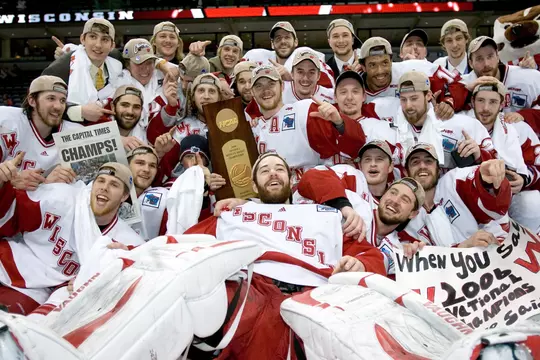
A vast majority of the 25-player roster, as well as UW coach Mike Eaves, is expected to be on hand Saturday night at the Kohl Center to honor that 20th anniversary outfit. The ceremony will be part of a Big Ten Conference series finale between the fifth-ranked Badgers and No. 8 Penn State.
Burish, the two-time team captain and right winger who went on to win a Stanley Cup with the Chicago Blackhawks in 2010, and Gilbert, a defenseman who scored the decisive goal on the power play in a 2-1 victory over Boston College in the national championship game before enjoying a 12-year NHL career, were seniors in 2006.
Earl was then a junior left winger who was named the Most Outstanding Player of the Frozen Four after scoring three goals, including two in a 5-2 NCAA semifinal win over Maine, while Elliott was then a junior goaltender who led the nation with eight shutouts, a 93.8 save ratio and 1.55 goals against average.
Meanwhile, Pavelski was a sophomore center who led the Badgers in scoring in '06 before turning pro and becoming one of the premier American-born performers to play in the NHL.
The five former UW teammates touched on a variety of factors that produced the program's first NCAA title since 1990.
"A really determined, really competitive bunch of guys," Burish said.
Earl, the first Black player to be named Most Outstanding Player in the Frozen Four, said UW was fortified by great leadership.
"Just a great bunch of guys who were willing to do what it took, to be held accountable and get to work every day," he said. "It's a special group."
Elliott, who was tutored by UW Athletic Hall of Fame goaltending coach Bill Howard and later became an inductee himself in 2017 along with Burish (2024) and Pavelski in (2025), spoke for most everyone involved when he addressed what he'd learned going to Wisconsin and playing championship-level hockey.
"After playing pro for a few years, I realized how much I learned in my four years about (playing) the game of hockey," Elliott said. "You don't really realize how much you're learning until you're gone."
This journey to the Frozen Four has roots that go back to 2002 when Eaves took over as coach and the Badgers waded through their worst season in program history. They went 13-23-4 overall – including just seven Western Collegiate Hockey Association victories – and averaged a measly 2.33 goals per game.
To this day Burish, Gilbert and three other seniors – A.J. Degenhardt, Nick Licari and Ryan MacMurchy – share a painful, exhausting, unforgettable bond that came to life with daily early-morning workouts, grueling sprint marathons, 5-mile runs in 100-degree heat and wrestling matches on the artificial turf of Camp Randall Stadium.
After the first practice, Eaves walked into the dressing room and said he was going to demand perfection from his players.
Making matters worse was the way the five surviving freshmen were treated by their teammates, who ridiculed their desire to live up to Eaves' demands.
"That was a hard year," Burish said.
"It was the toughest year I've played on a team,'' Gilbert said at the time.

The Badgers, fortified by young talent like Earl, Elliott, Pavelski, winger Jake Dowell, center Andrew Joudrey and defensemen Jeff Likens and Kyle Klubertanz, qualified for the NCAA tournament in 2004 and '05 before ascending to the throne two decades ago.
Eaves was the cultural catalyst for the turnaround.
"He pushed us to levels you never would have gotten to on your own," Burish said. "The training that we did, the practices that we had, you wouldn't have trained like that on your own."
"We heard the stories," Pavelski said. "We had it easy."
That championship season began with Eaves bringing the NCAA and WCHA trophies from 1990 to the first team meeting, a not-so-subtle message regarding expectations, especially knowing that the NCAA Midwest regional was to be staged in the Resch Center in Ashwaubenon and the Frozen Four was set for the Bradley Center in Milwaukee.
The Badgers were a juggernaut until mid-January when Elliott suffered a knee injury in practice that sidelined him until early March. His return to reliability came after a humbling WCHA series sweep at Minnesota State, Mankato that gave way to a spirited closed-door meeting.
UW went 9-1 the rest of the way, including three straight shutouts by Elliott heading into the Frozen Four. The most compelling was a 1-0 decision over Cornell that required three overtimes before freshman winger Jack Skille hauled in a perfect cross-ice pass from sophomore defenseman Josh Engel and scored with 11 minutes, 13 seconds remaining.
Eaves said he only recently watched the Cornell game on video but has seen the title game previously.
"Those two games stand out at a high level," he said. "The quality of play in both of those games was at a super-high level."
Elliott was brilliant on the way to 40 saves against a club that was a mirror image of the Badgers.
"We played a terrific game," Eaves said, "but we could have lost the game very easily."
The same goes for the championship match. After BC pulled its goaltender for an extra attacker, defenseman Peter Harrold squeezed off a shot with 2 seconds left that smacked the far post and kicked out of harm's way.
Eaves used that experience to make a point, comparing the 2006 outcome to the one his Badgers had in a Frozen Four rematch with the Eagles in the 2010 final at Ford Field in Detroit.
"You can have a real good team – good talent, good leadership – and you can have a coaching staff that tries to create the right environment and has a good system in place," Eaves said.
"In sports, sometimes it's your time to win and sometimes it's not. There's an X-factor involved in winning."
"In 2010, we're down 1-0 and Michael Davies has a clear-cut breakaway," Eaves said, "and he goes to shoot and the puck jumps 8 inches and he never gets the shot off."
One scene from the postgame celebration in Milwaukee showed Alvarez, the now-retired UW coaching icon and athletic director, with his arm draped over the shoulder of a grinning Eaves.
"One of those things that Coach Alvarez always used to say was winning is hard no matter what the sport," Eaves said. "There's some hard truth in that."
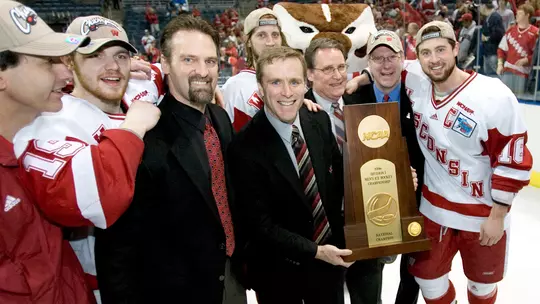
Eaves departed Wisconsin in 2016 and retired from coaching in 2022.
"Retirement has been good," Eaves said. "I enjoy it. And you know what? I don't miss the coaching. I look back on the job and what we do as coaches and its absolutely crazy. The hours and all that you put in. I loved it at the time; I truly loved it. But now that I step back, there's no way I'm going back into it."
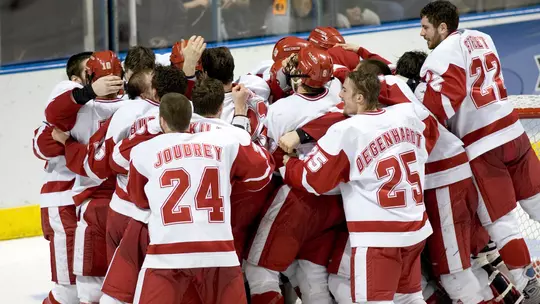
Asked which moment he remembers most about winning it all in 2006, Burish said the joyous mob that gathered around Elliott as soon as the final horn sounded.
"If there's one thing that jumps out it's the feeling that we weren't going to lose," Pavelski added. "We'd figure out a way."
Said Earl: "It was a grind, but you had total confidence the whole year."
Elliott said the outcome was defined by hard work.
"It's because we went through all those early mornings together and pushed so hard that when you get to that point in the season, the confidence is there because you put in the work," he said.
Oh, the stories that could be told if only that original NCAA trophy could talk. Burish said it spent a week on an extended tour of local bars, apartments and various pit stops along the way.
"We wanted to celebrate in Madison with the trophy," the captain explained. "I think we kept it for a week. We had friends and family around that wanted to see it."
All that attention proved costly -- literally.
"It got banged up, broken and got dropped," Burish acknowledged. "Finally, one day, Eaver called us and said they wanted the trophy back. That's when we realized the whole top was taken off."
According to Burish, he and his teammates had to chip in to buy a new trophy, which was on display for this mid-week gathering.
"The real one right now, if people want to know, is if you look close, there's super glue at the bottom and it's dented everywhere,'' Burish said.
Eaves is looking forward to catching up with his former players.
"The most interesting thing about talking with guys that you've had the opportunity to coach is asking them the question, 'What do you remember?' because those guys remember things so much more differently than you do and it's really fun to hear their perspective of what they remember and what was important and what they'll share with their own kids," he said.
Eaves said coaching at Wisconsin was "one of the best adventures of my life," putting up there on a list that begins with marrying Beth, his college sweetheart, and becoming a father to sons Ben and Patrick.
"Being in charge of a program like Wisconsin was the best of times and the worst of times all rolled up into one.
"You know you're helping young men grow up and learn about life through the game of hockey. As part of that experience, you want to try to win because winning is hard to do and it's part of the whole experience of being a collegiate athlete.
"You learn how to win. You learn how to lose. You learn how to grow up and become a man."
Burish, a Madisonian and one of 13 Wisconsin products on the '06 team, put this accomplishment in perspective.
"The biggest thing for me as I've gotten older is how much I appreciate all the things that I got to do," he said. "My only goal in sports or in life was to play for the Badgers and win a national championship. That was it. It was never a Stanley Cup. It was never the NHL.
"I appreciate it so much more now. I'm so much more proud of it today than I ever have been."
The fact he and his sister, Nikki, both won NCAA hockey titles for the Badgers in 2006 begs for perspective. A week after her brother won his, Nikki, an assistant captain for the women's team, got hers by virtue of a 3-0 victory over Minnesota.
"It's the coolest accomplishment of my life," Adam said.