'It's a battle you can't win on your own'
January 25, 2018 | Men's Hockey, Andy Baggot, Varsity Magazine
Hockey alumnus Rob Andringa’s battle with cancer has gained formidable support — his Badgers brothers.

 |
||
|
BY ANDY BAGGOT
UWBadgers.com Insider
MADISON, Wis. — From the time he was a toddler, Rob Andringa has been pushing roots deep into the fertile soil of the Wisconsin men's hockey program.
The youngest of four kids growing up in Madison, Andringa resided at 5109 Flad Ave. Five doors down was the epicenter of the Badgers.
That's where legendary UW coach Bob Johnson, his wife Martha and their five children lived.
The families became close. The Andringas, Conrad and Phyllis, had season tickets for games at the old Dane County Coliseum. Rob would regularly visit the home dressing room, program in hand, seeking autographs from 1970s greats like Steve Alley, Lloyd Bentley, Tim Dool and Wayne Thomas.
Sometimes the players, local legends after the Badgers won the first of six NCAA titles in 1973, would show up at the Johnson house while the Andringas were there.
A youngster walked around amid future national champions, Olympians, NHL standouts and Hall of Famers in boyish awe.
It's one of those days... A great day for hockey!
— Wisconsin Hockey (@BadgerMHockey) January 26, 2018
Decades have passed and Andringa, 49, has become distinctively intertwined with all those roots.
He went from being a stick boy to being a cerebral front-line defenseman for UW, playing a program-record 179 career games from 1987 to '91.
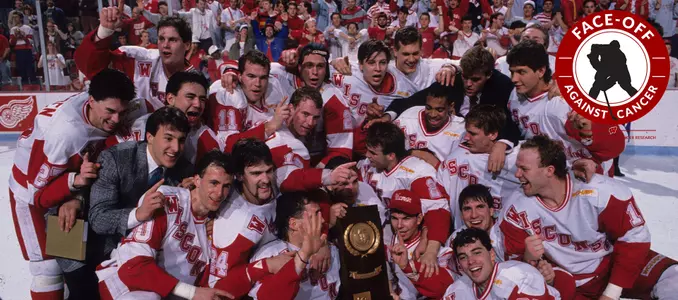
He won an NCAA championship in 1990 and served as co-captain the following year.
Andringa went on to serve as a color analyst for UW and Big Ten Conference games on radio and TV, lending his voice to the most recent national title run in 2006.
To review, the only roles Andringa hasn't played for the Badgers are as a coach and Zamboni driver, though he gave the latter a shot "and almost ran it into the boards."
Now the boy is a man — a husband, father and friend — drawing much-needed inspiration and strength from those roots.
Andringa learned on Dec. 15 that he has colon cancer. Since then he's been inundated with gestures of support from all corners of his life, many going back to those formative years on Flad Avenue.
An email from Alley, the Olympian and UW Hall of Famer.
A text message from Mike Eaves, the all-time leading scorer in program history who won an NCAA title as a player in 1977 and head coach in 2006.
Calls from the likes of Bentley and Dool.
Andringa gets texts almost daily from current Wisconsin coach Tony Granato, who provides encouragement and updates.
Of course, Andringa is in constant contact with the 24 teammates who also own NCAA championship rings from 1990.
"We're about as close as you'll get to really seeing true brothers within a 25-man team," he said.
Updated @BadgerMHockey helmets for tonight's game with the JJ stickers and Lundeen #Badgers
— Nate LaPoint (@N_LaPoint) January 26, 2018
Andringa will tap into another important support system Saturday night at the Kohl Center when the Badgers close out a Big Ten series with Penn State.
The game has been billed "Face-off Against Cancer" and will highlight the work of physicians and researchers at the UW Carbone Cancer Center.
The event will also recognize those who fight or have fought courageously against the disease, as well as the community that supports them.
That explains why Andringa will be honorary captain for the Badgers and why Noah Sanger will be featured in the ceremonial puck drop.
Sanger, the 5-year-old son of volunteer goaltending coach Jeff Sanger, is battling leukemia.
Also lending their time to the cause will be Wisconsin football coach Paul Chryst and men's basketball coach Greg Gard.

Andringa and Sanger will represent all those in the Badgers family whose lives have been touched by cancer. There are too many to count.
After all, Bob Johnson, who led UW to three NCAA crowns, died of brain cancer in 1991.
His successor, Jeff Sauer, who guided the Badgers to a pair of national titles, died of pancreatic cancer in 2017.
Granato's father, Don Sr., and younger brother, Don Jr., are cancer survivors.
So is Ethan Hughes, whose older brother Cameron is Wisconsin's senior center and captain.
Gard's father, Glen, also died of brain cancer in 2015, a loss that prompted his son to create the "Garding Against Cancer" initiative.
The list goes on.

"What's really weird is I've been to some of these games before where you're highlighting causes like this," Andringa said. "You're probably not paying your full attention as you should."
And now?
"We're on that side of the ledger," he said.
After growing up and starting a family in Madison — wife Christi, son Jack and daughters Carson and Dara — Andringa received a promotion with RBC Wealth Management that prompted a move to Stillwater, Minnesota, in 2015.
It will mean a lot for him to come home and be surrounded by familiarity and encouragement.
"There's part of me that's excited because I get to be in an element that I'm so comfortable in," he said.
It will mean a lot for Andringa to be back in Madison even though it means some trepidation.
"There's part of me that's a little scared because I'm that guy that has cancer," he said.
Andringa, a Madison Sports Hall of Fame inductee in 2011, has approached this challenge with confident optimism. He's two rounds into a series of six scheduled chemotherapy sessions and, so far, the usual caustic affects have been tolerable.
Andringa still drives to the office and recently went and watched two 1990 teammates-turned-coaches — Gary Shuchuk and Barry Richter — whose teams were playing in the Twin Cities area.
"You can't stop living," Andringa said. "You can't hole up in a corner and go, 'I got a bad deal.' You've got to live.
"You have to laugh, you have to cry, you have to be scared, you have to be elated. You have to continue all your emotions and run your life like you're going for it."
Andringa is going for it.
"This ain't going to stop me," he said of his diagnosis. "This ain't going to define me."
Andringa said he's reading books that emphasize the upbeat rhythms of life and the aura of faith.
"They always say the mind is one of your best healers in this and I've looked at everything positively," he said.
Andringa is in the process of creating space in his home for a "war room." Let him explain.
"If you ever have a bad day or bad news," he said of an idea he got from a co-worker, "you can go to that spot and it can re-energize your thoughts about how you're going to take this on and what do you need to do to mentally beat it."
Andringa is gathering posters, pictures and other mementos collected over the years from Madison Memorial High School to UW and beyond.
"Things that matter to me," he said.

What does Andringa want people to know about his duel with cancer?
"That it affects everyone, whether it's you directly or a friend or somebody you know," he said.
"It's a life changer. It's a battle you can't win on your own and it's a battle that will live with you forever. I'm hopeful that I'm one of these people, as I push my body through this chemo, that my body reacts in a way where it shrinks it and deletes it.
"Right now they say it's not curable, but I've heard stories that it's not curable, yet the people are cancer-free now."
Andringa has had talks with Don Granato Jr., about his bout with Hodgkin's disease — he's been cancer free since 2015 — and former NHL player and coach Eddie Olczyk about his current fight with colon cancer.
Their message: "You can't get too far ahead of yourself," Andringa said.
This week's Badger Hockey Digest has @brian_posick talking with @Osiecki24 and Illinois native @seamus_malone who look back at a big win in Chicago and ahead to continue the momentum against Penn State. #Badgers
— Wisconsin Hockey (@BadgerMHockey) January 25, 2018
Along the way Andringa has come across two other former Badgers — Gary Engberg, a goaltender from the early 1970s, and Dave Lundeen, a celebrated center on the 1977 NCAA titlists — who are waging their own health battles.
"You can't do this on your own," Andringa said. "You need support from your family, your friends, from outsiders because it's truly how your mind works.
"On one side you have this (sense) knowing that your mortality is right there. Then there's the other side — which you tend to believe in more — which is 'This ain't happening to me.'
"What jumps me up over that edge is my ability as an athlete to thrive on people giving me texts, phone calls, support. That motivates me just like it motivates me to see my kids every day and seeing my wife every day and talking to my mom and dad and my family."
Andringa got a lot of his spunk from his 80-year-old father, a respected long-time Madison pediatrician. Three weeks after Connie suffered a broken left arm and wrist and serious head injuries in an accident — he was hit by a school bus while walking in his Middleton neighborhood — he was at his son's hospital bedside.
"Having him around was something I didn't truly understand or appreciate until he left after the week he spent with me," Rob said.
Connie gave his son something to remember forever.
"I should be dead or a vegetable based on what happened to me," the father told Rob. "There's a reason why I'm here. I'm here to take care of you."
There was a time Rob felt like a failure for having never reached the NHL like many of his college teammates. That's no longer the case.
"Pro hockey never hit it with me and after a couple years I realized why," he said. "It was because, to me, the Badgers were it. I didn't need to go to another level."
Playing hockey at Wisconsin, Andringa said, "was my pinnacle."
Now, hearing from so many of his fellow Badgers in his time of need, gives Andringa pause.
"It's only cemented my belief that we truly are the best program in the world," he said.