Conversation With Openweight Coxswain Erin Buchanan
May 09, 2002 | Women's Rowing
There have been special situations in the history of sport where a person served the role as both coach and player. Baseball-great Pete Rose led the Cincinnati Reds as both from 1984 until his retirement as a player in 1986. Legendary hoopster Bill Russell led the Boston Celtics to the the 1967-68 NBA Title as player and coach. Hockey innovator Lester Patrick led the New York Rangers as the coach from 1926-46, but came off the bench during the Stanley Cup Finals in 1927 to play goal for the the eventual champions.
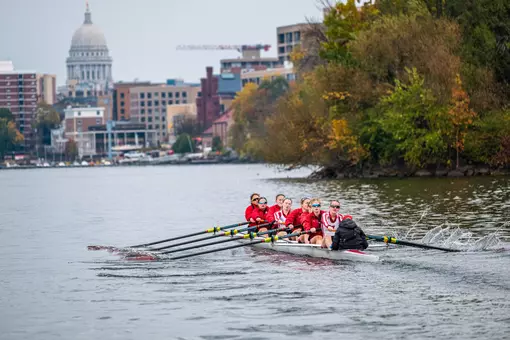
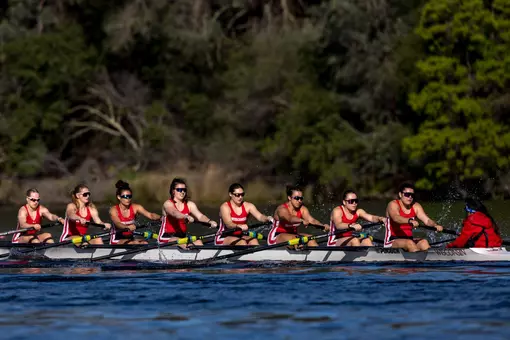
While senior women's openweight rowing team member Erin Buchanan may not have the same accomplishments on her young resume, she is one of a long line of Badger player-coaches. You see, Buchanan serves as an on-the-water coach for the openweight women's varsity, steering the shell, inspiring her boat and helping the squad improve while out on the water as one of the team's coxswains.
UWBADGERS.COM sat down with the senior to discuss how she became a member of the Wisconsin women's openweight crew and to talk about what exactly a coxswain is.
Born in the town, Madison, Wis., where she now attends school, Buchanan did most of her growing up in Appleton, Wis., where her first contact with the sport was made.
'My really good friend (Erin Bye) from home rowed back in Appleton in a small club,' said Buchanan. 'When we got to the UW, she told me I should try it, so I went down to the boat house and have been coxing ever since. '
The senior's rowing start is a familiar tune for many of the members of the three Badger rowing teams. Many of the student-athletes that race for the men's, women's openweight and women's lightweight teams had never rowed before college.
'The majority of the people on the rowing teams are home-grown Wisconsin kids,' Buchanan said. 'They are very inexperienced and they go to SOAR (Summer Orientation Advising and Registration). The team will have coaches over the summer stand there and look for tall people to row. For coxswains, they look for small people. The neat thing about this sport is that you can be extremely successful knowing absolutely nothing about it. You don't have to have a lot of background. In some cases, the people that row in high school get recruited and come to school here, but you get to a pretty even playing ground once you get to the varsity. You learn pretty quick to pick this sport up.'
UWBADGERS.COM: How do you learn to become a coxswain'
Buchanan: 'The more and more you are in a boat, the more experience you get. That's the best way to become a coxswain. You learn how to handle a boat, to steer and watch the traffic pattern. The more you spend in races, the more you see other boats along side of you. You become more confortable with seeing where you are at and relaying that to the rowers. A lot of times you listen on a tape. We can tape races. I tape a lot of my races, and they'll show them to younger coxswains so they know what is said in the races. A lot of it is very personal. It becomes your own style. Your crew has to trust you, so the more you can handle a boat the better they will feel about having you there. The way you talk to them, the way you coach them, the way you get them to respond to you is very personal. One year a crew really likes a coxswain that babies them and tells them, `It's o.k. You're fine,' and then other years they want, `Do it now.' A hard part of coxing is that you can flip-flop from year to year. You can be in the four one year and the varsity eight another year.'
UWBADGERS.COM: Are there weight limits for coxswains'
Buchanan: 'You have to weigh 110 pounds for women and 125 pounds for men. If you are under that in races, you have to carry weight. The coaches will look for small people with an outgoing personality when they are recruiting. Or they 'll look for someone that is very decisive because coxswains are always making decisions.'
UWBADGERS.COM: What exactly is your job on the team'
Buchanan: 'It's a weird position. It's probably the weirdest position in sports. The coxswain's job is essentially to be a coach in a boat. You're the brain, they're the muscles. Sometimes rowers will get into a boat and stop thinking because they have a little person up front that tells them exactly what to do, when to do it, how to do it and everything that is going on around them. Rowers learn that they are not supposed to talk in a boat. All the talking comes from the coxswain. In a racing situation, your job is to steer straight, or in the head races of the fall it is to find the shortest course possible. In a spring sprint race you tell them where they are at with other crews, whether they are winning or losing, and coach them on the way their strokes look, the way they are moving their bodies or their blades. You do a lot of timing stuff. If someone is not with somebody else in the boat you see that and you call them on it. Certain rowers in your boat, as you get to know them, need remiders on particular things. It's a very weird job in that essentially what is being evaluated is how your personality meshes with eight rowers, or four rowers in the case of a four, and how you learn to adapt. It's a very brain-oriented sport.'
UWBADGERS.COM: What are some other differences between coxswains and other rowers'
Buchanan: 'A hard part of the position is that in some respects a rower can perform physically and block out everything else that is going in their life mentally. If, as a coxswain, you have a bad day and that reflected in your voice, it can be frustrating because you're rowers aren't having a bad day. You always have to be conscious of the way you are projecting your voice. '
UWBADGERS.COM: How does a coach coach a coxswain'
Buchanan: 'For us Mary Browning was a coxswain in college so she is very conscious about teaching us. Teaching us about what a stroke should be like, asking us what a boat feels like. Ultimately the best way to be a good coxswain is to be in a boat. They teach you about a race course. In the fall, when you're turning corners, they'll teach you about which is the shortest course. In the spring, basically you need to know where 500 meters is, 1000-meters, 1500 then 2000.'
UWBADGERS.COM: As a coxswain, do you physically train like the rest of the team'
Buchanan: 'I've always been one that enjoys working out. Anytime we are on the water, there isn't any time for us to work out. In the winter, we weight lift with them, but more so with smaller weights so we aren't putting on the muscle mass that they are. As far as the ergs go, we don't really do that. They are anaerobic in a way that they burn calories, but they also put on muscle. They are made to make our rowers stronger. For us, we don't need to add that. This year I've learned getting on an erg is very helpful in order for me to tell them what they are doing right or wrong. I can see it, but I can't always feel it. I 've spent a lot more time this year on an erg and I got into a boat a couple of times just to see what it feels like. They're not very fun. They are a lot of really hard work. They're stationary and they are a lot tougher than moving a boat through the water.
There are times that we do work out with them. They like to see that we are doing it with them. Anytime there is a team run, we'll do it. Anytime there 's a timed run, I'll do it just to see where I am at. I see them push themselves to a new level every time I see them practice. For me to coach it and motivate them to go there, sometimes I need to know what it feels like to go there too. '
UWBADGERS.COM: How do you communicate with the rowers in your boat '
Buchanan: 'Essentially, you're at the front of the boat, but what looks like the back. You are facing the way you are going and your rowers are facing you. You have a headset that plugs into what is called the cox box. The boat is wired with speakers at each seat of the boat. So if you have an eight-person boat, there are eight speakers in the boat and you plug in the speaker wire into your cox box. In the old days, they used to use huge megaphones, but now the rowers will hear you through speakers that are down by their feet.'
UWBADGERS.COM: Coxswains always look squeezed into boats. Are the seats comfortable'
Buchanan: 'The seat for the coxswains are small, but they are made for small people. Sometimes it becomes very uncomfortable to the point where your hips are pinched and your legs will go numb during a practice. That's not so fun. You sit in the stern and there's a seat. It goes down to the bottom of the boat and your cox box plugs in around the bottom. You have padding in the back of you and padding that you're sitting on. A little bit, not anything huge. When you cox in a sprint you are very bent over. You want to be racing as well so its hard to sit straight up and keep yourself there when you are so excited about what's going on. You have a pulley system that runs around your back and its connected to a rudder underneath the boat. In a racing four, you are in a bow-loader. A bow-loader is where you lay down in the bow of the boat and your head rests up against a small pad. You lay down and you steer with a longer stick. Your feet are in the bow of the boat. When you are in an eight or stern-loaded boat, you are kind of crouched up with your knee to your chest. You brace every time the rowers take a stroke because of the pressure on your feet that goes up against the board in the coxswains seat. The shells have come so far. I am so lucky because they are very different than they ever used to be. I think the men have a little more trouble fitting in their seat. Men's boats are always going to be a little bit larger, a little bit wider and heavier than women's boats, but they definitely have the same problems.'
UWBADGERS.COM: There is a tradition in rowing of throwing coxswains into the water after races. Why do rowers do that'
Buchanan: 'Every time you win a race, win a regatta, your coxswain gets thrown in the water. I got thrown in the first year of Big Tens. The first year of the Big Ten Championship was here in Madison on Lake Wingra and I raced in the varsity four and we won the event and I got tossed in Lake Wingra. It was cold, but it is tradition. Everyone does it. It is an exciting thing. The whole idea is to get thrown in, because then you win a championship. They try to surprise you, but you know its coming. It 's just a matter of when. I can definitely remember being thrown in at Big Ten 's. We had just an incredible race in the fours and afterwards my boat threw me in and it is kind of one of those things that made you think `This is all worth it. This is why I do what I do everyday, twice a day.' It's a neat tradition. '
UWBADGERS.COM: It seems like the rowing alumni are well represented all over the country. Why do you think that is'
Buchanan: 'One of the reasons rowers are so dedicated is that the life of rowing structures your life and you have to be structured. You get up every morning at 5:45, if not earlier, to come down and basically pull your brains out. Then you do it again in the afternoon. In order to get that in physically, and be a student, not only do you have to really budget your time, you have to eat right, you have to sleep well, you have to basically structure you life around the sport. When you do that you really truly need to love what you are doing. It's kind of this unspoken, not-talked-about thing that only rowers know, is that you physically push your body to a new level every day. I can't credit myself, becuase I don't physically put myself through what the rowers do, but watching them, I feel like they are the most physically fit, incredible athletes.
You use every aspect of your body when you row. You use your legs, you use your back, you use your arms and you use your brain. They have to be so fit. You sacrifice a lot of things. I try to go to bed at 10 o'clock. What college student goes to bed at 10 o'clock' It's a different lifestyle. I never would have thought I would have to get some much into one day. There's things you get out of it. The people that you meet are on the same level as you. They love the sport just as much as you and they make the same sacrifices. Even if its as simple as, `I don 't get to see my family all spring season because I'm racing every weekend.' But I do get to travel. We get to go to Michigan, Iowa, Florida, Boston. We get to go to all these places. You see states across the United States from the water. You wake up in the morning and see the sun rise, you go to practice later and see the sun set.
It does have an incredible amount of support with alumni, and I think it has to do with simply the amount of hours you spend in the sport. There's a lot of frustration and a lot of politics like any other sport. When you leave the boathouse, you're still thinking about what happened in practice, `how did I feel today, ' or `I can't walk up the stairs because my legs are aching.' It 's a funny thing, but you'll be biking to class at 8:50 in the morning, and you're in the bike lane and eight people zoom past you. You are like, `Yeah, well I just did 20 stadiums and lifted weights.' You do all that before people get up in the morning. In a way, you are very unrecognized for the amount of work you do. I am so impressed with the athletic ability of the men's team and women's team. It's a lot of hard work.'
UWBADGERS.COM: Your team doesn't get to row at home all that often. Are there chances to watch the teams compete'
Buchanan: 'It's one of those sports that nobody really knows anything about. It's a neat sport to watch and I'm glad that Madison has Midwest Sprints every year because it does get a lot of people involved in it. I do the Thank-A-Thon and we call people and thank people for donating money to Wisconsin athletics. I tell them I'm on the rowing team and they tell me, `We come watch you every year even though I don't know a thing about it.''