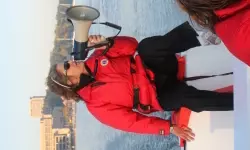
Bryans talks about home racing this Sunday against Minnesota
April 26, 2011 | Women's Rowing
April 26, 2011
MADISON, Wis. -- The women's openweight rowing program plays host to racing against Minnesota on Lake Mendota this Sunday at 8 a.m. Head Coach Bebe Bryans appeared at Wisconsin's Monday news conference to talk about the event, which is the first women's openweight varsity raceday on Lake Mendota since 2002. In addition to questions on Sunday's race, Bryan addressed questions on using last year's success with this year's team, as well as on on former UW national champion rower and head coach Sue Ela and her induction into the UW Hall of Fame.
A full transcript follows. View the archived video footage of the news conference by clicking here.
Bebe Bryans: We've just completed what I sort of think of as the preparation phase of our season. We have a very young team. We have 21 sophomores on this team, eight seniors. So we're definitely skewed to the younger end of things, so we decided to front-load the season, and we had some really tough competition very early on. In fact, we had two major competitions before we were even on the water, Lake Mendota.
So we went out to California the first week in April and raced in the San Diego Crew Classic, where we faced all of the strong West Coast teams. And it was a bit of a gamble, both because of our youth and because of our lack of water time, but they really stepped up and performed wonderfully, and that sort of set the stage for the rest of our prep phase.
We're still in selection. We're now, we've come off the road now. We get to be home until Big Ten championships, so that's made things really nice for us now to really get down to the nitty gritty of selecting boats, making sure the right women are in the right seats in the right boats so that we can go as fast as we can, so that's what we're doing right now.
QUESTION #1: How much does Sunday's regatta factor in to what you're trying to set forth for the remainder of the year?
BRYANS: Well, for one thing, just being able to race at home is huge for us. This will be the first time I've raced at home since I've been here, in seven years. We've raced on Lake Wingra, but we've never been able to race on Mendota, on our home race course, in front of our boathouse and our fans. So I think having that and having it be Minnesota, who is a great rival for us, is huge, and we're hoping the weather cooperates and we can get it, we can not only get it done, but get some really good racing in. So it's the last real, real time prep before Big Ten Championships, so it's our last chance to really test what we have in place at that moment.
Then again, we have another week before Big Ten championships. So we have two weeks before that final regatta. And the Big Tens has a little bit more, not more meaning really, but, in the past, we've had Big Ten championships and then we've had the Central Regional championships, which was our last chance really to qualify for NCAAs.
This year, the Big Ten coaches decided, after many, many years of talking about it, that we were going to move the Big Ten championships two weeks later to when our central championships were, not compete in the central championships, and have Big Tens be it, which is in line with what everybody else does, what all the other conferences do. We were the only major conference in the country that had a conference championship, then a regional championship, and then the national championship. And we feel that this will set us up better to compete on a more level playing field with everybody else at NCAAs.
It doesn't change the focus of that regatta, but it does add to it, let's put it that way.
QUESTION #2: You know, Bebe, oftentimes, and when teams have success a prior year, they can carry that over. Can that be done in crew? I mean, last year you were, what, seventh in nationals and won the Big Ten. Is that something that can also work . . .
BRYANS: Absolutely. You know, and it all depends on how the athletes choose to use it. The good news about this group is, with all of those young sophomores, they were all Big Ten champions. They won the novice eight, and they won the second novice eight at Big Ten championships. So they knew how to race at that level. It's different on the varsity level, so they had to bring, it's almost like going from high school to college, going from novice to varsity, and they've done a great, great job of doing that.
And I think our senior leadership has really helped them, helped not only lead them, but also show them, come and get... I'm a senior, come and get me. Don’t back off on me. Don't think I deserve anything more than you do. Come and get me. And I think that's been instrumental.
We've got sophomores in all of our boats, including our varsity eight. In fact, the stroke of both of our eights, the stroke of all three of our top four boats are sophomores that walked on to our team last year. So that sort of gives you an idea of where we are, but they're rock solid. They're rock stars. They're just racers and they're relentless, so it's pretty cool. But they want to be better than we were last year. They see last year as a starting point, not an ending point by any means.
So, again, as sophomores and as younger folks, you have to remind them more often sometimes of what that means. You can want it, and then you can work towards it, and those are two different things, but I think we're on the right road.
QUESTION #3: You mentioned walk-ons. What percentage are you seeing now of the people that come on to the team have prior rowing experience?
BRYANS: On the open weight side, it's still about 80 percent walk-ons. Lightweight side, we have more experienced athletes, partially because we're really at the top of our game lightweight-wise, and there aren't as many opportunities on the lightweight side. So I think for those two reasons, we have a lot more recruited rowers on the lightweight side.
We do have quite a few recruited non-rowing athletes. So we are looking for the best athletes in Wisconsin, Minnesota, Illinois, anywhere around this area. We want the best athletes we can get because we know we can teach them how to row. I've got two kids right now that were walk-ons, who are now fifth-year seniors, so they've exhausted their eligibility, but they're training for the national team. So that is what you can aspire to and really reach for if you're a good athlete and you work hard.
QUESTION #4: Who are those two fifth-year seniors?
BRYANS: Grace Latz and Vicki Opitz.
QUESTION #5: Based on what you saw of Minnesota at the Big Ten Double Dual a few weeks back, and the fact that you guys have been able to train at the same place you're going to race for a couple weeks now, or a good part of a couple weeks, are you confident that you'll bring home the win in front of your fans on Sunday?
BRYANS: Well, what we saw two weeks ago, or three weeks ago, is a different animal than what we're going to see next weekend. Minnesota was in a similar situation to us, in that they hadn't really been able to row very much before the Big Ten Double Dual because they had flooding up there. This has been the winter that just would not go away.
In fact, they were flooded out, the day before we left for San Diego, the University Bay was unfrozen, but everything else was still frozen. So we put in at Willows Beach, and we rowed in that little bit of bay that was open. So they're going along, I'm like go to port, go to port, because the ice was right there. So I'm like port, port, port, stop. Okay, turn around. Now go to port, port. But they've had a similar situation, so I expect they're going to be better than they were when we saw them at the Big Ten Double Dual, and hopefully we will be as well.
So I'm confident, but I never take anyone for granted, especially a quality team like Minnesota.
QUESTION #6: It looks like about 70 percent of your roster are Wisconsin kids. Pretty close, right?
BRYANS: Yeah.
QUESTION #6: I mean, this is your first home meet in seven years, like you said. Can this serve as kind of a way to get the word out, whether they be on kids on campus or even off campus?
BRYANS: Sure. I hope so. I mean, it's the best race course in the world when we can use it, you know, because it goes right by the boathouse, which is just a beautiful facility and a great place to watch from. And then we end at the Terrace, so it doesn't get any better than that. So if you guys know anybody, please help us. Last weekend, the lightweights got to race on the course, and they had a great experience there, so hopefully. Yes, it can only help us.
It's just so great to have the opportunity to race and let people watch what we do, because we are a bit obscure. We are one of the more obscure sports anyway. I think that's safe to say.
QUESTION #7: In case you didn't know, Sue Ela is in this year's Hall of Fame class for the UW.
BRYANS: Really?
QUESTION #7: Obviously, you didn't.
BRYANS: Yay!
QUESTION #7: Can you maybe talk a little bit about that and her induction? She'll be inducted in the fall.
BRYANS: Thank you for telling me that. It makes me incredibly happy because she's been inducted into the Collegiate Rowing and Coaches Association Hall of Fame. She was one of the first coaches to be inducted into that body. And I just think she is the epitome of what women's athletics is at the University of Wisconsin. She started out as an athlete. She was part of what helped our sport become a varsity sport at Wisconsin, and then she coached for 25 years or so. And she's still involved in the program, mainly with the alumni right now.
She is one of the main reasons that women's rowing is what it is today. She's one of the founding mothers of collegiate rowing, and so it just makes me really happy to have her university and my university now accept her and recognize her and celebrate her for that. They could not have made a better choice. Thanks for letting me know.