My Brother's Keeper
September 15, 2016 | General News, Men's Hockey, Andy Baggot
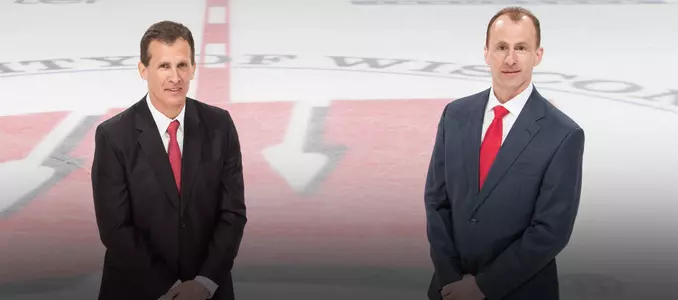
The bond between Tony and Don Granato transcends their job titles
 |
||
|
The bond between Tony and Don Granato transcends their job titles at Wisconsin and their shared office space at the Kohl Center. As the tough times in their lives have illustrated, the brothers' ties run deeper even than the passion they share for a game that has come to define the Granato name. Their individual traits combine to make them a strong team as coaches, but it's the traits they share that make them a strong family.
BY ANDY BAGGOT
UWBadgers.com Insider
From Varsity Magazine
On the surface, the two brothers are nothing alike.
Tony Granato, the second oldest of six, is all passion and impulse. He believes there's no door he can't open, no plan he can't execute, no mind he can't change as long as he invests 110 percent in the project.
If that doesn't work, he'll either try to charm your socks off or barrel right past you.
Don Granato, three years younger, is all calculating and meticulous. He believes in plans and tactics, in getting two or three moves ahead of the next guy, in having all his strategic ducks in a row.
If that doesn't work, he'll just go back to the drawing board.
Those who know the Granatos best describe the new gatekeepers of the Wisconsin men's hockey program as opposites.
Cammi Granato, their younger sister, grew up with them and experienced first-hand their oft-times intense sibling rivalry.
"I think they're completely different, if you want to know the truth," she said. "Completely different."
Mark Osiecki, their close friend and co-worker, has known the family since grade school and conversed with the brothers almost every day for the last 20 years.
"The differences, and you see it on a day-to-day basis, are drastic," he said. "Drastic."
Those realities go back long before March when Tony was hired as head coach of the Badgers and, in a span of two phone calls lasting a total of 10 minutes, invited his brother and their longtime buddy to join him as associate head coaches at their alma mater. They're gearing up for a season that begins Oct. 1 when the Badgers host Victoria (British Columbia) at the Kohl Center.
Tony, 52, was the larger-than-life big brother who became a standout center at UW -- one of two players in program history to amass 100 goals and 100 assists in a career -- an Olympian and an NHL all-star who played 13 seasons at the highest level in the world. He scored 248 goals in 773 games in his NHL career while playing for three teams, but is best known for a pugnacious approach that resulted in 1,400 penalty minutes.
Just about everything about Tony is emphatic.
"He has boundless energy," Cammi said. "He's always smiley and up and happy."
Don, 49, was the kid brother who, though smaller and less talented, battled gamely to make his mark even if pain and bloodshed was involved. He started off as a goaltender -- a very good one, apparently -- before abruptly switching to forward when he was a sophomore in high school. To better understand the intricacies of the position Don asked for a VCR for his birthday and proceeded to tape and pore over NHL games. Don scored three goals in his first midget game and wound up following his brother to UW, where he played 162 career games and earned an NCAA title ring in 1990.
Just about everything about Don is deliberate.
"There's no panic," Osiecki said. "He's very detailed and very analytical."
But for every difference between the Granato brothers -- most a product of simple family dynamics -- there's a swatch of common ground.
Both are similarly humble, grounded and competitive.
Both are people persons.
Both are driven to succeed in the game they live and adore.
Both are passionate about all things Wisconsin even though they grew up with siblings Christina, Cammi, Robbie and Joe and their parents, Don Sr. and Natalie, in Downers Grove, Illinois.
Perhaps the most compelling, and telling, link between Tony and Don Granato is that both cheated death and did so in large part because they literally leaned on one another.
""In NHL, everyone would think, 'Oh, he just hired him because he's his brother,'" Tony said. "Here everyone knows his resume. He's the best qualified person for this position, period. "
Go back to a February evening in 1996.
As soon as visiting hours ended, nurses converged on Tony Granato's hospital room and began the task of ushering family members into the Southern California night.
In less than 12 hours, Granato would be undergoing four hours of brain surgery to remove a blood clot located frighteningly deep in his left temporal lobe.
Nearly three weeks had passed since a late January night when Granato, then a 31-year-old winger with the Los Angeles Kings, had been checked head-first into the boards during an NHL game in Hartford, Connecticut.
Granato seemed OK at first -- he played again two nights later and attended a Super Bowl party hosted by teammate Wayne Gretzky -- but soon began experiencing massive headaches and memory loss. He was hospitalized for a week and released after tests revealed some pressure on the brain, but nothing definitive.
When the issues became worse, Granato was re-examined and admitted to UCLA Medical Center for emergency surgery. The entire family flew in from various points on the map to stand in loving vigil.
At one point the family -- including Tony's wife, Linda, the mother of four young children -- was warned that the procedure was anything but routine. A specialist, Dr. Neil Martin, and his surgical team would have to negotiate delicate brain tissue in order to address an intracerebral hematoma. Tests determined that it was pressing against Granato's cerebral cortex, where memories are stored.
There could be any number of complications, family members were told. Granato might need extensive rehabilitation for speech, balance, coordination or vision or all of the above. His decorated professional career was certainly in jeopardy.
"You could literally walk in, have a conversation with him, walk out and walk back in two minutes later and he didn't know you were just in there," Don said of his brother. "It was not hard to see he had severe brain damage at that point."
There was another possible outcome from the surgery and it gnawed at all those who gathered at Tony Granato's bedside.
"That I'm going to lose my brother," Don said quietly.
When visiting hours ended, Don refused to leave. He spent the night at his brother's bedside, sitting in a chair and periodically laying his head on the mattress.
"I remember him vomiting all over me," Don said. "I'll never forget the feeling that it didn't matter. I couldn't smell it. I couldn't feel it. It didn't matter."
Tony was wheeled into surgery at 8 a.m. and by 1 p.m. was in recovery.
"When he came to, 100-percent miraculous," Don said. "The best it could have been. The doctors were very happy."
Tony wound up playing five more NHL seasons with the San Jose Sharks and, in 1997, received the Masterson Trophy, an annual award given to the NHL player who best exemplifies perseverance and sportsmanship.
Nine years later, Tony and Don saw their brother's keeper roles reversed.
"He probably says mine was more scary," Tony said. "I say his was more scary."
In February of 2005, Don was diagnosed with Hodgkin's disease, a form of cancer that affects the lymph tissue.
"The part that I remember most about the whole thing was that (previous) summer, up in Eagle River (at the family cabin), we were running together and he was coughing a lot," Tony recalled. "He's a better runner than I am and he couldn't keep up with me.
"The fear for me was, 'Holy cow, this should have been diagnosed a long time ago. That we all missed it and this is really going to be hard to beat.'"
Tony said his brother's diagnosis -- stages 3B to 4A -- indicated the disease was far enough along that multiple areas of the diaphragm had been affected.
"I was scared for sure," Tony said. "There's a reality there for sure. There's the fear of what happens if he doesn't beat it."
Don, who was coaching Worcester of the American Hockey League at the time, said he was devastated by the diagnosis.
"It was more serious than I'd like to talk about," he said. "It was scary.
"I wasn't feeling good, I can tell you that. I lost a lot of weight, a lot of strength. I wasn't good."
Don opted for an aggressive form of chemotherapy. Instead of spreading it over six months, it was done over three months by staggering once-per-week sessions with twice-per-week treatments.
"The chemo was hard," Don said, noting he followed it up with radiation sessions that spanned February to August.
Tony was at his brother's side for eight of the 12 weeks of chemo, flying from his home in Denver to treatment sessions in Chicago and Boston. Tony was an assistant coach in the NHL with Colorado at the time, but a labor dispute between players and owners cancelled the season in 2004-05.
"He was there for me when I had mine," Tony said of his brother.
Tony didn't have a job to go to -- the lockout cancelled the Stanley Cup playoffs for the first time in history -- but that doesn't mean he was without commitments.
"I can remember saying, 'You've got to go home. You have four kids at home,'" Don said.
"I felt bad for Tony because he's away from his family in Colorado, but I'd be lying if I said his support wasn't real important."
That's a Granato thing. Everybody rallies, everybody pitches in when things get difficult. That was the case when Don Sr. fought prostate cancer in the early 1990s. That was the case when Natalie underwent open-heart surgery this summer in Chicago. Despite frenzied schedules -- moving to Madison, finding homes, addressing countless work-related details -- Tony and Don Jr. took multiple shifts caring for their mother in the hospital.
"I strongly believe that our family, when things happen, we're there for each other," Tony said.
"To have somebody nudge you, push you, that obviously cares about you, is nice," said Don Jr., who has been cancer-free for 10 years. "On a much grander scale, that's what coaching's all about."
Which brings us to the brothers' shared endeavor at UW. Though almost-daily confidants throughout their coaching careers, this is the first time the Granatos and Osiecki are on the same staff. They have a lot of work to do seeing how the Badgers have won a combined 12 of 70 games the last two seasons.
"This is probably the only situation where it could work," Tony Granato said of the threesome.
When he suddenly became an NHL coach for the first time with Colorado in 2002 -- Granato was promoted from assistant after Bob Hartley was fired during the 2002-03 season -- he spoke with both his brother and Osiecki about being assistants on his staff, but ultimately went in other directions.
"In NHL, everyone would think, 'Oh, he just hired him because he's his brother,'" Tony said. "Here everyone knows his resume. They know the hiring isn't because it's my brother. He's the best qualified person for this position, period. That's the same way I feel about Mark on the other side."
In fact, Tony refers to Don as his coaching mentor. After all, Don began coaching in 1993 -- nearly a decade before Tony -- moving from the U.S. Hockey League to the East Coast Hockey League, the AHL and the NHL, winning championships along the way. Don also guided U.S. squads to international gold medals as head coach at the prestigious National Team Developmental Program the last five years.
"When I say mentor, he's the one that really got me thinking a lot of different ways on the coaching side of things," Tony said. "He's able to try things and implement things that you wouldn't be able to do at an NHL level. The NHL level it's day to day; win-the-next-game mentality. It's not about long-term development, long-term implementing new systems or new style of play or new practice habits or new ideas."
"We pick each other's brains. We point things out. He always had some sort of different view point than I did when you're stuck right in the middle of it. He'd always find me ways to think about, 'OK, let's figure out how I can make an adjustment.'"
Tony had four different stints with the Avalanche -- assistant, head coach, assistant again and head coach again -- from 2002 to '09. He also worked as an NHL assistant in Pittsburgh and Detroit between 2009 and '16. During those times he had routine conversations with his brother as well as Osiecki.
"That's how you become better," Tony said. "When you're stuck in a room with the same coaches all the time you're working with each other, but you're also stuck in that mentality of how that's working and the day-to-day operations of that staff and the dynamics of that staff.
"So you go outside to someone you trust. Those two guys are guys I relied on an awful lot."
The Granato brothers grew up in a hockey environment that was intensely competitive, but so constructive and impactful that it produced an icon.
Cammi, 45, became a pioneering international superstar, serving as captain for Team USA on the way to the inaugural Olympic gold medal for women's hockey in 1998. In 2010 she became the first woman inducted in the Hockey Hall of Fame.
"They've always had a special bond," she said of her older brothers. "I think when they were younger they wanted to kill each other. There was a lot of wrestling and fighting, but that was just brotherly competitiveness in them."
Cammi said Tony was the "ringleader" for family hockey games and everyone else -- including Robbie, 47, a center who played for the Badgers from 1992 to '94 -- complied. Don took on the task of organizing everything right down to tournament brackets and a trophy.
It's where the seeds of instinct and personality were born in the two UW coaches.
"I wanted to win as badly as he wanted to win," Don said of Tony. "He could win just by talent and skill. I had to figure out the strategy in trying to beat this guy who outweighs me by 30 pounds and is being a real jerk right now as a kid."
Don said Tony "didn't have to over-think things" because he could overpower his siblings.
"I'm much more analytical and I had to be to keep doing what I wanted to do," Don said. "You have to pick your spots. You had to defend. You have to recover quick. You have to play a tight game. You've got to be ready to battle and scrap. Your attention to detail had to be very high because you're giving up size and strength and skill at that point."
Tony said Don's attention to coaching detail has been enhanced over the years.
"He sees a bigger picture more clearly than I do," Tony said, adding that view goes back to when Don was a goaltender.
"He was a goalie for so long, so he saw the game differently than I would have ever seen it," Tony said.
Why did Don switch positions? The inspiration came when Don Sr. and Natalie took the family -- sans Tony, who was attending Northwood Prep School in Lake Placid, New York -- to see Tony's future college team play in Madison.
"I remember sitting in the Dane County Coliseum," Don Jr. said of the Badgers' home from 1967 to '98. "Sold-out game. (Pat) Flatley was there. It was '82-83.
"Sitting in the stands -- the crowd, the band -- the atmosphere was incredible. I remember it like it was yesterday. I sat there and said, 'I want to score a goal out here.'
"From that point I said I'm going to switch to forward and play for the Badgers."
Don used the VCR he got for his birthday to understand plays, techniques and tactics. He found the device so valuable that he brought it with him to UW and watched video on the road. He wound up scoring 45 career goals, including 12 as a junior when the Badgers won their fifth national title.
Tony thought his brother was making a huge mistake, saying the switch was an "impossible" task.
"That's not like a shortstop moving over to second base," Tony said. "It's not a tight end moving to nose tackle. It's almost like changing sports and he was able to pull it off."
It took a while before Tony endorsed the move. He felt his brother was good enough to get a Division I college scholarship and was taking the wrong path.
"I was a pretty good goalie," Don said, "but when you want to do something, you've got to do what you want to do. You have to follow your passion."
That's what the brothers are doing right now. Their shared priority, along with Osiecki, is to return Wisconsin hockey to elite status as soon as possible.
The methods of the Granato brothers aren't always the same, but they have the same intent.
During Cammi's extraordinary career, first at Providence College and then internationally with Team USA, she would seek advice from both when she was struggling.
Don's message: "You're way over-thinking this," she recalled.
Tony's message: "If you work at it you'll get it," she said.
"I think they're alike with their passion, their will to get whatever it is done and accomplished and their will to succeed," Osiecki said of the brothers. "But Don's like, 'Don't worry, I got this.' Tony's like, 'We've got to have this done now.'"
Osiecki was a selfless, shot-blocking defenseman who played with Don Granato at Burnsville (Minnesota) High School and at UW before a 93-game stint in the NHL. In the midst of talking about the differences between the Granato brothers, Osiecki smiled.
"I think I was brought in here to be the peacemaker," he said.
Cammi said her older brothers have become much closer as they've grown. She can't wait to see how this project unfolds.
"The experience on that staff together is unreal," she said. "They did this together. They know how to work together."
Brothers' keepers, indeed.