Weaver-Klees ‘an inspiration’ and will be sorely missed
May 21, 2020 | General News, Men's Basketball, Men's Hockey, Andy Baggot
Long-time academic advisor set to retire next week
 |
||
|
BY ANDY BAGGOT
UWBadgers.com Insider
MADISON, Wis. — Mary Weaver-Klees has had only one job in her professional life and it's about to come to an end, thankfully by her choosing.
She's spent nearly four decades working as an academic advisor for Wisconsin Athletics, generating reviews that would make her a superstar on Yelp all while exhausting the storage capacity of multiple laptop computers with photos of the student-athletes she's nurtured over the years.
"She put her heart into every one of them," men's hockey coach Tony Granato said.
He would know better than most. Not only have his players worked closely with Weaver-Klees throughout his four-season tenure at his alma mater — compiling some of the program's highest cumulative grade-point averages in the process — Granato leaned heavily upon her expertise and encouragement to obtain his undergraduate degree at age 52.
"I don't know how to describe her other than to say she's incredible," he said.

When Weaver-Klees began this journey in 1983, she was part of a three-person, full-time staff that worked with 700 or so athletes in 25 sports and once used the Field House concession stand for an office.
When she completes her last official day on May 29, Weaver-Klees will leave behind 16 full-time colleagues — headquartered at the modern Student-Athlete Performance Center and Kohl Center — who advise a pool of 850 student-athletes in 23 sports.
In all, Weaver-Klees has crossed paths with 102 head coaches in 27 sports, hundreds of assistants, thousands of teenagers — men and women, foreign and domestic, ready for college or not — and who knows how many deans and professors.
She worked directly with every sport except softball. Men's basketball and men's hockey were her last assignments.
RELATED: Lucas: Rashard Griffith has earned his Senior Night
That idea that Weaver-Klees, 65, is retiring to spend more time with her family — husband Jeff, 30-something sons Evan and Lucas and 6-year-old grandson Remington — is difficult for some to fathom.
"She's going to be impossible to replace," men's basketball coach Greg Gard said.
Mary Weaver-Klees is the real MVP 🐐 After nearly four decades as an academic advisor, she's retiring We reached out to Badgers, past and present, to send a message. We heard back from so many we couldn't include them all. We'll miss you, Mary! 👏 📰 http://go.wisc.edu/qzm6z9
— Wisconsin Basketball (@BadgerMBB) May 21, 2020
The reasons are many, but start with this.
"When you have that longevity, you know how campus works," Gard said. "That's such a valuable resource to student-athletes navigating those waters.
"That's an awful lot of knowledge sitting behind that desk. She bridges a lot of areas that coaches can't walk into. She's a very trusted person because she's done things the right way."
Not only has Weaver-Klees come to know the school from a variety of critical angles — its layout, majors, courses, syllabi, classrooms, rhythm and history — she has brought the ideal personality for any moment.
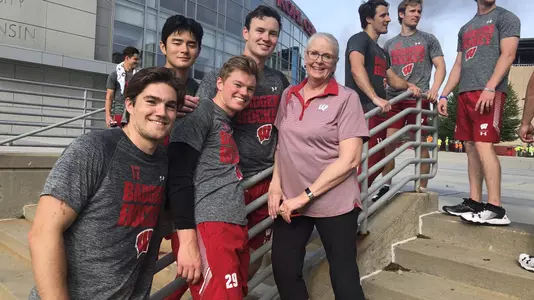
"She treats each kid like they're her own kid," said Ty Emberson, a sophomore defenseman with the men's hockey team.
"She brings joy to the table," said D'Mitrick Trice, a junior guard with the men's basketball team.
"So amazing, so kind," said Ann-Renée Desbiens, a former standout goaltender for the women's hockey team who had Weaver-Klees for an advisor for four years. "It just shows how great she is to be around there for so long. I'm sure everyone has good words to say about her."
When UW student-athletes arrive at the Kohl Center at the Frances Street entrance, descend to the ground floor and head to their respective headquarters, the first sign of humanity is the quaint Fetzer Center where Weaver-Klees' office is located. At the very least the parties share a smile and a wave. More often than not there's a detour and a conversation that may have nothing to do with school work.
"It's going to be tough not having that to look forward to every day," Emberson said.
"Not seeing her there is definitely going to be weird," Trice said. "She's a blessing to be around, somebody you always want in your presence."
Weaver-Klees has come to know how they feel. Working from home during the COVID-19 pandemic has forced her to deal with a sense of separation anxiety and what it will feel like when she wakes up on May 30 and realizes that she's crossed into a new world.
She last set foot in her office at 7 a.m. on March 16, packing up as many files as she could. She's had virtual meetings with coaches and student-athletes on a daily basis, but, while helpful, they don't come close to generating the energy you get from having flesh, blood and attitude in your presence.
"It's been really, really good for me to see what retirement will be like and I'm not a big fan," Weaver-Klees said. "It's way too quiet. I'm happy when they call or text me because it gives me a reason to connect with them.
"I will miss the students and I don't think I realized when this happened how much I'm going to miss them. They're crazy, busy, sometimes complaining, sometimes being happy, sometimes not knowing what to do. Just the noise of them made the Kohl Center pop. It had a great vibe.
"I will miss my teams. I'll miss my coaching staffs. But (the pandemic) has helped me ease into that."

What will Weaver-Klees do in retirement?
"Be the best grandmother I can possibly be to my 6-year-old grandson, who's going into the first grade," she said. "Be supportive of his parents. Organize photos. I've got a bazillion hours of scanning to do."
Weaver-Klees got a degree in psychology from UW-Stevens Point and a master's in counseling and guidance at UW-Madison before encountering one of the biggest influences in her life.
The late Dr. Diane Johnson was the director of academic services for Wisconsin Athletics back in the mid-1970s. Her office, on the third level of Camp Randall Stadium, is remembered for its humble centerpiece: a desk comprised of a wooden door laying across two three-drawer metal filing cabinets.
"She was a force," Weaver-Klees said, noting that Johnson would put red padlocks on the lockers of football players who were in academic arrears, thus forcing them to come and see her.
"She told me to listen to their stories and don't let them get away with anything," Weaver-Klees recalled. "Hold them to the goal, which is graduation."
According to Weaver-Klees, Johnson had some specific expectations for her staffers.
"Always, always, always they are students first and athletes second," she said. "Never give up on them."
Weaver-Klees said she learned to treat her student-athletes the way Johnson did.
"They clearly loved her because she cared so much," Weaver-Klees said. "That's what I lived with."
Gard sees those traits in how Weaver-Klees deals with all her charges.
"In order to be a good teacher — and that's what she is, a teacher, an educator — you have to be able to communicate and in order to communicate you have to have trust," he said. "In order to get that trust, you have to have a relationship with people. She's very good at relating and, over time, developing that trust."
Alan Zussman also worked with Johnson and served as an academic advisor alongside Weaver-Klees until retiring last year. They once spent several months working out of concession stands at the Field House, displaced by a renovation project and asbestos concerns.
"I sat right next to the Coke machine," Weaver-Klees said.
"We'd see students right next to the popcorn popper," Zussman recalled, chuckling. "It was a very, very makeshift thing."
Zussman said Weaver-Klees was a hard worker who was never intimidated. He said her strength was her nurturing persona.
"Mary is a good listener and patient," he said. "Those two things can really make a big difference."
The case of Nick Pasquarello is a good illustration of that. He was a freshman on the men's soccer team in 1990. By the end of his second semester, he was on academic probation.
"A lot of people questioned whether or not I could hack it," he said. "I was getting chastised by a lot of different people."
Pasquarello, a first-generation college student, had a meeting with Weaver-Klees.
"She didn't judge me or anything like that," he said. "She just kind of put her arm around me and asked me a couple questions."
What happened?
What are you interested in?
"She did it in such a genuine and caring manner that I felt comfortable around her," Pasquarello said. "I was able to open up to her and have some real honest conversations."
Soon, the business major became focused on a career in communication arts, graduating in 1994. Pasquarello subsequently worked with the men's and women's soccer programs and the School of Business at his alma mater before becoming executive director of the National W Club in 2019.
"That's what really helped put me on the path and realize that this was a real special woman that cared about me as a person and that I was given the tools and resources necessary to be successful," Pasquarello said.
"I feel like I'm a better person because I got to know Mary. I honestly can say I never would have graduated from the University of Wisconsin if not for her."
Granato had a similarly impactful experience with Weaver-Klees. After 26 seasons in the NHL — 13 as a player and 13 as a coach — he was hired to guide the Badgers on the condition that he finish work toward an undergraduate degree in his first year on the job. Weaver-Klees was his guide on the 15-credit odyssey toward a diploma in Human Development and Family Studies that started in 2016 and spanned two semesters and a session of summer school.
"We spent a lot of time together trying to get that organized," said Granato, who starred for Wisconsin from 1983 to '87.
The project began with a pep talk. Granato remembers the first time he showed up in her office with his backpack on.
"I can't believe I'm doing this," he told her.
"Tony, you're going to do great," she said before rattling off a list of reasons why she was certain that he would succeed.
"She's an inspiration," Granato said.
Visiting Weaver-Klees was the first order of business when coaches like Granato and Gard hosted recruits and their families. She always set a friendly, direct tone, having already done a deep dive into the prospect's background and transcript.
"If the (visit) was at 8 in the morning, she'd would have been there at 7 to learn about the kid, putting her presentation together based on where he's from and who he might know, what his school's like, what classes he's taken, what he's going to take," Granato said. "I want them to feel what I feel. They come out of there and they're smiling."
Gard said Weaver-Klees was an effective, consistent recruiter.
"You sit down there (in her office) and you watch mom and dad's reaction when they hear her lay out how we operate, what this university can do for people, how we function and what her role is," he said. "I know for a fact that she puts parents at great ease. When they come out of her office, they come out with a smile."
When her sons were young, Weaver-Klees would sometimes take them with her for recruiting presentations.
Lucas once tagged along as a toddler and spent time playing with a football prospect named Ron Dayne. As he grew, Luke recalled his mother taking late-night and early-morning phone calls from coaches and student-athletes.
"She was essentially on call 24-7," her youngest son said. "She put her students first and will do anything for them. As long as they succeed, she's happy."
Lucas, 30, and Evan, 34, were student-athletes in college — Luke played soccer and basketball at Edgewood College in Madison; Evan played soccer at UW-Parkside in Kenosha — so they have an appreciation for their mom's work.
"She was a mother to so many of her students and I think a lot of them would say that," Evan said.
He's right.
"She's been like a mom away from home for our guys," Gard said.
"She's a back-up mom that we all have," Emberson said.
Weaver-Klees has lots of great memories — the march to the 1995 NCAA men's soccer title and the two Final Fours in men's basketball in 2014 and '15 are three biggies — and countless forever relationships. She keeps the Christmas cards she gets from her former student-athletes in plastic bags for safe-keeping. She has file upon file of pictures, too.
It's all been a blast.
"You don't stay at something for 37 years and not like it," she said.
Make no mistake, Weaver-Klees will leave an immense void.
"I got a tear in my eye talking about her," Granato said. "Because she's not just somebody we work with. She's an amazing friend and person."