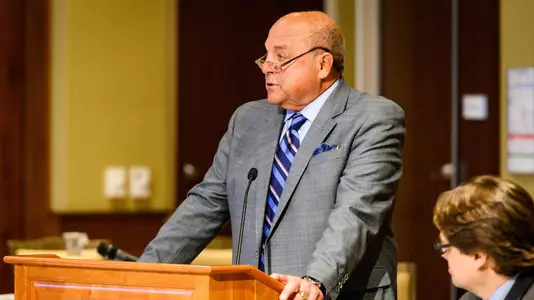
Lucas: Alvarez, UW navigating uncharted waters
July 16, 2020 | Football, General News, Mike Lucas
Badgers’ AD talks COVID-19, knee surgery and conference-only football schedules
 |
||
|
BY MIKE LUCAS
UWBadgers.com Senior Writer
MADISON, Wis. — After boarding the commercial airliner, Barry Alvarez saw that there was already a passenger in his row. As he sat down — and there was an empty seat between them — the University of Wisconsin athletic director noticed something out of the norm.
At least for this point in time.
The man was wearing a mask.
Today, Alvarez doesn't leave home without one.
But four months ago, on a flight from Indianapolis, Indiana to Naples, Florida …
He did a bit of a double-take.
"The guy recognizes me … says hello … and introduces himself," he recalled. "He wouldn't shake hands. But he handed me some disinfectant wipes to wipe off the armrests and tray table. And I'm thinking to myself, 'Man, this is a little different.'
"That was the morning after we canceled the Big Ten tournament. It was still very early."
Very early in the coronavirus pandemic.
It was March 13 and the dawning of a new normality.
Forty-eight hours earlier, Alvarez and some senior staff members had begun taking part in conference meetings in Indianapolis, the site of the men's conference basketball tournament. The UW contingent was excited because the Badgers had won eight straight and were the No. 1 seed.
On that Wednesday (March 11), Minnesota defeated Northwestern and Indiana blew out Nebraska in first round games at Banker's Life Fieldhouse. During the opener, the Big Ten announced that it was banning the public for the rest of the tournament starting with Thursday's round.
The fans booed.
Prior to the second game, the head coaches — the Hoosiers' Archie Miller and the Huskers' Fred Hoiberg — met in front of the scorer's table, but skipped the normal handshake. They feigned an elbow bump. In the second half, Hoiberg was forced to leave the bench after experiencing flu-like symptoms.
He was later diagnosed at a local hospital with a common cold.
Earlier that day, the NCAA revealed the men's and women's tournaments would be staged without spectators except for essential staff members and family. That night, the NBA suspended its season after Utah's Rudy Gobert tested positive for the coronavirus. The dominoes were about to fall.
On Thursday (March 12), Rutgers and Michigan were set to begin pre-game warmups for their scheduled noon tipoff when the players were sent back to the locker rooms. The Big Ten then issued a statement canceling the rest of the tournament. Many other conferences followed suit.
Major League Baseball halted spring training and pushed back the start of the regular season. The National Hockey League and Major League Soccer both suspended operations for a month. Or until further notice. By the end of the day, the NCAA canceled March Madness (its postseason tournaments).
"You realize the severity of it all when the professional leagues were all of a sudden making those decisions — they're canceling and it's immediate," Alvarez remembered vividly. "You not only realize the severity of the pandemic, but you realize that things are going to change quickly."
He couldn't help but think, "Everyone's life changed that day."
• • • •
Following his flight from Indy to Naples, Alvarez rejoined his wife Cindy at their Florida condo for what constituted an extended spring break since the UW campus had shut down in Madison with all classes going online. Alvarez summarily tried to get into a daily routine at his home away from home.
"First one up in the morning makes the coffee," he said. "We'd get at least two newspapers and then I'll go online and read the Madison paper. After I go through my e-mails, I talk to senior staff to see where we are on certain things and if any decisions have to be made. I like to start the day that way.
"That takes up most of the morning. Around noon or one o'clock, I'd go on my walk."
Usually, he'd walk for 90 minutes to two hours.
It was a good escape, but not a complete one from the new norm brought on by COVID-19.
"You'd walk by somebody," he said, "and both of you would bail for the curb."
It was during one of his walks that Alvarez scratched an insect bite near his ankle.
He didn't think much of it until "I got up one morning, I had chills and my knee was on fire."
Years ago, Alvarez had his right knee replaced and now he guessed that it was infected.
"Anybody who has artificial knees or hips knows that if you have any infection or any bacteria in your system, it will go right to the metal," he said. "I called my orthopod (orthopedic surgeon) and he told me to go the emergency room. They took samples and within an hour, I'm headed into surgery."
Alvarez had his knee flushed twice over three days and was hospitalized for almost a week. It was not long after he was sent home and started rehabbing that he ditched his cane. For nearly two months, he had a PICC line for antibiotics. That was removed a couple of weeks ago.
"I feel great right now," the 73-year-old Alvarez was saying last Friday. "They check my blood once a week and my numbers were very, very good last week."
On this morning, Alvarez had a two-hour conference call with Big Ten athletic directors and league staff. With the uncertainty of the coronavirus pandemic and the unavoidable emotional peaks and valleys, Alvarez has been trying to hold the line. A straight line. Not too high. Not too low.
"I've been steady," he said. "I stay in contact with a lot of people."

At the top of his contact list has been Wisconsin head coach Paul Chryst.
"I talk to Paul regularly several times a week," Alvarez said. "He has been great. He has thought everything out as far as how we would practice and how we'd have to break practice up and just how we're going to get through this if we play.
"Paul and his assistants have had tremendous communication with all of their players. They know the situation and they've been proactive and creative in how to meet with the players and keep them involved. That was true even when they were at home before they came back on campus."
Over the last four months, Alvarez has also tapped into some of his Big Ten confidants.
"Jim Phillips and I have always communicated," Alvarez said of the Northwestern athletic director who was chosen Monday as the chair of the NCAA D-1 men's basketball committee. "Ohio State's Gene Smith is someone I've always respected and I can go to. Warde Manuel is another good guy. He does a good job at Michigan and I appreciate visiting with him."

Alvarez has a more personal inner circle, too, including Ted Kellner, a prominent Wisconsin donor and investment guru from Milwaukee; Tony Canonie, a former Badger football letterwinner from Michigan; and Rick "Gordo" Coleman, an Alvarez teammate at the University of Nebraska.
"Along with my staff and my family," Alvarez said, "I talk to those guys regularly."
Speaking of family, his grandson, Jake Ferguson, is the starting tight end for the Badgers.
"I touch base with my kids almost daily," Alvarez pointed out.

Among his additional daily connections is Chris McIntosh, who heads up his senior staff.
The 43-year-old McIntosh, a 1999 consensus All-American tackle, is the deputy athletic director.
"Mac has been our point guy on a number of things, he has been vital," Alvarez said. "You can't anticipate the magnitude of a pandemic. You've never lived one. You've never experienced one. You have nothing to draw upon to realize how it's going to affect the whole world, let alone athletics.
"So, you have a lot of different game plans in anticipation of what may happen. Mac has been the point for all of that. I'll do my conference calls in the morning usually starting at 7.
"Mac and I talk every day and we get caught up on where we need to be. He's invaluable."

Last week, the Big Ten eliminated non-conference football matchups for 2020. The Badgers were scheduled to play Southern Illinois and Appalachian State at Camp Randall Stadium and Notre Dame at Lambeau Field in Green Bay.
"It gives you more flexibility — you can make decisions within the league without depending on someone else and you can adjust accordingly to whatever comes up — it gives you a chance," Alvarez said. "All of our nonconference opponents were very cordial and we'll try to reschedule those games.
"I thought Jack Swarbrick was especially cordial," he said of the Notre Dame athletic director. "The first thing he wanted to know was about next year's game in Chicago (at Soldier Field in what is designated a UW home game). He said, 'Is that still on?' I told him absolutely.
"And we're going to look into rescheduling that Lambeau game.
"It took me 15 years to get Notre Dame on the schedule and then we have this (a pandemic) ...
"I told Jack, 'Let's make it happen.'"
Alvarez was not about to make any predictions. Not now, not with so many unknowns and an ever-changing landscape. But he was confident that "we'll all get through this." And he suggested that "there will be a lot of things that we will appreciate a lot more once we do."