Lucas: Alvarez ‘set a bar that will be hard to beat’
June 29, 2021 | General News, Mike Lucas
Gerry DiNardo looks back on career of friend and opponent Barry Alvarez
BY MIKE LUCAS
UWBadgers.com Senior Writer

MADISON, Wis. — As Big Ten head coaches, Gerry DiNardo has the distinction of going undefeated against Barry Alvarez, a College Football Hall of Famer.
Now granted, it's the smallest of sample sizes — DiNardo is 1-0 against Alvarez — but neither has forgotten the results from Oct. 12, 2002, in a half-empty Memorial Stadium in Bloomington, Indiana.
"We won the game on a skinny post," DiNardo recalled fondly.
"We blew a 19-point lead," Alvarez lamented with a wince.
Seeking redemption from a 63-32 beatdown at the hands of the Hoosiers the year before in Madison, the Badgers got the early jump in the rematch. But after UW extending its lead to 29-10 with 9:34 left in the third quarter, the Hoosiers scored 22 unanswered points to escape with a 32-29 win, their first home victory over Wisconsin in 10 years.
"I was just thinking about that Indiana game the other day," said Alvarez, who was then in his 13th season at Wisconsin. "We had a dropped catch and a couple of motion penalties that killed us."
"I don't know if we ever stopped them," said DiNardo, who was in his first season at Indiana. "They probably stopped themselves more than we stopped them. I don't remember the game that detailed."
Detailed enough. DiNardo was spot-on with his analysis, which he generally is for Big Ten Network. Since 2007, he has been a studio host with Dave Revsine and Howard Griffith.
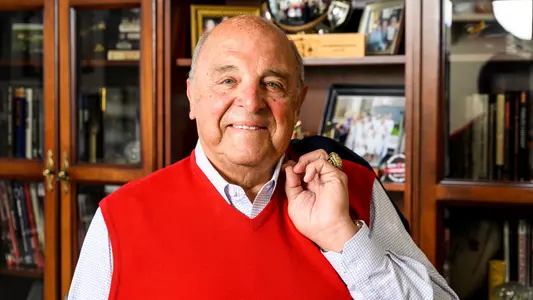
With the 74-year-old Alvarez retiring at the end of June, culminating a three decade-plus run as head coach and director of athletics, DiNardo has the ideal credentials to critique the Alvarez era given his own experience as a college head coach (Vanderbilt, LSU, Indiana) and his front row seat with BTN.
"There's very few people that have had the kind of success that Barry has had without someone previous to him," DiNardo observed. "I always say if you've had greatness in your past, you can have greatness in your future. Who was the most successful coach prior to Barry at Wisconsin?"
The answer is the late Dave McClain, who coached the Badgers for eight seasons (1978-85) and posted an overall record of 46-42-3. McClain's teams never won more than seven games in any season.
McClain died of a heart attack in April of 1986. He was 48.
"Dave McClain had some success and deserves credit," said DiNardo, whose wife Terri, a UW grad, was a student athletic trainer during the time McClain coached. "Dave did a really good job, but could you really say anyone ever had the same success as Barry did? And the answer is no.
"Lou Holtz had success at Notre Dame. But so did Ara Parseghian. So did Dan Devine. So did Knute Rockne. So did Frank Leahy. You can't say that about Wisconsin and Barry. You can't rattle off four or five coaches that had extraordinary success."
DiNardo can speak first-hand to the Notre Dame model. As a player (1972-74), he was an All-America guard under Parseghian and a dependable contributor when the Irish won the 1973 national championship. DiNardo's older brother, Larry, was also an All-America lineman at the school.
"Barry paved the way for people to have better success than him," DiNardo went on. "And if someone does better than Barry that will be Barry's greatest contribution to Wisconsin because he set a standard that was higher than anybody else (119 wins) … He set a bar that will be hard to beat."
Bret Bielema and Paul Chryst were hand-picked by Alvarez for his staff. Both marinated as assistants. In his seven seasons as the UW head coach, Bielema went 68-24. Chryst, who played for McClain, is entering his seventh year with a 56-19 record. In 2019, he passed McClain in wins.
Among modern-era coaches, only Ohio State's Urban Meyer won more in his first five seasons in the Big Ten than Chryst.
"Every program you take over, one of the most important things is building a staff and finding your niche in recruiting," he opined. "In a state like Wisconsin, Barry drew on his Nebraska experience. Walk-ons. Small state. Not a lot of players in Nebraska. The ones that were? Usually linemen.
"Barry played the game as a reflection of his recruiting. It was, 'We can be as good as anybody in the offensive line. That's where it starts. Now we can leave the state to compliment it with the players we can't get in a 100-mile, 200-mile, 300-mile radius.' Identifying your niche that soon was critical."
View Photo Gallery: Barry Alvarez: Hall of Fame Football Coach
• • • •
Prior to that 2002 meeting between Indiana and Wisconsin, DiNardo and Alvarez had clashed once before in the 1990 Orange Bowl. DiNardo was the offensive coordinator of No. 1-ranked and unbeaten Colorado. Alvarez was the defensive coordinator of defending national champ Notre Dame.
DiNardo offered this scouting report on Alvarez's defense, "They weren't overly complicated on defense — they were sound, and they didn't make a lot of mistakes — they had good players. They were just really well-coached. You weren't going to trick them. You were going to have to beat them."
Alvarez shared a flashback from the week of practice leading up to that game.
"Lou (Holtz), all of a sudden, started showing up on the defensive side of the field," he recounted. "I asked him, 'Why are you down here?' He says, 'Do you know that they've scored 90 percent of the time in the red zone?' I said, 'You don't think we can stop these guys, do you?'"
Holtz expressed his reservations on the Alvarez-coached defense slowing down the Buffs.
"What makes you think that?" Alvarez fired back. "Last spring and throughout camp, anytime we practiced, we put the ball on the 6-yard line, first and goal, and you've got Tony Rice at quarterback, who's every bit as good as Colorado's Darian Hagan, and you haven't scored on us yet.'
"We've defended that offense every day. He (DiNardo) was running option."
Holtz got the message. So did the Buffaloes, who had been averaging 34 points and over 470 yards of total offense. Alvarez's defense held them to a little over 280 yards in a 21-6 victory. Colorado, moreover, failed to score on three red-zone drives in a scoreless first half.
That included a first-and-goal from the 1 in the closing seconds of the second quarter. That possession ended with a botched fake field-goal attempt. Holtz later had a framed picture hanging in his home of the Irish's defensive penetration on the line of scrimmage during that goal line stand.
After the Orange Bowl triumph, Alvarez accepted the Wisconsin head coaching job.
"When I got ahold of Pat (Richter, the UW director of athletics) — with our defensive effort against Colorado still fresh in my mind — the first words out of my mouth were, 'How was that?' From that point on, whenever we had a big win at Wisconsin, we would greet each other with, 'How was that?'"
Upon his arrival in Madison, Alvarez installed his Notre Dame defense with the Badgers.
Here was the DiNardo synopsis of the Alvarez blueprint.
"It was the running game on offense, it was stop the run on defense and it was change the field position with the kicking game," he said. "Barry was very traditional. He recruited, motivated and coached that way. Honestly, it was a formula that I don't know would be a winning formula nowadays.
"I'd love to ask Barry, "If you were still coaching, would you be in the spread?' I would predict a 'yes' answer because the great ones evolve, and I consider Barry to be a great one. He probably can't answer the question because people would take it too seriously about what Paul's doing."
It was posed to Alvarez. After a brief pause, he answered.
"That's a good question," he conceded. "I wouldn't be as hard-headed as I was. I wouldn't run the same offense that I ran. But I wouldn't run the spread. I would do what Paul is doing. I'd want to be balanced, 50-50. I'd still want to run some power stuff because that's the kind of kid we can recruit.
"We get linemen that can knock people off the ball."
Ah, yes, the time-honored recruiting niche.
"People are always going to think Wisconsin and Ronnie Dayne — that's what they're going to think is my legacy on offense — running the ball 90 percent of the time," Alvarez said. "When Ronnie was a freshman, we beat the heck out of Utah in a bowl and we threw six passes. Two were completed.
"When we had Sammy (Mike Samuel) at quarterback, we were going to run the ball because that's what we could do best. But we changed when we had Brooks (Bollinger). By the time I retired, as the game kept changing, I thought we were more wide open and very similar to what we're doing now."
Alvarez paused again.
"I know damn well we didn't get credit for our balance in '93," he said, chuckling.
Contrary to any perception, he insisted, "We threw the ball around, too."
During that 1993 Rose Bowl season, the Badgers averaged 250.8 yards rushing and 204.4 yards passing. Brent Moss ran for 1,637 yards and Terrell Fletcher for 996. Darrell Bevell completed 68 percent of his passes to receivers like Lee DeRamus (54 catches), J.C. Dawkins (36) and tight end Mike Roan (34).
The punctuation mark was a victory over UCLA in Pasadena.
Years later, Alvarez would say, "I can't go anywhere in the Wisconsin or the United States without running into somebody who wants to tell me what they were doing when we won that first Rose Bowl. That game gave everybody credibility. It gave our fans bragging rights."
More than anything, he would tell anybody who would listen, and the fans did, "It showed them that hope was alive. That game put our program on the map. We were legitimate."
• • • •

DiNardo pondered the Alvarez legacy as a coach and administrator.
"A lot of things are obvious," he said. "But the more and more I thought about it, the conclusion that I came to was that his most valuable contribution has been as a valuable voice based on being a player (Nebraska), an assistant (Iowa, Notre Dame) and a head coach and athletic director (Wisconsin).
"If anyone understands the student-athlete, and the current student-athlete, it's probably Barry Alvarez. Things have changed immensely since he was a student-athlete. Things have changed drastically since he was an assistant. And things have changed for head coaches and athletic directors.
"How could you stay current on all of those things unless you were all of those things? His voice is important because he can talk about experiencing all of those things and how they've changed. How many people can say they were a player, an assistant, a head coach, an athletic director?
"That's his contribution. His voice carries so much weight because of his experience."
On Chris McIntosh succeeding Alvarez, DiNardo added, "We've all benefited from mentors. You can't be afraid to evolve. You can't be afraid to do things different. You have to say, 'I'm going to do it better.' If Chris says, 'I'm going to do it better than Barry' that's not a knock on Barry.
"It's the same thing I said about what Barry has done with the football program. Barry should be pulling for Chris to be a better athletic director than him because Barry has set such a high goal. And if Chris meets or exceeds that goal, he has made Wisconsin better."
Another niche for Alvarez. Leaving only one question upon his retirement: How was that?