
UW Athletic Hall of Fame: Cheryl Bailey
July 28, 2022 | General News, Women's Basketball, Women's Hockey, Volleyball
Former UW associate athletic director helped lead Badgers through major upheavals to success
UWBadgers.com Senior Writer
MADISON, Wis. — As an administrator, Cheryl Bailey was inclined to run towards resolution. Not from it. That was a trait ingratiating Bailey to her University of Wisconsin superiors, Pat Richter and Barry Alvarez, the athletic directors who held her decisiveness and decision-making in high regard.
Bailey (née Marra) was on the ground floor of a sports renaissance that transitioned the Badgers from the Dark Ages to a Fiscal and Competitive Enlightenment. It started with the chain of command when chancellor Donna Shalala hired Richter to take over a debt-ridden athletic department in 1989.
One year into the job, Richter hired Bailey to be the associate athletic director for women's athletics, replacing the retiring Kit Saunders-Nordeen. Bailey was 35, the youngest administrator on Richter's staff; younger even than some of the head coaches in the 13 sports that she was to supervise.
"Age really wasn't anything I thought about," she said. "I had a sports background and had been an athletic director. While it was at Division III (Denison), you're still doing the same types of things. You're overseeing coaches who are trying to get the most that they can out of the athletes they have."
In March of 1991, the UW Athletic Board acted on Richter's recommendation and voted to reduce the 25-sport program to 20 by cutting baseball, men's and women's gymnastics and men's and women's fencing. The budget also capped spending for men's and women's crew.
A year later, Richter announced a reorganization of his administrative staff and the consolidation of the men's and women's revenue and non-revenue sports under the direction of two associate athletic directors: Bailey who took on 11 sports; and Joel Maturi, who drew nine.
"One of the things that sticks out in my mind when I made the decisions in terms of who was going to run what programs and be the sports administrator," Richter said, "was that we gave Cheryl responsibility for both men's and women's basketball and some other men's and women's sports."
Five men's sports were assigned to Bailey: basketball, soccer, swimming, tennis and golf.
"There were a couple of women administrators in the Big Ten who didn't like that because they said it took her away from the women's sports," Richter added. "But in my mind, we believed it made more business sense, just in efficiency and things like that, and it gave her bigger responsibility."
Upon Richter's retirement, Bailey came under the direction of Alvarez.
"She was important when I took the job as athletic director because I needed a strong women's administrator and she fit that role — she was much stronger than she gets credit for and I recognized that," said Alvarez, who assumed the dual role of AD and head football coach in April of 2004.
"She was on top of the business. She wasn't afraid to express herself and speak her mind. She made some very tough decisions during a changing time in college athletics. In some cases, they weren't popular. A lot of people criticized her. But they were tough decisions that had to be made.
"Competent people and people who gets things done are very important. Those are the kind of people I want to surround myself with. She made the right decisions. Like I said, times were changing, and you couldn't operate with the rules you had in the '70s and '80s. She had to make those decisions."
Some choices were more clear-cut and easier than others, she agreed. Some were unpopular.
"I tend to look at things and say, 'Here's the situation, here's the challenge or problem, we need to find a solution,'" Bailey said. "You look at the best options you have and, yes, you have to make that hard choice. And they are hard choices. But it's easier to make that choice in order to move forward."
By the time that Bailey moved on professionally from Wisconsin, she had been a part of an administrative team that changed the face of Badger athletics. She can look back contently on her 15 years of service to the department. Especially in light of her UW Hall of Fame induction, Class of 2022.
Bailey follows in the HOF footsteps of her predecessor, Saunders-Nordeen, a 1998 inductee.
"She had the ability to say, 'I'm here if you need me and she always was,'" said Bailey, also appreciative of Paula Bonner, another pioneering Hall of Famer. "Kit was so well-respected by not only the athletic department, but the university as a whole. It was great to be able to ride behind her."
That Bailey is being recognized on the 50th anniversary of Title IX has special meaning for her.
"I was a product of Title IX," she said earnestly, "when Title IX came into existence."
• • • •
In 1972, these 37 words put Title IX into law: "No person in the United States shall, on the basis of sex, be excluded from participation in, be denied the benefits of, or be subjected to discrimination under any educational program or activity receiving Federal financial assistance."
In '72, Bailey was a high school junior in her hometown of Jamestown, New York (which is far closer to Buffalo than Manhattan). Bailey was a sprinter. But since there was no girl's track team, she ran with the boys. The coach was supportive. She was pretty good. And it wasn't controversial at all.
During her senior year, there were three girls on the boy's team.
"In the beginning," Bailey said of Title IX, "people were not sure that there was that interest. The number, if I recall early on, was 27 to 1, the number of men versus women playing sports."
Today, women account for 44 percent of NCAA athletes, according to the Women's Sports Foundation.
On the quest for gender equity and a more level playing field, Bailey said, "For everybody to understand the value that sports hold for men and women, boys and girls, is to understand that those opportunities are important, and they really transform women just as much as they do men."
In college, Bailey competed on the women's track team at Slippery Rock (Pennsylvania) University. After graduation, she worked one year as an elementary teacher in South Carolina where she coached the boys track team. In 1979, she landed at Denison University, a Division III school in Granville, Ohio.
"I started the women's soccer program at Denison — the first collegiate (women's) program in Ohio — I was given a blank slate and told to put it all together," said Bailey, also a member of the Denison's Hall of Fame. "I was young. I was 26 when I got the job … I didn't know soccer. I had never played soccer.
"It wasn't a collegiate sport when I was in school. But she (Penny Van Horn) took a chance on me which I greatly appreciated … You just get thrown into the fire and you just make the decision, 'What do I need to do? Who do I need to bring in to help learn the things that need to happen?'"
Van Horn was the women's athletic director, the position that Bailey took over in 1983. During her 11 years at Denison — whose nickname was fittingly the Big Red — Bailey got valuable administrative experience, while earning her master's from Ohio State. A D-I job was on her radar. The UW obliged.
"When I got here, I joked that Al didn't tell me that they were $2.1 million in debt," Bailey said of Al Fish, the chief financial officer and associate athletic director. "Honestly, the very first month I was there, I was asked to cut the women's budget by 10 percent.
"That's one thing if you're all starting at a base that's equitable. But, of course, it was not back then. When we had to take a look at what were the possible options of what we could do, there just wasn't any money to be able to invest in a different way.
"That was extremely hard to think that we have to cut anybody's opportunities, let alone women at that point in time. That was a challenge. I was just getting my feet underneath me to understand who all the players were and the next thing I know … I know it weighed heavily on Pat."
It took over a decade for the UW to achieve Title IX compliance. Throughout the highs and lows, Bailey was a strong advocate and voice for women on campus, and nationally. There were many highs in the '90s, including the additions of softball, women's hockey and women's lightweight crew.
On Oct. 8, 1999, Minnesota-Duluth defeated Wisconsin, 8-1, at the Kohl Center. A crowd of 3,892 attended the debut of women's hockey. Julie Sasner was the coach. Kendra Antony scored the only goal. Jackie MacMillan had 50 saves. The year before, she practiced with the men's team.
The department dedicated nearly $1 million to the sport. Turned out to be a good investment.
Six national championships under Mark Johnson later …
In a 2005 op-ed in the Wisconsin State Journal, Bailey wrote, "Thirty years ago at UW-Madison, 12 club sports for women were officially integrated into the athletic department and received varsity status. These 12 sports had 109 participants with no scholarships and a budget of $118,000.
"Today (2005), the UW-Madison still supports 12 women's varsity sports … There are nearly 400 women student-athletes, 227 on scholarship. Today's women's athletic budget exceeds $9 million. It's all thanks to Title IX … which has played a crucial role in these advancements."
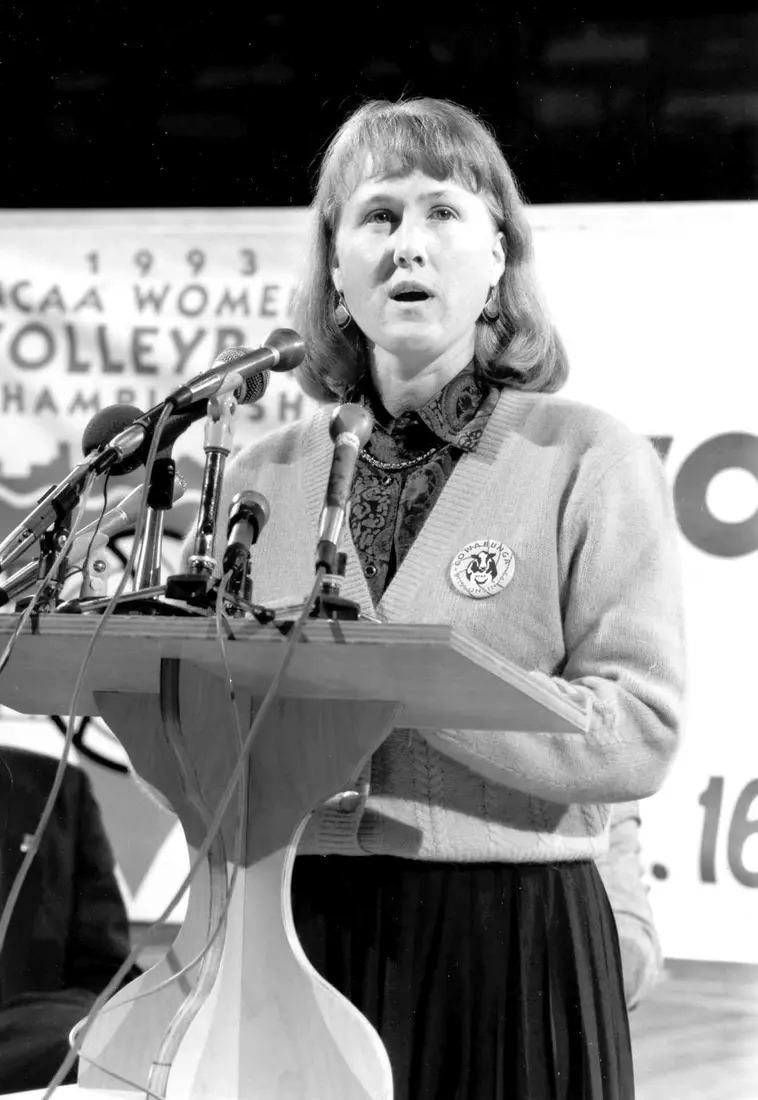
To this day, Bailey still has warm feelings about the growth of Wisconsin volleyball — culminating with the school's first national championship last December. Bailey cut her teeth on the sport. In fact, she was instrumental in helping stage the 1993 NCAA Final Four in Madison at the UW Field House.
Wisconsin sold 20,634 tickets — guaranteeing sell-outs of 10,067 for the semifinals and finals — which established an NCAA attendance record smashing the previous mark (16,346) set by Minnesota. Long Beach State defeated Penn State for the title. BYU and Florida rounded out the field.
"As I sit here talking to you," Bailey said recently from her home in Charlotte, North Carolina, "I have a smile on my face because that's such a great sport. I'm excited they stayed in the Field House and I'm excited about the renovations that are happening there as well."
In 2021, the UW ranked No. 2 in D-I attendance averaging 7,540 in 15 regular-season matches.
"To see the attendance growth in women's sports," she gushed, "that was really special.".
• • • •
In April of 2005, Bailey announced she would be leaving the UW to pursue other professional opportunities. It wasn't spur of the moment. She had informed Alvarez of her intentions a year earlier. Alvarez thanked Bailey for her contributions and called her "a champion for the student-athlete."
During her 15-year run, which included chairing the women's basketball committee, Bailey hired seven coaches who received Coach of the Year recognition at least once. She was also in the middle of a messy and controversial dismissal of men's soccer coach Jim Launder who had won the 1995 NCAA title.
"You get yourself in situations where you see a big picture of something that is challenging, that has to be solved and not everybody can see all the pieces to that," she said. "Was it hurtful? Sure. That was hard to have to go through something like that for the coaches, the players and for me personally."
Summing up Bailey's tenure, UW Athletic Board chairman Bruce Jones told the Wisconsin State Journal, "She's good to her word in terms of she takes a position, and she tells you why and looks you right in the eye and tells you that's where she's coming from.
"Sometimes she knew that there was going to be consequences and fallout for some of the decisions she made. But she still followed through and made them."
With Madison and the daily grind of a Big Ten administrative post in her rearview mirror, Bailey took some time off to be with family in New York. But it didn't take long for her to get the itch again. In 2007, she took over as the General Manager of the United States Women's Soccer National Team.
On her watch, Team USA won gold in the 2008 Olympics and bronze and silver in the 2007 and 2011 World Cups. After five years in that role, Bailey greeted a new challenge as Executive Director of the newly formed National Women's Soccer League. Like Denison, she was again working from scratch.
"I had two opportunities in my life to be given a blank sheet of paper and told, 'Start something,'" she said of starting a college soccer team and pro soccer league. "That's pretty special to have that at the beginning of my career and at the end of my career. I know how blessed I am.
"That to me is full circle. I have ridden the wave of Title IX the entire time."
A wave washing ashore of the UW Hall of Fame. Asked what she's most proud of, she said, "Being part of the team that was able to take Wisconsin from where we were in 1990 when I got there to the success they have, top to bottom, with most of their sports right now … It was a team effort."
What about the next 50 years of Title IX?
"One thing we're seeing, because there's so much more social media out there, people are learning about women's athletes," she said. "I'm hoping to see that the attendance at a lot of different events — and we are seeing that — is really going to blossom.
"I don't think it'll be nearly as dramatic of a change as we've seen in these last 50 years because of where we started from. I anticipate it will continue to grow and get more support financially. It's not quite the same yet. There's equity and then there's equality. Those sometimes are a bit different."
At that very moment, she was pulled towards some television programming in the room.
"I'm sitting here watching the Women's Euro (soccer) games in England … and they're sold out."
Letting it all sink in, she paused and gushed again, "That's amazing to see the growth."
It put that smile back on her face.