More than Words: Badgers' bond shows through shades of pink
October 21, 2015 | Women's Hockey, Andy Baggot
Pink-splashed sticks a show of support from UW women's hockey team
 | ||
|
BY ANDY BAGGOT
UWBadgers.com Insider
MADISON, Wis. -- They stand out like beacons, unmistakable messages of love, dedication, honor and, sadly, pain.
In an outer hallway that leads to their dressing room at LaBahn Arena, members of the Wisconsin women's hockey team store their sticks in a vertical rack along the wall. There are a host of brands, sizes and configurations, but one color catches your eye.
On this mid-October day shades of pink can be found on nearly a dozen sticks. They were specially made for the occasion – Breast Cancer Awareness Month – and they are draped in meaning.
For sophomore defenseman Lauren Williams, pink tape wrapped around the handle is a nod to a survivor and a hero.
For sophomore winger Baylee Wellhausen, pink swatches on the shaft of her stick are a tribute to a mother she lost when she was 8.
For junior defenseman Jenny Ryan, the vibrant hue acknowledges a maternal grandmother who lovingly sang and read books to a 5-year-old as they rocked back and forth in a favorite chair.
For junior center Sydney McKibbon, the pink ensemble is a silent shout-out to a favorite cousin whose battle with an insidious disease is ticking toward a decade.
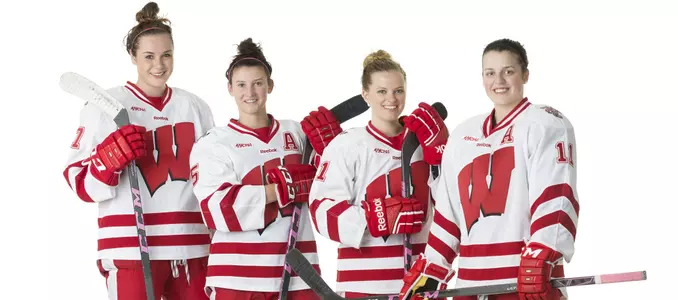
There are other stories within the Wisconsin dressing room. In all, nine members of the team are sporting sticks adorned in pink to raise awareness, trigger conversations and shine a light on deadly threat. They'll be on display on home ice one last time Friday at 7 p.m. and Saturday at 3 p.m. when sixth-ranked Bemidji State comes to Madison for a Western Collegiate Hockey Association series against the third-rated Badgers.
The colorful tribute took root two seasons ago. Former All-America goaltender Alex Rigsby got permission to put pink tape on her stick during October of her senior season in 2013. It was a nod to her mother, Nancy, who was diagnosed with breast cancer a year earlier and now lives free of the disease.
The custom sticks debuted a year ago. They were a project spearheaded in part by former captain Blayre Turnbull, whose mother, Margie, died of cancer in 2009, and whose grandmother, Leona, is a cancer survivor. Turnbull was ably assisted by Paul Hickman, the director of hockey operations for the Badgers.
During a home series last October, Turnbull, then a senior, surprised Nancy Rigsby with a pink stick with "Mama Rigs" emblazoned on the shaft.
"It's obviously a really special cause not only for myself, but for a lot of the girls on the team," Turnbull said. "It's not just one or two girls getting the pink sticks. There's a whole bunch that have them."
Turnbull elected to have her grandmother's name scrawled on her stick last season.
"It makes things special and really puts things into perspective," Turnbull said. "It reminds you you're not playing for yourself. You're playing for some special people."
In a way, the pink sticks are megaphone loud.
"I get a lot of questions: 'What are the pink sticks for?'" Ryan said. "It definitely catches a lot of attention."
In a way, the pink sticks are intensely quiet.
"They're a way of saying it without needing to use your words," Ryan said. "I know a lot of the girls have some really personal stories with them."
Some want to share, but some do not. Almost all the sticks include names, dates and cryptic dedications printed on the shaft.
"It's definitely something that's going to be unique to girls and it's something we all have to deal with in our own ways," Williams said. "Whenever anyone sees the names on the sticks, we definitely look to each other and if you want to share your story, you can. But some girls are a little more closed off about it."
Regardless, there's a sisterhood.
"At that moment when you see one of your teammates with a pink stick -- you see the name on it and you see who that person is -- it's a community moment," Wellhausen said.
"It's important to know there's a lot of people going through what you're going through, some people in a much bigger sense," McKibbon said.
Based on current data compiled by SEER Cancer Statistics Review, nearly one in eight women born today in the United States will be diagnosed with breast cancer in their lifetimes. It happens without warning.
Wellhausen's birth mother, Karen, was 34 when she died. Rigsby's mother was 52 when she was diagnosed.
"It's a reminder that anything can happen," Williams said. "My mom had always been an extremely healthy person. I know many women who are affected by this are healthy going into it."
A cancer diagnosis makes no provisions for circumstance.
Turnbull, from Stellarton, Nova Scotia, was 17 and about to enroll in prep school in Minnesota when her mother died. Williams, from Windsor, Ontario, was 15 and attending a boarding school in Toronto when her mother, Robin, got the news of her diagnosis.
"It wasn't the best of times," Williams said.
Perhaps, but it was a period of valuable enlightenment.
"Throughout the entire thing she was always just this amazing inspiration for me," Williams said. "Even though she was going through this tough time I never saw her as anything but the strongest person that I knew."
On the shaft of Williams' stick is a subtle tribute: "Mom CF 06-2013." It means Robin has been cancer-free since June of 2013.
"Watching her go through something like that was really tough and I thought this was one of the little things I could do to let her know how much she meant to me and how much her whole journey has affected me," Lauren said of her mother.
"Obviously, some haven't been as lucky as I've been to have such a good outcome with my mom."
Wellhausen's mother died in 2004 after a 5-year fight with breast cancer. Baylee's stick simply has "Karen" etched on the shaft.
Coming up through the pre-college ranks, Wellhausen made a point of donning the pink bandanna her mother wore to chemotherapy sessions and fundraising walks for every practice and game. Now it's draped around the neck of a stuffed teddy bear Wellhausen takes wherever she goes.
Holding onto the stick and seeing the dedication to her mother elicits powerful emotions inside Wellhausen.
"Knowing she's with me at all times is definitely an empowering feeling," she said. "As much as it was a tragedy, I know that her strength and her fight have taught me to go out there and battle on the ice and to keep fighting.
"You're not going to win every battle – she didn't – but it's about how hard you battle and I'm going to go out there with that mindset."
Wellhausen now finds herself part of a prominent Wisconsin family. Her father, Kevin, got remarried in 2006. His wife, the former Christina Granato, is the sister of Tony, Don and Rob Granato, who were standouts for the Badgers men's team in the 1980s and '90s. Their sister, Cammi, won an Olympic gold medal for the U.S. women's hockey team in 1998 and, in 2010, became one of the first women inducted in the Hockey Hall of Fame.
Seeing all the other pink sticks in the LaBahn Arena rack gives Wellhausen mixed feelings.
"It made me feel less alone, but it also made me feel sad that so many have to deal with such a disease, either directly or indirectly," she said.
Ryan, from Victor, New York, fondly remembers her grandmother, Joy, who beat breast cancer, but later died of pancreatic cancer when Ryan was 5.
"She had this one wooden rocking chair in her living room and we always used to sit on that and sing," Ryan said. "She would read me books from there. I loved sitting in the rocking chair with her."
McKibbon's cousin, Judy, lives 45 minutes from McKibbon's home in Oakville, Ontario. Judy has battled uterine cancer for eight years. It recently moved to her stomach, according to McKibbon.
"She's still fighting," McKibbon said. "She's one of those people that brightens up the mood of the room when she walks in. She can make anyone laugh. She's definitely one of the funniest people I've ever met even in the midst of all this."
When the Badgers face Bemidji State, those with pink sticks will do so empowered, but also humbled.
"Just stepping on the ice you're playing for a bigger meaning," McKibbon said. "You're playing for more than just yourself. We're all playing for someone who's got someone on their stick."
Williams' philosophy speaks for all involved.
"You have to kind of seize each moment and make the most of life," she said, leaning on her favorite pink stick. "I just proud I get to use this every day with her name on it."