Badger legends is a series dedicated to celebrating our former men's soccer players who have taken their experience at Wisconsin and shaped it into a new path. Each month, we'll be celebrating one men's soccer alum from a different decade.
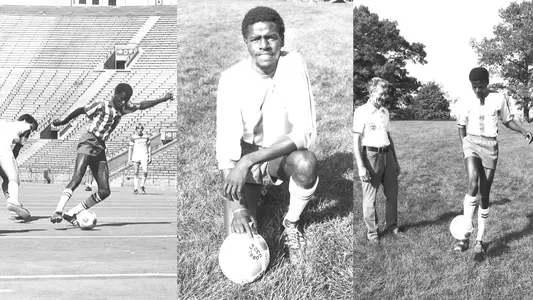
This month we celebrate the career of Amadou Diagne, who played striker on the first varsity men's soccer team in UW-Madison history in 1977.
Amadou's story begins in Senegal, where he was born in the coastal city of Saint Louis in 1951. The sport of soccer was ingrained into the city, feeding Amadou's love for the game with pickup games on the streets.
"It was during those pick-up games of 2-on-2; 4-on-4 or however many players we could have that I learned most of the basic skills of the beautiful game," Diagne explained.
"Passing, dribbling around opposing player while avoiding collisions with pedestrians, cars and bicycles; it made me the player that I was."
Diagne's first taste of soccer success came from his selection to his elementary school's team, where he won the city school's championship. Amadou credits these early experiences for helping him learn the basics of the game, as well as helping him unlock his competitiveness, and "a strong drive to always rise-up to overcome the challenges that I am confronted with when facing an opponent."
Once Diagne reached high school, he discovered his strong interest in biomedical sciences. Studying up on the medical advancements and scientific breakthroughs made at American academic institutions invoked a sense of desire in the young Senegalese man, one that would follow in the footsteps of his brother, Edris. Edris, now an Emeritus Professor, was hired by UW-Madison to help create the African Studies Program.
Amadou made it his goal to attend Wisconsin, and with the help of his brother, he made it to America, studying bacteriology and nutritonal sciences as a lab specialist at the McArdle Laboratory for Cancer Research.
Despite Diagne's dedication to research and his studies, the then-UW student still found time to play soccer. His skill honed from his home country earn him a spot with the Shorewood Hills Soccer Club of the Madison City League. After finding success in regional championships, Dr. Bill Reddan spotted Diagne and convinced him to join the University's new soccer program, of which Reddan was to be the first head coach.
"I jumped at the opportunity as I was very happy to join a great group of teammates who shared the same mindset," Diagne described.
"Play together as a team to win and make our school proud of giving us the varsity sport status for the first time."
Amadou enjoyed extensive success in his one and only year on the soccer team. He scored 11 goals, making him the leading scorer of the first team in program history.
"As any striker in soccer, I loved scoring. Some of my fondest memories were of scoring goals for the team, especially in games for which we came out as winners."
But even more important and everlasting to Diagne was the memories he made with his teammates.
"I remember the camaraderie, the team spirit and winning games. I have fond memories of taking long bus trips with the team to play away games; including a trip to Bloomington, Indiana, to play in the Big Ten tournament where we beat the Ohio State Buckeyes."
The Badgers enjoyed a 6-5-1 record in 1977, an impressive total for their first go-around as a team.
Diagne's playing career Madison was not over, however. The striker would establish further connection with the state capital in his years with the Madison 56'ers a team in the Major Amateur League. He felt great pride in representing the city when traveling to play teams throughout the state.
"I considered Madison as my second hometown," he explained.
"It was a welcoming place where people were very nice, the landscape was beautiful. Nice, crisp fall weather, and beautiful spring seasons made up for the harsh winters."
Diagne also spoke highly of the community and all the work that the University does.
"In short, my favorite part of living in Madison was that I had a small-town feel while being connected to the rest of the world."
Diagne would eventually move on from Madison in the pursuit of helping others through medical research. Amadou's desire to help others came from his large family, extended by his cousins who lost their parents at an early age. His brother, when helping him come to America, told Amadou to "pass it on," which are the words he lives by now.
Today, Diagne works as an employee of Gilead Sciences, Inc, a California-based biopharmaceutical company.
"I work with a team to help facilitate sustainable access to our medicines in low- and middle-income countries, in diseases which profoundly affect communities in Africa and elsewhere around the World, like HIV, Hepatitis B and C, COVID-19."
He credits UW-Madison with helping him in his career path. The director of McArdle Lab during Diagne's time was Howard Temin, a Nobel Prize Laureate who discovered reverse transcriptase, the enzyme the HIV virus uses to multiply. Professor Bill Sugden, the current director of McArdle and Diagne's mentor, told Amadou to "pass it on" after training him.
Amadou continues to pass it on to this day. His research impacting the lives of many in his former continent, and his skills on the pitch were recognized by the Wisconsin Soccer Association, who inducted him into the hall of fame in 2005.
At the end of Amadou's UW soccer season, coach Reddan pulled him aside to let him know that the Badgers' athletic director had decided to award him a letter, a jacket, a letter ring and a plaque engraved with his name.
"This is a fond memory that will always stay me; knowing that my name and my achievements with the Badgers soccer team were recorded in the annals of the UW's Athletic Department for future generations of Badgers to see."
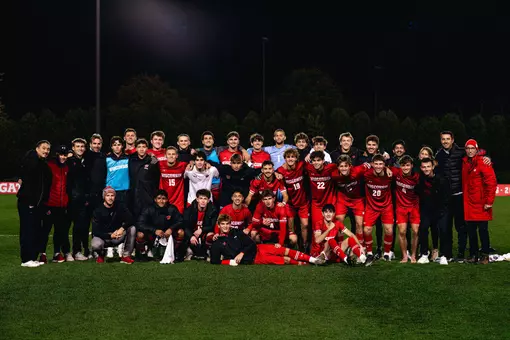
Last October, Amadou proudly wore his letter jacket and ring to participate in the Homecoming festivities to cheer on the Badger soccer and football teams. Men's soccer alumni at a game vs. Michigan State in 2023
(Diagne in back row; 3rd from the left)
"My time playing with the Badgers taught me the value of teamwork, of supporting each other to reach the objectives that we set for ourselves at the start of the season and at every match we played throughout the season."
According to Amadou, these are the values he's taken into his professional life and even in the work he does today. Forever a Badger.