Prestigious Head of the Charles Next for Rowers
October 17, 2002 | Lightweight Rowing
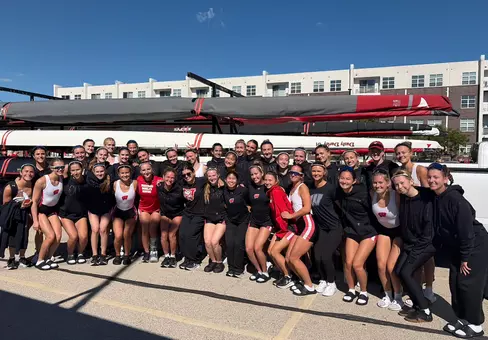
The Badger women's openweight and lightweight eights and fours will visit Boston this weekend, a place dripping with American history, in hopes of making history of their own. The teams will race on the Charles River in the prestigious Head of the Charles, the world's largest two-day rowing event. The Badger men's team will also compete.
'It's the largest rowing event in the country, ' said head women's rowing coach Maren LaLiberty. 'An estimated 250,000 people spectate by standing along the Charles River. There's upwards of 4,000 competitors, mostly from the United States, but they come from around the world to compete. It has become the most prestigious rowing event of the fall.'
It has also become a large part of the season for the Wisconsin lightweight eight boat, the two-time defending champions in the women's lightweight eight division. They will make an attempt at their third-straight title this Sunday, Oct. 20.
'I think that we have another chance to repeat this year, ' LaLiberty analyzed. 'We are starting in first place and that's always an advantage because then you don't end up running into anybody else 's crash that has occurred up ahead of you. It is difficult, however, because you don't have anybody to try and catch and there's only people trying to catch you. Also, we've beaten Riverside Boat Club, which is on the Charles River, for the past two years and they certainly aren't very happy about that. '
The Badgers will send a young boat made up of one senior, two juniors and six sophomores. Three of the sophomores were walk-ons when they joined the team last season and so will be looking at the event to gain some much needed experience.
'Despite their youth, they have shown a lot of speed this year,' commented LaLiberty. 'I think it's just a matter of them taking their enthusiasm and the endurance they have right now and keeping calm during the race.'
No matter the lightweight eight result, the Head of the Charles is special. The incredible scale of the event makes it so, as does the course itself and what can happen during racing, as LaLiberty explains.
'The race is similar to a cross-country ski race in where the athletes begin 15 seconds apart. The whole point of the race is to try and catch the people ahead of you because then you know you've beaten them. You don't know whether you've won the race or where you've placed until they 've done all the calculations, so that makes it really exciting. Even if you don 't pass anybody, you still might win. You are really racing the clock. What also makes it interesting is that when you pass other boats there's always the possibility in getting tangled up in their oars. The boats that you're passing are supposed to give way and let you have the shorter course, but they don't always do that. This is really a coxswain's race more than anything in that the coxswain has to understand the course, the strategy behind the course and the geography of the course. They also have to be extremely aggressive to get the other crews to do what they want. They have to have very fine control over their athletes because there are certain parts of the course you have to pass a boat right then or you will never pass them because there is no other part of the course that will allow it. They have to be able to put their foot on the accelerator when they need it, have the rowers move when they need to move, have them slow down when they need to slow down, and have one side go harder and one side go lighter and that's hard to get them to do.'
The added challenges for the coxswains come in the form of bridges and turns that are not part of the equation in most other races during the rowing season.
'There's a number of tricky places and the first one is the Weeks Footbridge which comes about 2500-3000 meters into the race,' LaLiberty said. 'There's a turn and a bridge you have to go under and the bridge is supposed to only take two eights at a time, but we have certainly seen more than that go under there. The combination of the bridge and the turn is what has made it be a very exciting spectator site. Boats have gotten tangled up in each other there many times. '
'There's another bridge, the Anderson Bridge, which also has a fair number of crashes because there's a turn and a bridge with a small arch. Then there's a very long, three- to four-minute starboard turn and you don 't want to be passing on the outside. Just before the starboard turn, which is at Harvard Boathouse, there is a lot of strategic moves there because if you're going to get ahead for the starboard turn, you have to have made a move and be passing to the inside before that starboard turn.'
Adding to the prestige of the event is the difficulty in simply getting an entry to participate in the regatta. Unlike other American regattas, each boat entered must get accepted. There is only one way to ensure entry into the event and that is by performing well when you do get your entry.
'There are so many people who want to row at this regatta its really exciting when you actually get an entry,' LaLiberty said. 'If you finish within five percent of the winner of your race, you get an automatic entry the next year. That is extremely important and that's what we always try to go for at the very least during our races there. It's an all-comers event. They have high school events, men's and women's events, college events, lightweight events, openweight events, sculling, sweep rowing, all ages. I think they have an 80-and-over category and everything else in between. There isn't anybody who is excluded from it by category.'
The Badger openweight eight, which finished 16th at last year 's race, hopes to improve on their performance and build upon last week's win at the Head of the Rock in Rockford, Ill. The Badger openweight eight last won the race in 1988.
'Our openweight team is looking very strong. We did very well last week,' said LaLiberty. 'They showed they can go really fast. We 've got seniors, juniors and sophomores in this boat. I'm seeing great things for them. They're starting 15th and I don't think that there 's anyone starting after them who can pass them. I think it's just going to be a matter of them understanding the strategy of the course in order to finish as high up as they can. We've got the national team in our race so I don't know this race is about winning, but we would certainly like to be the top collegiate crew. '
Wisconsin will also enter boats in the women's lightweight four and championship four events with its lightweight and openweight teams competing, respectively. Four sophomores and a senior coxswain will race in the lightweight four event. In the championship four, four sophomore rowers and an experienced sophomore coxswain will race.
'It's a very well run regatta' concluded LaLiberty. 'It's very exciting. It takes rowing to a new level in that it becomes an impact sport which it normally isn't. It's where the rowing world gathers once a year. Anybody who loves rowing will go to the Head of the Charles. '
For more information on the Head of the Charles, visit www.hocr.org.