Bret Bielema's media day transcript
August 17, 2009 | Football
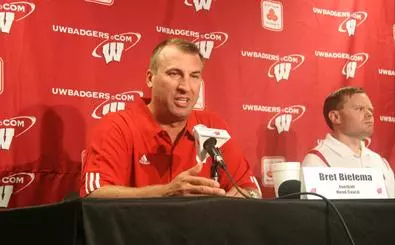
Badger head football coach Bret Bielema addressed the media Sunday during the team's annual media day.
Below is a full transcript from the nearly 30-minute press conference and you can also see the mid=3516"> --> archived video from Bielema's media session.
BRET BIELEMA: Because of budget cuts, we 're keeping this room in the 80s for the rest of year. But it's great to be back. We've been at it a week, and the part that I really enjoyed over the last week is, because of NCAA rules, we have a one-a-day practice schedule. We're only allowed to work with them on the field in a practice environment one time a day. And what it does allow you to do is get a lot of film correction, a lot of opportunities to sit down and visit with your, especially your younger players on the details of becoming a better football player individually and collectively becoming better as a team. And I really felt over the last week you could see some steady improvement.
And then one thing jumped out to me yesterday. We actually had our first double day yesterday. And in the morning, we were in full pads and full uniform, and traditionally, over the course of the last three years, I've always allowed the players, when we come back in the afternoon session or the evening, we've always gone at half pack. Some guys would be in full pack if we didn't believe they performed as well as we 'd like to. And just based off of the way we finished, wasn't really happy with the way we went about things, you know, pointed out a few critical errors.
So I brought everybody back in full gear last night, and we went out on the field from 7:30 to about 9:45 and had the best practice that we've had this camp, to this point. And in reality, it should have been the most tired they've been the whole time, the most worn down, the most physically tested they had been through the entire week, and they performed at their highest. So I thought that was a, I gave them great credit, and that hopefully is an indication of some things to come.
QUESTION #1: Thanks. Coach, is it just an outsider 's perception or are there many more unanswered questions this summer than there have been in your previous tenure'
BIELEMA: Well, I think from the standpoint, you know, you just look at the players that we lost. You lose the players that we did on the defensive side of the ball, not only in the front line, we lost three or four, but also in the middle to the lose two or three linebackers, and then we only lost one corner, but he was a very good player that had started and been there for over three years. So the pure competition for those spots brings up a lot of questions, and, of course, I'm not oblivious to the fact that, you know, after a 7-6 season you have to answer a variety of different questions.
And I know our kids, one of the things that you guys might be disappointed in today, and one of the things we've helped them kind of get through, is, you know, the great part about 2008 is it's part of history. You know, people write about it and report on it. That has been done, due diligence, and now we're in 2009 and we take it and we move forward. So I think there are questions, but as coaches those are the questions you look forward to answering. And if you're the right type of player, you look forward to answering those questions as well.
QUESTION #2: Speaking of outside perceptions, whether it's media or fans, everybody wants to classify a team . . . season, a championship season, a rebuilding season. How do you classify, characterize what this season is going in'
BIELEMA: That's a great question. And I think, you know, from my perspective as a head coach, I look at every season as it kind of unfolds. This is the 2009 season. I don't know what's going to lay in front of us or what's going to happen in front of us other than what's really here today. From my perspective and our player perspective, we've really taken a model that you got to take every day for what it is. You got to maximize every opportunity that you have today, and hopefully that's going to make us better prepared for tomorrow.
And you know, one of the things that we do in our program is we have a clock in our team meeting room that's been counting down the days from last January, when we first met as a team, to our opening game against Northern Illinois, and that's where our focus is. It's just one of those things we don't get off task on.
QUESTION #3: Billy Nagy said the other day that he 's got an appointment to check on his wrist on Monday, and then you had said earlier you're hoping maybe to get Moffitt involved in some light things next week. Can you update us on that, how close those guys are'
BIELEMA: Yeah. Jeff, you're right. Billy Nagy and Dezmen Southward, another young man that when you guys get out there, you 'll see Dez has got a club on his hand. Dez had his surgery soon after coming here in June. So both those guys will meet with our hand specialist tomorrow. I believe that 's in the morning. And I don't know if they'll be cleared after that meeting, but that will give an indication. I know they're really looking, again, I'm not a doctor, but they're going to, from what I've been told, kind of check on the progress of the healing, you know, check and do all the things they do to examine that and see where they're at and see how that can adjust their timeline.
As far as John Moffitt, I walked into a team meeting today, and John was grinning from ear to ear because I know he really did the most extensive work he's done yesterday, and we're kind of holding our breath today to find out the soreness, and he felt really, really good. So I'm sure he'll have an extra, you guys like interviewing him anyway. He's one of the better interviewees, I think, that guys can take.
QUESTION #4: What did he do yesterday . . .
BIELEMA: You know what, you can ask him. I wasn 't there when he did it. I know he worked one-on-one with our trainers, and it wasn't on the football field. It was more just rehab type stuff and things that, he was, I take that back, he was snapping. He snapped to our quarterbacks and did some things that were non-contact.
QUESTION #5: Coach, it's kind of the old football saying, if you have two quarterbacks, you don't have any. Do you want this to be your chance to refute that with kind of whoever goes in there' I don 't know if you've narrowed it down to two, like you said you wanted, but whoever goes in there just feeling that you will be comfortable with whoever that is '
BIELEMA: Yeah. You know, we actually have four quarterbacks. Nathan Tice came in and actually has been a nice little addition to us. He 's done a great job, great attitude in our fall camp. But I think as things have kind of shaken out over the course of the first week, you know, the part that we 've seen out of our younger players in particular is the growth and development that they've had.
You know, Jon Budmayr continues to, do the same things that he did in the spring. And Curt Phillips (has) really probably continued to progress as good as anybody. A guy that does a lot of good things when he's put in a situation, but he makes mistakes as well. And then the older players with Scott and Dustin, you know, they have continued to perform well, but we've probably given a larger percentage of reps to Curt and seen his development as well.
So we're excited how all of them keep moving along. You know, like I said, going back to last spring at the end of it, we'd probably name someone ten days out at a minimum, but hopefully that might be even more accelerated.
QUESTION #6: Hi, Coach. You had talked about this yesterday, but with Carter and Pleasant being out, what are the chances of them being back for the regular season' And with kind of, you know, there were suspensions for the bowl games, now you got a couple more now, is there any kind of growing concern with that'
BIELEMA: No, the suspensions that came from the bowl game were things that were due to issues beyond me. It wasn't by me. It was because of policies, you know, and those were kind of a separate issue. One of the major factors in those things was academically related, and one of the steps that we took during the out of season, you heard me comment on it, was a change in the class attendance policy, and the result was the spring semester, which had the highest GPA in the history of Wisconsin football. We actually had 98 guys in the spring semester, and 48 or more, 48 guys had a 3.0 GPA or higher, which is very, very good. So I thought that addressed that issue.
The Shane Carter and Aubrey Pleasant situation was just as it is in release. You know, it's an indefinite suspension. That's all I'm going with.
QUESTION #7: Coach, can you update us on Louis Nzegwu and his comeback from his injury he had'
BIELEMA: Louis Nzegwu' Everybody just kind of goes by that last name. Louis, in my opinion, coach Partridge will be out there, probably had as good a practice as I've ever seen him have last night. He 's working as a two, reps in there for J.J. (Watt), but he also reps in with the ones on certain subpackages. Louis is a changed man.
I think a lot about, you know, his first time I ever laid eyes on him, he came into our summer camp, and we were excited, you know, this young man coming in from Platteville. He 's kind of a running back by nature. He's got huge yardage, and the coaches had kind of said he might project as a defensive lineman. And I walk over to a 101 drill and see this big, tall, gangly, great frame, you know, but really skinny, and he 's a man. He's a man now. He probably, I'm sure, is over 250. He 's got big arms. He can really run, very athletic.
And the great thing about Louis is he don't say nothing. Just goes about his business. A very, very quiet, silent approach, but I like the way he works, and he 's really paying dividends for us now. His injury is, I mean, he wears a brace, I think from a comfort standpoint. I know that he's actually tried testing the waters without it on. He just felt more comfortable with it.
QUESTION #8: What are the ways a healthy Aaron Henry can impact the defense this year'
BIELEMA: A healthy Aaron Henry, you know, and I know that you guys know this from interviewing him firsthand, he's an unbelievable human being, great frame of mind, so he can bring great things to the huddle. I brought up a certain thing that Aaron did on the field. He had an amazing play, made a nice break on the ball, and made a nice play down the sideline, and in his celebration, let the ball go in the air. And there was two occasions last year where that happened, and we were penalized for it. And any time I can draw the attention of the whole team by something that Aaron Henry did wrong, I think makes it even that much better to correct.
So Aaron Henry has great presence in the huddle. He has great perception of people and the situation, and the thing that he can, when he's healthy and he's seen a couple plays, to this point, I don't want to upset any of the wide receivers, but maybe the best catch of fall camp right now is a play that he made over the middle where he just kind of accelerated underneath the player and made a nice play on the ball, attacking it at its highest point and came up with a great pick.
QUESTION #9: Coach, just kind of a general question again. Can you point out maybe the strengths on both sides of the ball for your team ' Obviously, John Clay is going to be a guy that's going to get the ball a lot on offense, and then maybe linebackers, (Jaevery) McFadden, maybe the defensive backs are your strength on defense.
BIELEMA: Yeah, gladly. The part that you guys are going to witness this week is John Clay as a running back in our program, and believe me, I know he's got a very good upside, a lot of potential, but what you're going to see is three, four guys that are very good football players. John Clay, as you all know, has got size and speed and ability. Zach Brown is playing as good as I've ever seen him play. Probably, to me, just looks extremely fast. He has really been able to put his foot in the ground to go north and south on several different occasions this fall that have really jumped out to me.
And then between Erik Smith and Montee Ball, both freshmen, you know, Montee being a true freshman and Erik redshirting, I've been very impressed with where they 're at right now. Two different kind of backs. Erik is very quick, kind of a little slither guy, but Montee Ball has been very impressive in the first week of camp and definitely knows how to run the football how we like to do it.
I think strength-wise on the offense, you know, you got to look at the wide receiver corps. Isaac Anderson and Nick Toon in particular, and David Gilreath has been a little bit limited with some of the things he's been able to do, but those three guys in particular have jumped out. Kyle Jefferson has flashed a little bit, but those, that position, because of the experience they bring to the table, has got to be a strength for us.
And you know, we're hoping the tight end position, Garrett Graham is playing and catching the ball as well as he's ever played, and then, you know, two guys that need to be big for us, Mickey Turner, who's been a silent guy but has played a lot of football for us, and then Lance Kendricks, those three guys might give us a better tight end package than we had a year ago, when you talk about the cumulative effect that all three of them could bring to the table.
And defensively, I'm really excited to watch our defensive line jump out. I 'm not saying they're going to be a strength, but for me, a year ago, in January, I'm sorry, six months ago when we started looking at the departure of the players we lost, that was a position that really jumped out to me. Coach Partridge has done a really, really good job, has really played up that fact to our players, and they 're practicing with a great attitude.
And the secondary kind of emerge out of a group that, kind of some unknown players a year ago, now Jay Valai, Chris Maragos have got reps, have played, and have done a good job. And then Aaron Henry, having Henry turning back in, like Tom pointed out, I think brings volumes to that position.
QUESTION #10: Bret, you mentioned yesterday that with the safeties, with (Kevin) Claxton and Shelton Johnson moving up, what do you like about those two, and what's the next step with both of them'
BIELEMA: You know, Kevin Claxton will be strictly, with Chris and Jay, they actually can interchange between the free and strong. Actually, during the spring, we played a little bit of left and right. Kevin Claxton is really just a strong safety. He can play the free safety and our strong safety, in effect, at time, does play that, but he's very big. I think Clack probably weighs about 220 pounds, so he's a big body back there. The thing I've been encouraged with is he 's really broke on the ball well this camp.
Over at the free safety, Shelton Johnson, but also Josh Peprah, a freshman that, his brother, actually, was with the Packers last year. You know, he's really a very focused, kind of like Louis (Nzegwu), he's a very focused young man, and kind of just goes about his business, and he really began to flash on Tuesday and Wednesday of last week when I had him as a look team against our special teams, and he came close to blocking a few kicks and you could just see that he knew how to move in a very efficient manner, football-wise. So he's into that mix as well, and I'm excited to kind of see how those guys pan out here this week.
QUESTION #11: Coach, you hear a lot of the players talk about having a chip on their shoulder. What does that mean to you'
BIELEMA: Well, you know, chip on the shoulder, having an edge to them, I think that's one thing that here at Wisconsin we 've had to try to maintain, and that's been one of our selling points is, you know, we may not always be the most highly recruited classes. We may not always have the sexiest lineup, but we're going to go out and play with an edge and beat a few of the guys along the way that maybe other people don't think we can. I really do sense that with this group.
You know, after a couple of years where you have a lot of success, to go five years to a January 1st bowl game and to have that, if you're a freshman, you're a sophomore, every year you're doing those things, you just assume it's going to happen. And when it doesn't, reality hits you in the face, and it allows you to kind of wake up a little bit and realize that edge that you have to play with.
QUESTION #12: Bret, you've talked before about the importance of spring ball, primarily for freshmen coming in. Can you just talk about Travis Frederick and the amount of reps he got with the first and second team and how that's really benefited him'
BIELEMA: Huge. It's a great point. I think that, you know, Travis, because of where he's at right now with the departure of John Moffitt in the early part of camp, if he had been an incoming freshman coming in here, and coach (Bob) Bostad and coach (Paul) Chryst and all the offensive coaches for the first time, it would be almost overwhelming. But because of what he's been able to do in the spring, through the summer he's really been a very nice surprise to us.
The most entertaining move I've seen out of Travis was last night. We had a little dance contest in the locker room, about 10 p.m. I was taking a shower after practice, and I heard some good beat coming out of the players locker room, and I was worried what may be going on in there, and I walked in and there was a crowd of 100 players judging and evaluating the freshmen talent show of dance moves. There were a couple highlights and there's a couple lowlights. I think Travis would probably be on the lower end, but that's probably something you can ask them.
QUESTION #13: Bret, of all the decisions you have to make in this camp, how important is making the right call at quarterback to the success of this team ultimately'
BIELEMA: Well, and I don't mean to minimize the question, Tom, at all, but every decision I make is big. And when you 're dealing with a situation like that, when someone is going to make the decision whether or not they're going to start or if they're going to be on the bench, if they're going to be third-string.
Because it is a quarterback position, because it is something that people look to, and I learned over the course of the last season how important good quarterback play is, you look to do it right the first time. But you kind of just have to deal with the cards as they lay when you have to finally make that call. And at the time when we made those decisions last year, we felt that was the best decision for our team. And you know, looking back at the end of the year, I wouldn't have done things anything different. It was the facts that were in front of us, and that's where we were at.
But you know, this year, there's a lot more options. Last year, it was probably just between two guys. To me, this year, we entered fall camp with four options that are real, and those options have kind of began to clear themselves away from one another over the course of the first week. And really this week, we're looking for bigger separation even more.
QUESTION #14: Coach, who will we see playing fullback this year'
BIELEMA: You'll see a host of guys. One of the nice surprises has been Bradie Ewing. We had him back healthy, and went all Monday through Friday, and then Friday tweaked his groin a little bit, but he's already been cleared for tomorrow's practice. So Bradie's been nice, as we thought he would. He's, you know, very gifted athletically, and nobody has better intentions of having success than Bradie Ewing, so he'll be in there. Sam Spitz will be in there a little bit. But what you'll see, and as you guys know, coach Chryst loves the tight end position. There will be times where we may have three or four tight ends on the field by pure count, but Mickey (Turner) has been repping a lot at the fullback position, as well as Lance Kendricks.
QUESTION #15: Bret, you mentioned Gilreath 's been limited. What's his issue'
BIELEMA: Going back to last year at the end of the season, he had some foot issues, feet complications. And what we try to do is put him in the best situation to get healthy and get into fall camp, and he's been 100 percent. He hasn't missed anything, but we are limited. Some of our guys, our more veteran players, you know, whether you want to call it a pitch count or number of reps, whatever it is, we really try to minimize things at times to get younger players (more reps).
For instance, when David Gilreath wasn't in there, it was a chance for maybe Kraig Appleton to get more reps. And we already know what David can kind of bring to the table, in theory, and that's what we've been able to do.
QUESTION #16: Bret, what's the effect of going through another August and not having that guy at quarterback' Has that held back the progress of the program at all, having to go through this . . .
BIELEMA: We've got four quarterbacks. Haven't been to a practice where we don't have one. I guess I don 't know the question, if you're . . .
QUESTION #17: Identifying a starter sooner . . .
BIELEMA: No, I think the competition brings the best out of people. And I know at the quarterback position those guys came into camp, they knew what was on the line. They knew what was out there. And unlike game day, they feel the pressure of that every day, and we get to see, A, how they perform and, B, how they react to their performances. You know, if they make a critical error, are they going to make the same mistake the next day or are they going to move forward' And that's been the part that's probably been the most exciting to watch as coaches, and kind of get a feel for, and the players are very perceptive as well. The players know when someone makes a good play and, on the same account, they know when someone makes a repeated mistake.
QUESTION #18: Bret, I think you mentioned earlier that you might have an idea who the number one guy is a little earlier than you first anticipated. What have you seen to lead you to that belief'
BIELEMA: At the quarterback' Yeah, well, again, kind of just what I said off earlier. Dustin, because he is a fifth-year senior, we have him set at a certain accountability, certain level of performance that we expect him to have. And if he makes a mistake, compared to an underclassmen who hasn 't seen as many reps and hasn't been given as many opportunities, there 's a difference, and you have to evaluate those situations.
So, I mean, you have to look, you know, one of the things we pride ourselves on in recruiting, and, in my opinion, the last two years have done as good a job as possible of recruiting players that we can project. You know, not that, we all love ready-made guys, but guys that maybe we can get here to the University of Wisconsin and get into our strength and conditioning program for a year, year and a half before we really see what truly they can bring to the table. And I thought we had done that now with the quarterback, as well as a couple other positions.
You know, you got younger players right now that, okay, they're done with the first week of fall camp, whether it's their first year or second year here, where do you project them a month from now, and that's what we kind of have to do, for instance, when you're evaluating a Curt Phillips or a Jon Budmayr.
QUESTION #19: Like Barry (Alvarez), you cut your teeth as a defensive coach, whether position or a coordinator, before you became head coach. Have you found yourself, over this last year or last two years, maybe taking the defensive struggles a tad more personally than any other sorts of mistakes' Have you found yourself maybe putting in a little more input in that department'
BIELEMA: You know what, that's a good question. One of the things that I did, I made a very clear decision after the end of my time as a defensive coordinator to become the head coach is I wanted to hire a group of coaches to do what I hired them to do, to coach the game of football. I hire an offensive coach to, or an offensive coordinator, Paul Chryst, to run the offense. I hired a defensive coordinator to become the defensive coordinator and be the decision maker on that side of the ball.
I think if you ask my staff, I give equal time to both sides of the football. I critique and evaluate, you know, practice, games, and sit down, you know, game week I spend the same amount of time and prep with the offense as I do with the defense. You know, there 's certain things that are going to jump out to your mind, but what I learned as a head coach is you can be just as much a benefit to the offensive side because you 've been scheming against it so long. You can identify weaknesses when you 're game planning a team that you may say, hey, they got a fundamental flaw right here, or players.
You know, I can identify a Jake-leg when I see one, you know, a guy that maybe isn 't going to be able to, how about that one, Jake-leg, you like that' Someone that isn't going to be able to do the same thing time and time again. You know, one of the parts that as a special teams coordinator, it allows me to objectively see the game. I go back to my first year and, you know, it's, again, it's a part of history, but when I look back after that first year, we were faced with a fourth down situation in the Capital One Bowl against Arkansas. And you know, the coaches wanted to know, on third down, do I got two downs or do I got one, are we going to kick a field goal.
So you have to make a decision way before the play even happens, and at that point I said, no, you got one down. We're going to kick a field goal in this situation. I believe it was a 40+ yard field goal, and it was a little bit of a wind factor. And we didn 't convert on 3rd down. We kicked the field goal. Taylor (Mehlhaff) ended up putting it through. It was a big point in the game, and in reality that ended up being the deciding point total for the game.
And I don't know if I wasn't the special teams coordinator who was in tune with, you know, when the ball, what Taylor felt he could make or not make, if I would of just kind of have to make a decision because I'm involved with either offense or defense, I wouldn't have been able to make that call. And so for that reason, I really think the balance that we have right now is good.
QUESTION #20: What have you thought of (Kraig) Appleton so far, and have you seen enough to know if he can help you this year '
BIELEMA: Kraig Appleton came in in good shape, came in and really made an impression, I think, on, one thing, coaches, but our players. You can hear players react to a couple catches that he made. Unfortunately, for him, on Friday, it was either Thursday or Friday, the days kind of run together now, I know today was Sunday, but that was just by chance, I think it was Friday he actually was just running on a little go route and tweaked his hamstring a little bit. So I don't know if he's going to be able to go on Monday. It's not, it doesn't look to be a prolonged thing, but he definitely is limited. He didn't practice yesterday on either practice, and he was back walking today, and he assures me he's going to be back there as soon as possible. But he's a guy that I think, if healthy, can help us significantly this year.
QUESTION #21: Bret, your points allowed has gone up the last couple years since the one great season. What maybe gives you the best hope that you can reverse that trend this year'
BIELEMA: Well, you know, in points per game, there's a lot of factors that go into it. You know, obviously, defensively accounts for most of it. Field position offensively, points you may give up when you 're not even on the field. One of the frustrating factors I always used to get upset with when I was a defensive coordinator, I couldn't believe in all the NCAA wisdom that if a point was scored, you know, while you weren't even on the field, how that could be factored into defensive football, but it's statistically how it has to work out.
So the part that we have to do defensively is probably, you know, eliminate the big play. I think if there was one thing last year that our guys, now that involves a lot of different things. It may be a communication error. It may be a critical error on a technique that was used. It may be on a call. We have to minimize the big plays, which will affect, you know, have a big effect on the scoreboard.
QUESTION #22: Coach, can you touch on the defensive line' You lose three starters. Seems like a lot is being expected of J.J. Watt. I don't know if that's accurate. But just touch on the line.
BIELEMA: Well, you know what, I think a lot is expected of J.J. Watt, and he'd be the first one to expect it. J.J. is a great competitor. You know what, whatever J.J. Watt decides he's going to do, he 's going to do it 100 miles an hour. He's one of our best guys in community. You know, here's a guy that's never suited up in our stadium to play a football game yet, and he's one of our best representatives off the field. He, I think, relishes in that role. And he'll actually be one of the few guys that will play inside and outside, you know, based on game plan.
But I really like the development of our defensive tackles, Dan Moore, Patrick Butrym and Jeff Stehle. Those three guys have really had a good fall camp. Jeff Stehle, to me, is playing at a very, very high level, and that's a great thing to see with a fifth-year senior who's had the story he's had. And O'Brien Schofield has continued to move along and do some good things, and behind him with Brendan Kelly and, like I mentioned earlier with Louis, I like the mix that we got up there right now.
QUESTION #23: Bret, other than that, the projection principle you mentioned a couple minutes ago, what else have you changed about how you guys evaluate and recruit quarterbacks coming out of high school'
BIELEMA: Well, you know what, two quarterbacks that are in the program, Jon Budmayr and Curt Phillips, were two quarterbacks that were either one or two on our board when we set up our recruiting list, and feel very confident with this year's recruiting class where that's going. And for the first time in my time, that's really been significant. So if we're doing what we need to do in an evaluation process, and being able to project those guys into playing here, I think that's a big step in the right direction, and we've been able to do that.
QUESTION #24: Are you looking for different skills, different makeup . . .
BIELEMA: You know what, no. Paul (Chryst) was kind of in an evening situation, you know, when he first came aboard. You know, the role that he was put in, you know, to be there for one year and basically knew what was coming with my situation, so he kind of had to get a feel for where I was. And he'd be the first to tell you, you know, during that season, I didn't share with anybody about, you know, employment status or anything like that. So that first year, we (had) kind of a different recruiting process than we normally go through. But the last two, and, you know, in signing Curt Phillips two years ago and signing Jon Budmayr, guys that we really, really felt good about, had high, again, like what I said, based off of what we saw. You know, the ability.
I loved Jon Budmayr from the standpoint his sophomore year he took them to a state championship game, you know. Curt Phillips, the first time you meet him and the confidence that he carries, and, you know, the fact that he doesn't get rattled. And then, you know, both of them can throw the football and can run a little bit, so that's a benefit for them as well.
QUESTION #25: Just a minor point, Bret. Unless I miscounted, you still have just 103.
BIELEMA: Yes.
QUESTION #25: Are you guys close to adding the two'
BIELEMA: You know what, the two guys that we replaced, and I'm glad you brought that up, we brought in two players. It was actually a young man that was going to walk on to our program that couldn't get cleared physically, so we brought in one player, and then, obviously Tyler O'Kane left, which brought us back up to 103. With a roster spot by Aubrey Pleasant and Shane Carter, when I make the decision to remove them from the program, there's a process that has to go through before we can bring them back into the 105. So it's something that we'll work through in the next week. And if not, then we 'll just live with a 103.
QUESTION #26: Coach, you touched on it before, but talk about how this tight end corps could actually be better than last year '
BIELEMA: Well, it's hard to replace Travis Beckum's numbers, and Travis was a great competitor. The thing I always loved about Travis was the way he competed. You know, in big games, Travis was going to play big, and you could count on that, and that kind of helps you at other positions. What I'm talking about is Garrett Graham, you know, just athletically can do a lot of the same things Travis did. You know, he catches the ball very well, he runs very well, and does a lot of good things. But now you bring in Lance Kendricks, and a lot of you, you saw the spring, but Lance is very gifted athletically. He's a lot like Travis. He 's probably a little bit bigger than Travis, and that's the factor that I think with him and then the addition of Mickey Turner, those three guys can give us a group that hopefully will bring a lot to the table.
QUESTION #27: Last year, one of the issues was penalties that were maybe of a mental variety, offsides, false starts, lining up in the wrong things, or something on the sidelines even. How have you guys addressed that in the off season, in spring ball, and through now, and is that something, it's easy to see in X's and O's what you can fix when a tight end doesn't catch the ball, but how do you address those issues'
BIELEMA: Exactly. Great point. You know, the thing that we've really tried to emphasize to players is, you know, no matter, in fundamental, for instance, the first six periods of every practice is fundamental drills, okay. So we're going to go through 30 minutes of the basics of your position and how good you can be at that, and that's all movement. That's all things that you do, you know, after the snap, either offensively or defensively.
The thing I've really tried to stress to the kids, and you can see it and you can hear it from them personally, is all those things that we work on, all the skills that we work on, all the calls we make from a coaching standpoint, none of that has an effect if we don't even get to the snap. So anything that is detrimental to the team, that happens before the snap, can't be tolerated. And they're aware of it. We 've done certain things, you know, with conditioning. But the highest level of accountability has to come from within, and I think our players are really starting to get that.
That's why, to open up with what I said, I thought Saturday morning, you know, some of those things that you just mentioned, you know, there was two procedure penalties, there was a pass interference, and I brought those people, the celebration penalty, I brought that to their attention, and that's why we practiced in full pads in the evening, and then we went out and had the best practice we've had the entire camp, which tells me that accountability has kicked in.
QUESTION #28: Now, with a few years under your belt, you talk a little bit about your coaching philosophies, especially when it comes to offense and defense, special teams in general, the balance between them. But overall, from Point A, which began your career as head coach here, to now, what lessons stand out to you in terms of who you've become as a football coach'
BIELEMA: Well, you gain great things with experience. I think that's the greatest thing. You know, I tell kids a lot of times what you try to do is relate stories that can help a young man go through things, and now as a 39-year-old head coach, I have to take the same philosophy to me. You know, one of the things I love to do is I take out a timeline. The average age of the adult male in the United States of America is somewhere around 72 years, you know. Halfway between 72, zero and 72 is 36. I'm 39, so I'm halfway, a little bit beyond halfway. Hopefully me, you, and every other male in this room will go way beyond that, but, hey, that's where you're going.
Halfway between zero and 36 is 18, and a lot of times that's the age that I get when a young man comes to campus. And the thing I have on them is, you know, almost 21 more years of experience in life. And what I have now is I have three years of experience as a head coach to relate back to things that I've done, you know, with our team, different concepts that we've tried to enforce, whether or not they've been successful.
The one thing I know is I know that I know how to win. You know, being a defensive coordinator and being a coach over the last, all my time here at Wisconsin, as well as my time before that at Kansas State, to win the ball games and to do the things we've been able to do to have success, you really got to stay concentrated on those things. But on the same account, anything that you look back and reflect upon and you realize didn 't come out the way that you wanted to, you really take under microscope how those things happen. So I think experience is invaluable, and that's what I rely upon the most.