Badgers’ winning culture mirrors coach
March 15, 2017 | Women's Hockey, Andy Baggot
Consistent, honest, diligent teamwork is Mark Johnson’s hallmark
 |
||
|
BY ANDY BAGGOT
UWBadgers.com Insider
MADISON, Wis. — One of the secrets to Mark Johnson's success as coach of the Wisconsin women's hockey team can be found most every day in the parking lot near the Kohl Center.
There, in its usual spot, is a 2001 Jeep. It has a couple splotches of rust and definitely looks its age, but is otherwise clean.
It has 170,000-plus miles on the odometer and a nickname the owner shares with a laugh.
"Baby Powder," Johnson said.
It was purchased used in 2003 as a means of transportation for Johnson's children as they moved through Madison Memorial High School. When the last of the five, Megan, left the nest for Augsburg (Minnesota) College in 2015, her father happily took the wheel.
"It's his baby," daughter Mikayla said.
In a way, the vehicle serves as a metaphor for how Johnson has gone about his UW coaching business the last 14 years.
It's understated and enduring. It's provided a worn, comfortable ride for the operator. It's responded to regular maintenance with remarkable reliability.

Johnson's modest choice of wheels helps define his coaching legacy, which is on the verge of more validation.
The Badgers (32-2-4 overall) have been ranked No. 1 in the country since the first day of practice back in September.
They repeated as Western Collegiate Hockey Association regular-season champions and won the league playoff title for the third straight time.
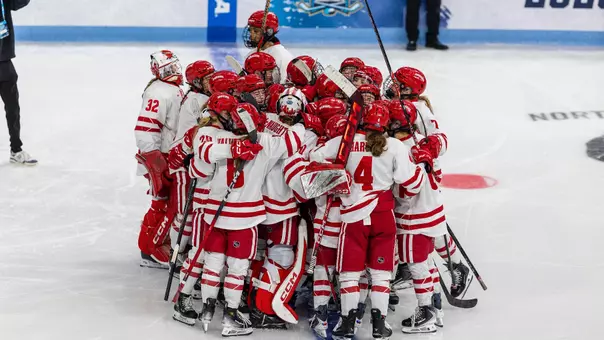
They have advanced to the NCAA Frozen Four for the fourth consecutive season — the 10th time since 2006 — and are working on a 21-game unbeaten streak (18-0-3) that dates back to early December.
UW will sic its high-octane offense, the No. 1 unit in the country, and suffocating defense, also rated No. 1 nationally, on Boston College in the semifinals Friday at The Family Arena in St. Charles, Missouri.
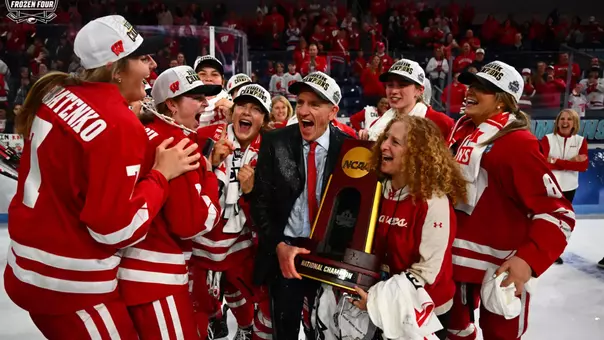
A victory over BC (28-5-5) would put the Badgers on the cusp of their fifth NCAA title under Johnson. They would face either Clarkson or Minnesota for the national championship on Sunday.
After Wisconsin scorched Robert Morris 7-0 in the NCAA quarterfinals last Saturday, closing out a 16-1-2 season at LaBahn Arena, Johnson read from a familiar script about looking forward to another game and another week of practice.
"Excited and looking forward to another challenge," he said, smiling.
Johnson has coached the women's program at his alma mater since 2002. Along the way he's fashioned a remarkable career record of 427-77-39 (.822). For perspective, that winning percentage puts him closer to Connecticut women's basketball legend Geno Auriemma (.880) than that of Boston College coach Jerry York, the winningest bench boss in men's hockey (.620).
Johnson has created a team culture in his image, which is easier said than done.
The Badgers skate with the same intense, goal-hungry spontaneity he displayed as a two-time All-American center, Olympic icon and 11-year veteran of the NHL.
At the same time, Wisconsin players and staffers co-exist in a bubble of predictability that Johnson began inflating years ago when he played for five NHL teams.
"As a player if you have good habits, you end up probably with good results," he said. "Most coaches have a routine about how they conduct themselves, whether it's September, November or now.
"You try to find things that will put people in a position where, relative to the game, they're comfortable, they're relaxed. That's when they play their best."
Johnson craves the familiar, whether it's the green tea he drinks before practice and games, the blueberry scone he gets with lunch from Panera or the timing of his pregame presentation to his players.
"He has a clock in his head," marveled Paul Hickman, Johnson's first and only director of hockey operations. "He doesn't look at his watch. Doesn't look at his phone. Ninety seconds and he walks out."
Every game day routine for the Badgers is the same. Every road trip follows the same script. Every practice, home or away, has the same rhythm.
"It's like 'Groundhog Day' and everyone's in their comfort zone," Hickman said. "Our routine, from the morning skate to the meal to when we leave for the rink, it's all programmed about the same every time."
Johnson doesn't make demands or give orders. In fact, he's the type of coach that can be found hauling equipment bags off the bus right alongside his players.
"He has expectations and everybody knows what they are," Hickman said. "Mark boils down all the things that go on in the whole constellation of the hockey world into the most important parts. It leaves you with a guy who really just cares about the core aspects."
Johnson is big on being comfortable, but not big on pretension.
He wears the same black nylon sweat pants, the ones he acquired in the mid-1990s, to every practice. The zipper on one leg has been broken for the better part of a decade, but he pays it no mind.
"They probably think I'm just some nerd," Johnson said with a laugh. "But I'm OK. I'm comfortable. And they're warm."
Johnson has had boxes of new gear, courtesy of the school's recent apparel deal with Under Armour, sit unopened in his second-floor office at LaBahn. He's happy with all his well-worn stuff.
"At some point he'll open them and try them on," Hickman said.
A large, flat-screen TV was once delivered to Johnson's office only to sit in its box for more than a year. Johnson had no immediate use for it.
"He walks over to Gordon Commons and gets the same salad every day," Hickman said of Johnson. "He walks down to the end of the line and, from what I've heard, he goes and stares at the soup, but he doesn't ever get soup."
Mikayla Johnson, a senior winger for the Badgers, said she can reasonably predict where her father will be at any given time of day, from his coffee stops to his workout and sauna at the gym to a night-time routine that includes a glass of wine and NHL games on TV.
"I can tell his schedule to a 'T,'" she said.
Pete Giacomini is a good friend and former neighbor of the Johnsons who serves as an official scorer for UW men's and women's hockey games.
"He's so predictable," Giacomini said of Johnson. "I know the best time for me to catch him on the phone is at 9:30 in the morning at the office."
In the book "Boys of Winter" — it profiles members of the Olympic gold-medal-winning Miracle on Ice team — Giacomini told the story of a long-ago garage sale at the Johnson house. On one of the tables were Johnson's game-worn gloves from those 1980 Winter Games. They were originally priced at $3 in part because Johnson isn't into stuff like that.
Those who know the Johnsons know that Mark's gold medal from Lake Placid has been used as a toy, a Show-and-Tell prop and casually dropped in a driveway mail box for retrieval.
When the Badgers won the 2007 NCAA title in Lake Placid — they were headquartered in the same dressing room Team USA used 27 years before — players repeatedly asked Johnson to recount his Olympic experience. He declined.
"He said the moment was about the girls," former UW captain Meghan Duggan said.
Johnson's former players have learned the value of his routines.
"Being out of college and having different coaches along the way, one thing I've noticed with him that stands out is that the preparation for us was the same every week," said Brianna Decker, a 2014 U.S. Olympian and Patty Kazmaier Award winner for the Badgers in 2012.
"It didn't matter if we were playing the top team in the conference or the eighth team in the conference. It was the same preparation every week. That's what I try to take with me from his style of coaching is that it shouldn't matter who you're playing. You've got to play the same way or the result might be different from what you want.
"The consistent personality he brings to the table every day at practice and for every game, it's the same and that's what players need."
That consistency is seen in good times — really big wins get a joyful fist pump from Johnson in the dressing room — but also when things go wonky.
When a practice drill goes awry, Johnson slides the bill of his hat to one side of his head.
"It's pretty subtle, but we always seem to catch it every time," Decker said.
When Johnson is unhappy with an outcome or an effort, his remedy isn't rooted in bluster.
"I think the best part of him is that he didn't need to use anger or profanity to address the team if we were playing poorly or he was disappointed in us," said Duggan, the 2011 Patty Kazmaier winner and two-time U.S. Olympian.
"I think what I loved about him was that he was never a coach to pat players on the ass. You knew when you disappointed him. You knew when you got the job done and made him happy or proud."

Decker and Duggan recalled a Wisconsin game in 2010-11 in which they — along with fellow standout and current two-time Olympian Hilary Knight — played poorly despite gaudy statistics. During a video review the following week, Johnson used clips that featured the trio.
"It was a learning experience for all of us," Decker said. "From that point on in the season, we knew we had to bring our 'A' game."
The three currently rank 1-2-3 in career scoring at UW: Knight, Duggan and Decker.
"He pointed out every time we screwed up," Duggan recalled. "It didn't matter that we'd scored however many goals and won the game. He's a coach that wants to make his players better and make his team the best it can be. He holds everyone to that standard regardless of the game or the opponent or if it's the playoffs or not."
Duggan, from Danvers, Massachusetts, said she came to Wisconsin because of Johnson and knew that when she took her official recruiting visit.
"There were so many different variables, but it was him," she said.
"There's just something about him. There's something about him as a person, the way he coaches, that just makes you want to be better.
"When you're on that team, the respect you have for him and the program and the university, he's built such an incredible culture that you want to be a part of it. You want to represent him and the team and the school. I don't think you find that at a lot of other schools and it starts at the top. It starts with him. He makes everyone want to be there, want to get better. He brings that out in everyone."
The Badgers haven't won a national championship since 2011. They were runners-up in 2012, missed the tournament altogether in '13 and have been ousted in the semifinals the last three seasons.
How heavy is that burden to Johnson, the third-winningest women's coach in NCAA history?
"That's the great thing about our game; you've got to play them," he said. "What makes championships so special is, for a lot of reasons, they're hard to do. When you win one, you really have to appreciate it."
The last four losses in the Frozen Four have come at the hands of the same opponent: WCHA rival Minnesota.
"Some years it might sting you more than others because you know you had a special group and you might not be back there for a while," Johnson said. "But I don't think it deviates from what I do."

Johnson, who turns 60 in September, is currently gearing up for his sixth Ironman Wisconsin, which consists of a 2.4-mile swim, a 112-mile bike ride and 26.2-mile run. He's training to compete alongside daughter Mikayla and son Patrick. Hickman is taking part as well.
Of course, Mikayla said her father has a routine, but it's unconventional. He bikes a lot, swims occasionally and "saves his run for race day."
She smirked.
"Some years I don't even know he's doing the Ironman and then we're going to the race to watch him and cheer," Mikayla said. "I think he does less (to train) than the average person."
How does he manage then?
"He's one of the most mentally strong people," she said of her father. "I don't think he shows that he's tired during it."
When it's over, Johnson will take another finish-line photo with his grandson, Nash. It will be their fourth.
Then Johnson will fire up the Jeep, the one pushing 200,000 miles, and head home.