On the Inside: Keeping the Badgers safe
October 20, 2018 | Football, Andy Baggot, Varsity Magazine
With bright lights comes big attention, and the Badgers trust the UW Police Department’s Athletic Liaison Unit to have their backs

 |
||
|
BY ANDY BAGGOT
UWBadgers.com Insider
MADISON, Wis. — Andy Nielsen stood on the field of mostly empty Michigan Stadium, squinting into dying Saturday afternoon sunlight. He had a serious look on his face, the kind a police officer gets when they seem worried.
A veteran detective with the University of Wisconsin Police Department, Nielsen was staring at the nearby access tunnel used to channel all sorts of humanity to the field where, in roughly two hours, the Badgers would face Michigan in a Big Ten Conference game.
In his first visit to the vast, iconic facility that would soon open its doors to a crowd of 111,360, Nielsen saw that the passageway would simultaneously funnel fans, players and coaches for both teams to and from the field.
Game officials, band members, spirit squads would also use the tunnel, its lower access point lined by boisterous fans of the home team and designed to bisect the visiting bench area.
Throw in the fact that large speakers, hooked up to the public address announcer and currently blaring music at a high volume, were tucked behind the Wisconsin bench and you understand why Nielsen's face was creased with a look of concern.
"Don't like it," he said.
As a uniformed member of the highly-trained, five-person athletic liaison security detail assigned to work with the Badgers, Nielsen's job is not to be deterred though.
It's to calmly assess, scrutinize, react and absorb millions of random bits of subtle information, all in the name of keeping members of the Wisconsin football entourage safe.
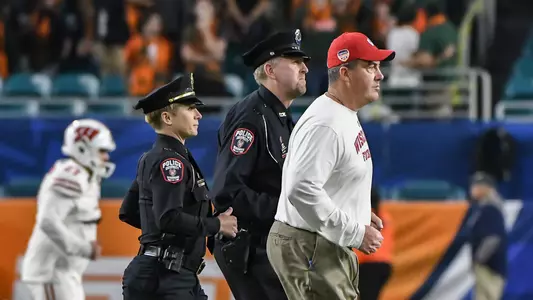
The data-gathering process could come in a very public setting, like escorting Wisconsin head coach Paul Chryst off the field after a game or flanking the bench to discourage unruly fans during one.
It could also come well behind the scenes, like taking the emotional temperature of the hotel lobby the night before the Badgers play or engaging the student-athletes with trust-building small talk that has nothing to do with sports.
It's a volunteer assignment that Nielsen and his four colleagues on the detail — Special Events Lieutenant Cherise Caradine, Training Sergeant Juan Avila, Officer Patrick Lau and Detective Matt Schirmacher — see as a privilege.
It's not just the 150 or so individuals associated with the football program, either. Members of the unit work with all 23 sports on the Wisconsin manifest, a task that calls for them to connect with coaches, make presentations to student-athletes about things like alcohol and safety and serve as a go-to resource for other security-related topics.

For example, all student-athletes and coaches have the cell phone numbers of their assigned officers in case questions or issues arise.
"There's a big trust they put on us," Nielsen said.
Caradine spent eight years on the task force before becoming its overseer in 2017. It's a coveted assignment, one that will be acknowledged as part of the Homecoming festivities during the Wisconsin-Illinois game at Camp Randall Stadium on Oct. 20.
While the UW Police Department is celebrating its 80th year in operation, the athletic liaison unit is closing in on 30.
It began in the early 1990s when Barry Alvarez was the football coach and former UWPD police officer Steve Sasso became his de facto bodyguard on game day.
Alvarez is now the Wisconsin director of athletics and Sasso is now retired, though his daughter, Kari, is the assistant police chief.
The approach to security has grown and evolved into a five-person operation that serves as a resource for the 800-plus student-athletes on campus.
"We do it because we love it and we're honored to be part of the program," Caradine said. "We feel very fortunate that we get to work so closely with such an outstanding program."
The five officers rotate for football assignments — including away games and practices — while sharing men's basketball and men's and women's hockey.
Nielsen and Lau accompanied the Badgers to Ann Arbor, an assignment that began around 36 hours prior to kickoff, before they made their way across Monroe Street from the UWPD headquarters and joined the team at busses parked at the north end of nearby Camp Randall Stadium.
The two men had to file required paperwork with the Transportation Security Administration and obtain a letter from chief Kristen Roman — a former Badgers volleyball player — citing the fact they would be carrying weapons aboard the charter flight.
The two Wisconsin natives — Nielsen grew up in Madison and Lau in Fox Point — also reviewed summary reports from previous trips to Michigan Stadium.
That was especially revealing for Nielsen and Lau because neither had been to the largest college football stadium in the country before.
The two men, both friendly and self-deprecating, sat in the very back of the Delta charter, preparing mentally for the weekend ahead.
"You have to be on your toes, big time," Lau said.

After a late-afternoon landing at the Detroit Metropolitan Airport, the four-bus caravan transported the party to nearby Ypsilanti and the hotel, where Nielsen and Lau checked in with the manager.
A team meeting gave way to dinner which gave way to some surveillance work by Nielsen and Lau. For the better part of four hours, dressed casually, they moved back and forth across the main reception area with their inner radar engaged.
"It's our job to figure out who's in the hotel and the surrounding area," Nielsen explained.
"How big is the bar? How late is it going to be open? What kind of crowd is in here? Are we in a hotel with a lot of Michigan fans? Is there a wedding here?"
Turns out the bar area was large and wide open and there was a contingent of Wolverines fans staying there. There also was a wedding reception on the docket.
Nielsen and Lau quietly patrolled the area while a host of Wisconsin players mingled with their families. The two men watched and listened intently until roughly 11:30 p.m. local time. That was the players' curfew for the next night's game, which kicked off at 6:30 p.m.
"Our job is to make sure all the players and staff get a good night's sleep," Nielsen said. "There's no interruptions. There's no fire alarms pulled. Nobody's going to be running through the halls, stuff like that."
It turned out to be a quiet night all around.
"The players are so well coached, so well — I don't want to say trained — that they know what's right and what's wrong," Nielsen said. "They know it's a privilege to be here also.
"We rarely have issues with the players and that's a testament to the coaching staff and the players they recruit."
At one point after dinner Nielsen accompanied Chryst to a meeting with ESPN broadcast personnel who would be televising the game. With few exceptions, someone is with Chryst whenever he's in public.
Nielsen explained that Chryst, relentlessly unassuming, will typically stop for photos and autographs for fans, "but there comes a time where there's that one person who's aggressive, it helps that we're there."
Chryst, in his fourth season as coach at his alma mater, was asked if there's ever been a time when he's been relieved to have a bodyguard at his side.
"Yeah, but probably not for the security reasons," he said. "They're good people and I appreciate how they're truly a part of this team."
Lau, a Wisconsin graduate in his second season in the security detail, said it's "an absolute pleasure" working with Chryst.
"He enjoys interacting with us and we enjoy interacting with him," Lau said. "He's very respectful with us. He knows we're there to do a job, but he won't hesitate to come and make small talk with us."
Nielsen, a graduate of Winona (Minnesota) State in his ninth year with the athletic liaison unit, said he and his four colleagues on the detail have created a level of trust with Chryst and TJ Ingels, the director of football operations whose many duties include travel and logistics.
"A great working partner," Nielsen said.
According to Nielsen, interacting with the student-athletes is the best part of the assignment.
He said this shortly after visiting the temporary athletic training area at the team hotel where he had a casual conversation with sophomore running back Garrett Groshek.
"It's a time to get to know people on a different level," Nielsen said. "You don't talk about football. I can answer questions about police stuff, anything else. Just getting to know people."
Nielsen said it's gratifying to see the evolution of the football players from apprehensive freshman sitting in the back of the room for his security presentation to trusting senior sitting up front.
"By the time they're a senior," Nielsen said, "my goal is to have them know my name, have them wave at me when I'm driving around or walking on campus, and be able to come up to me and talk to me in a setting like that — actually seek me out.
"That's my favorite thing in this role, which is a very privileged, unique role in our department that not many people ever get the chance to do."

Caradine, who grew up in Monona and graduated from Edgewood College, said openings on the unit don't come up often. When they do it's because of a job change or retirement.
"The officers get paid for their time," she said, "but it's time away from your family and time working outside of your normal business hours."
Members of the security detail get Personal Protection Team training with input from the Secret Service and FBI. Yes, it's come in handy.
Caradine said heightened security measures had to be developed to handle the attention paid to Russell Wilson when he quarterbacked the Badgers to the Big Ten title in 2011.
"Some fans tried following him home," she said.
When Wisconsin played in Miami in the Orange Bowl late last year, some fans actually hid in trees.
"I'm not kidding," Caradine said. "They would hide in the trees and wait for the bigger named players to come out to try and get autographs."

Caradine said there have been cases in other Wisconsin sports over the years where stalkers have created "sensitive" issues.
"It's scary, especially for the student-athletes," she said. "They're kids and confronting an adult that's putting you in an awkward situation like that is really unnerving."
That's one of the main reasons why the Wisconsin security detail exists.
"We get paid to be put in those uncomfortable situations," Caradine said.
Nielsen recalled a dicey situation at Ohio State in 2011 when fans rushed the field after the unranked Buckeyes came away with a 33-29 victory in the final seconds.
Nielsen and then-partner Mark Silbernagel, now the support service captain, were trying to get former coach Bret Bielema out of harm's way.
"Everyone's coming at us and it literally was a case where we were knocking people over," Nielsen said.
Once they got Bielema to the locker room, Nielsen and Silbernagel went back out to ensure that all players and staffers were protected.
"That was intense," Nielsen said.
There was no dramatic rush of students after Michigan rolled to a 38-13 victory on Saturday. No major breeches. No apparent security controversies.
Nielsen and Lau made sure everyone got safely from that long, darkened tunnel to busses that would take the Badgers to the airport and home.
"It's a good sense of security for people around here knowing that we're walking around," Nielsen said.
"You're very appreciative," Chryst said. "I know what their job duty says, but like any good group of people, it's so much more than that.
"That's when it's most meaningful. Who they are as people and how they interact with the players and the relationships that build off of that, that's what you're grateful for."