Lucas’ List: Noteworthy Wisconsin offensive lines
August 03, 2018 | Football, Mike Lucas
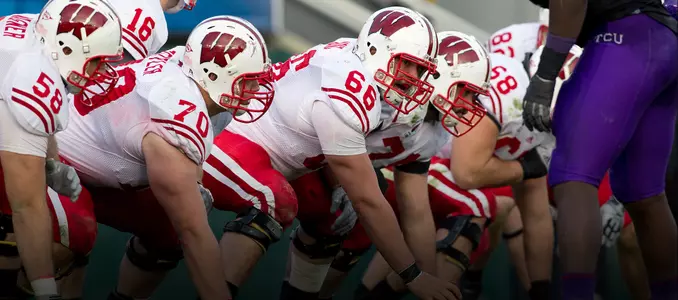
Mike Lucas looks back at some of the most notable fronts of the last 50 years
 |
||
|
BY MIKE LUCAS
UWBadgers.com Senior Writer
MOST UNSUNG: 1974
- Tackles: Bob Johnson (6-3, 239), Dennis Lick (6-4, 255), John Reimer (6-3, 262)
- Guards: Rick Koeck (6-1, 225), Terry Stieve (6-2, 240)
- Centers: Joe Norwick (6-0, 234), Art Zeimetz
Despite the loss of three senior starters from the year before – guards Dennis Manic and Bob Braun and first-team All-Big Ten center Mike Webster – the Badgers were able to regroup.
They did so without getting a full season out of Lick, an All-America candidate. After starting 28 straight games since breaking into the lineup as a freshman, Lick injured his knee in early November.
Reimer was more than an adequate replacement for Lick, whose Chicago St. Rita high school teammate, Billy Marek, went on a late-season tear by rushing for 740 yards the last three games.
Marek went for 206 (Iowa), 230 (Northwestern) and 304 (Minnesota) behind the self-proclaimed 'Marek's Marauders,' including tight ends Jack Novak (6-3, 239) and Ron Egloff (6-4, 206).
Lick, a No. 1 draft pick of the Chicago Bears, played six years (79 starts) in the NFL. Stieve, a sixth-round selection, played eight years (98 starts) with the New Orleans Saints and St. Louis Cardinals.
The Badgers went 7-4 in '74; their first winning record since '63 and last until '78.
MOST OVERSHADOWED: 1984
- Tackles: Jeff Dellenbach (6-6, 280), Kevin Belcher (6-7, 285)
- Guards: Chris Osswald (6-4, 255), Bob Landsee (6-5, 260), Dave Mielke (6-4, 255)
- Center: Dan Turk (6-4, 260)
All but Landsee, who blew out his knee in '83, were seniors. As a group, they embodied continuity. Dellenbach, Belcher, Osswald and Turk started every game the season before, too.
As a team, the '84 Badgers never really jelled consistently and ended up with an underachieving 7-4-1 record even though there was plenty of star power.
Wisconsin had the most players taken (11) in the 1985 draft.
Wide receiver Al Toon, cornerback Richard Johnson and defensive tackle Darryl Sims all went in the first round.
Turk and Dellenbach both went in the fourth round to the Steelers and Dolphins, respectively. Belcher was a seventh-round choice of the Los Angeles Raiders.
MOST UNDERAPPRECIATED: 1987
- Tackles: Paul Gruber (6-4, 291), Steve Rux (6-3, 245)
- Guards: Glenn Derby (6-6, 290), Todd Nelson (6-5, 270)
- Center: Rodney Lossow (6-3, 273)
This was a run-blocking, play-action, physical offensive line in search of a compatible offensive scheme to accent the running of tailback Marvin Artley. Instead, it got Don Morton's veer.
Rather than coaching to the team's strength, and adapting his system to the personnel, Morton wanted to put his mark on the program in his first season.
So, he benched quarterback Bud Keyes after the fourth game and started Tony Lowery, a rail-thin option QB. It was the beginning of the end for Morton, who was fired two years later.
Meanwhile, Tampa Bay selected Gruber with the No. 4 overall pick in the '88 draft.
Gruber was his generation's Joe Thomas. He was a stud on bad teams. He never missed a snap during his first five seasons in the NFL and ended up starting 183 of 183 games for the Buccaneers.
Paul Chryst, incidentally, can attest to the quality of that '87 offensive line (which has had two of its members, Rux and Lossow, go on to successful runs as high school head coaches).
Through the first four games, Chryst was a backup quarterback. Overall, he completed 5 of 7 passes for 67 yards. He also rushed for a touchdown, breaking a fourth-quarter tie with Ball State.
Then, after moving to tight end, he caught six passes for 67 yards, including a 7-yard scoring pass from Lowery against Minnesota.
MOST MEMORABLE: 1993
- Tackles: Mike Verstegen (6-6, 300), Joe Panos (6-3, 290)
- Guards: Joe Rudolph (6-2, 285), Steve Stark (6-3, 280)
- Center: Cory Raymer (6-4, 290), Brian Patterson (6-2, 275)
They were the backbone of Barry Alvarez's first Big Ten championship team and Rose Bowl triumph. They created running seams for Brent Moss (1,637 yards) and Terrell Fletcher (996).
They also protected quarterback Darrell Bevell.
Verstegen was a converted outside linebacker from Kimberly. Panos, a defensive lineman at UW-Whitewater before transferring, played center and guard before finding a home at tackle.
Rudolph, who was recruited as a linebacker, was a scout team nose guard before moving to offense. Stark, who was also the long snapper, worked his way into the lineup as a sophomore.
Raymer, an all-state defensive tackle at Fond du Lac Goodrich, made a seamless transition to offense. In '94, he was the UW's first consensus All-American since Tim Krumrie in '82.
Patterson, who was nicknamed the Microwave, didn't get many snaps. But he was ready when Raymer got hurt. He played the second half at SMU and started the following week against Iowa State.
Raymer, a second-round draft pick of the Washington Redskins, wound up having the longest pro career (10 years, 83 starts) of the group. Panos is now an NFL player agent.
Rudolph is Wisconsin's offensive coordinator and O-line coach.

MOST HISTORIC: 1999
- Tackles: Chris McIntosh (6-7, 310), Mark Tauscher (6-3, 310)
- Guards: Bill Ferrario (6-3, 303), Dave Costa (6-5, 291)
- Center: Casey Rabach (6-5, 291)
Going into the season, there was only one question, "Who was going to replace Aaron Gibson at right tackle?" Gibson was a consensus All-American and a first-round draft pick of the Detroit Lions.
As it turned out, Tauscher filled Gibby's void, though he wasn't even on the roster in the spring. After earning his degree, he was contemplating getting his master's at Youngstown State.
But he bumped into a couple of UW assistants (John Palermo and Jim Hueber, the O-line coach) at the Kentucky Derby and it was discovered that he had another year of eligibility, so he used it.
Going into '99, McIntosh, Ferrario, Rabach and Costa had the most cumulative starts (108) for an offensive line in the nation. McIntosh was the captain and anchor. Tauscher was the missing link.
Ron Dayne was the O-line's most vocal supporter/advocate after running into the history books. Not only did Dayne break Ricky Williams' NCAA career rushing mark, but he won the Heisman Trophy.
Rabach, a third-round pick, played nine years in the NFL. Tauscher was recently named to the Green Bay Packers Hall of Fame. McIntosh, a first-rounder, is Alvarez's deputy athletic director.
MOST OVERACHEIVING: 2005
- Tackles: Joe Thomas (6-8, 303), Kraig Urbik (6-6, 317)
- Guards: Matt Lawrence (6-5, 288), Jason Palermo (6-3, 294)
- Center: Donovan Raiola (6-3, 294)
The unknowns far outweighed the knowns: Thomas, a returning starter and preseason candidate for national awards; and Raiola, a two-year starter and the top center in the Big Ten.
The Badgers had to replace left guard Dan Buenning, a second-team All-American and a fourth-round draft choice of Tampa Bay; and right guard Jonathan Clinkscale, a starter in 44 of 46 games.
Moreover, they had a hole at right tackle.
Bailing them out were two gritty fifth-year senior guards, Lawrence and Palermo, the son of D-line coach John Palermo. Both looked like career backups until they were pressed into service.
Lawrence and Palermo didn't disappoint. Neither did Urbik, a redshirt freshman.
The result was a record-setting year by tailback Brian Calhoun and quarterback John Stocco.
Calhoun had 348 carries for 1,636 yards and 22 touchdowns to go with 53 catches for 571 yards. Stocco completed 197 of 328 passes for 2,920 yards and 21 TDs.
What made it all the sweeter is that the Badgers capped the season, Alvarez's final one on the sideline, with an upset of heavily-favored Auburn in the Capital One Bowl.
MOST DECORATED: 2010
- Tackles: Gabe Carimi (6-7, 327), Rick Wagner (6-3, 318)
- Guards: John Moffitt (6-5, 325), Kevin Zeitler (6-4, 315), Bill Nagy (6-3, 318)
- Center: Peter Konz (6-5, 313)
Carimi, a first-round pick of the Chicago Bears, and Moffitt, a third-round selection of the Seattle Seahawks, were first-team All-Americans.
Carimi was the second player in UW history to win the Outland Trophy (Thomas was the other).
In 2011, Zeitler, a first-rounder with Cincy, and Konz, a second-rounder with Atlanta, were both named All-Americans. In 2012, Wagner, a fifth-rounder with Baltimore, was first-team All-Big Ten.
Nagy was a "sixth starter," or the equivalent thereof in '10. He was a guard, center, tight end. Nagy, a seventh-rounder, started four games at guard as a Dallas Cowboys rookie before being injured.
The skill position players capitalized on all that talent up front.
The Badgers nearly had three tailbacks rush for 1,000 yards – James White (1,052), John Clay (1,012) and Montee Ball (996). They combined for 46 touchdowns.
Also benefiting from the talented O-line was quarterback Scott Tolzien, who completed 73 percent of his passes for 2,459 yards while helping guide the Badgers to an 11-2 record and a Big Ten title.
In sum, you could make a convincing argument that 2010 offensive line was the best in school history. But others would certainly be in the discussion.
Let's not forget, either, the 2012 O-line featuring Wagner and Rob Havenstein at tackles, Ryan Groy and Kyle Costigan at guards and Travis Frederick at center.
Wagner, Havenstein, Frederick and Groy are still playing in the NFL. All but Groy are starting. Costigan's body wore out, so he's helping build bigger and stronger bodies in the UW weight room.
There's not a wrong answer to picking your favorite offensive line. Let the debate begin.