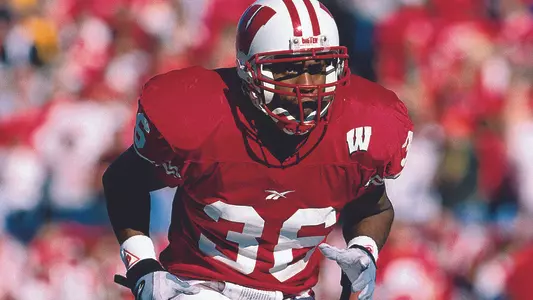
Dream Season Postscript: Wisconsin vs. Purdue, 1998
October 10, 2020 | Football
Cornerbacks Fletcher and Echols were tip of Badgers’ defensive spear on way to Big Ten title
 |
|
|
BY MIKE LUCAS
UWBadgers.com Senior Writer
MADISON, Wis. — As high school seniors, cornerbacks Jamar Israel (née Fletcher) and Mike Echols dropped hints that they had the football instincts and savvy to go along with the anticipation and the acceleration to reverse the momentum in a game with a timely play. Or two. Or three.
Israel had seven interceptions while also throwing for 1,600 yards and 19 touchdowns as an option quarterback at Hazelwood (Missouri) East. During his prep career, he scored on two punt returns and two kickoff returns. In addition, he rushed for 26 touchdowns.
Besides picking off 10 passes on defense, Echols had three touchdown catches as a receiver and three as a kick return specialist at Youngstown (Ohio) Ursuline. He also played on a basketball team that won the state championship his junior year.
Both benefited from redshirting as true freshmen. Israel added 10 pounds and Echols put on 15. Both were carrying about 170 pounds on their still skinny 5-foot-10 frames when they squared off against Purdue's Drew Brees on that adventuresome night in 1998. Both had picks in the win.
"I absolutely enjoyed playing with Mike," Israel said. "You come in with a guy and you're playing the same position, but you get along and you become good friends. It was wonderful to see his development, too, while you're competing with each other to make plays."

Echols had a unique challenge in that he was a diabetic. He dealt with it in high school and got a feel for how to control it during practices and game competition. UW sports information director Steve Malchow, also a diabetic, befriended him and shared some of his experiences comforting Echols.
"Being a fellow diabetic, sometimes when you have problems, you feel really isolated," Malchow said. "I just wanted to let him know that he wasn't on an island. It's a traumatic experience and you just have to explain to people that you can still live a normal lifestyle."
UW assistant coach Jay Hayes recruited Echols. Hayes' brother, Jonathan, had a long, successful career in the National Football League as a tight end. Jonathan Hayes was a diabetic.
"Thinking back, I didn't realize the magnitude of what Mike was dealing with," Israel said recently while jogging his memory on the marathon win over the Boilermakers. "It was remarkable to be that talented and play the game the way he played it and still deal with that type of situation."
• • • •
In 1998, the Badgers were built around their defense, a punishing unit guided by linebacker Chris Ghidorzi, the leading tackler; and fueled by rush end Tom Burke, who had an astonishing 31 tackles for loss and 22 quarterback sacks. "I always felt my hair was standing on end," Burke said.

In '98, the offense rarely committed a mistake to compromise field position. Mike Samuel had four interceptions in 155 pass attempts during the regular season. Ron Dayne had the only fumble by a running back. As a team, the Badgers lost four fumbles in 552 rushes, the lowest total in 52 years.
Special teams were also special, very special. Among the very best to execute their specialties in school history were punter Kevin Stemke, placekicker Matt Davenport and kick returner Nick Davis, whose 82-yard punt return for a touchdown got the Badgers on the board first in their game against Penn State.
The Nittany Lions were the springboard to the 1999 Rose Bowl.
With less than six minutes left in the first quarter in the regular-season finale, Camp Randall erupted when the score was reported: Ohio State 31, Michigan 16. The mission was clear. If the Badgers beat Penn State, they would finish in a three-way tie with the Buckeyes and the Wolverines.
Wisconsin and Ohio State didn't play in '98. Michigan was the only team to defeat UW. But under the tie-breaker rules, the Badgers would get the Rose Bowl invitation because the Buckeyes and the Wolverines had gone to Pasadena more recently.
Wasting little time, the Badgers took a 17-0 halftime lead against the Nittany Lions on their way to a convincing 21-3 win (Burke had four sacks). Before the game, Penn State linebacker LaVar Arrington opined, "From the running back to the line, everybody at Wisconsin is big. Maybe it's the cheese."

Dayne tore his left pectoral muscle in the first quarter. At less than full strength, he still rushed 23 times for 95 yards. Samuel was more than happy to pick up the slack. Mixing option keepers with quarterback draws, he rushed for a career-high 89 yards.
On one of his 13 carries, Samuel took on Arrington in what was a thunderous, open-field collision that had Samuel popping up to his feet before a dazed Arrington. Say cheese, LaVar. Arrington later said it was the hardest that he had been hit the entire season.
"Mike was one of the toughest-minded guys I've ever been around and you can couple that with his physical toughness, too," said UW offensive coordinator Brad Childress. "Mike really got beat up. But he still wasn't afraid to lower his shoulder if he had to bowl you over."
• • • •
Not that the Badgers needed another chip on their shoulder going into the Rose Bowl against UCLA, a 10-point favorite. But they got one thanks to college football analyst Craig James, who pontificated that Wisconsin would be the "worst team to ever play in the Rose Bowl."
That played right into the Alvarez wheelhouse.
"Coach Alvarez could take someone not liking our logo and make us upset about it," Davenport remembered. "I'll never forget when we played Stanford (in '96). During his pregame, he said, "These guys throw a Frisbee on campus. No way are we going to let a team that plays Frisbee beat us.' For some reason that made sense to us. And we were all like, 'All right, let's go get 'em.'"

The Badgers outlasted the Bruins, 38-31, behind Dayne, who rushed for 246 yards. Nobody was more impactful on defense than the aforementioned Israel, who picked off quarterback Cade McNown in the fourth quarter and returned the interception 46 yards for a score.
Israel finished his three-year career with 21 picks overall (the school record later matched by Jim Leonhard) and five pick-sixes (including two against Drew Brees and one each against McNown, Illinois' Kurt Kitner and Northwestern's Zac Kustok, which Israel returned 93 yards).
"Jamar contests every throw," Alvarez said. "And that's confidence."
• • • •
That confidence surfaced before the 1999 Michigan State game. On that Monday, Israel went public with his desire to cover the Spartans' star receiver, 6-foot-6 Plaxico Burress, one of the premier pass-catchers in all of college football. Moreover, Israel demanded the one-on-one assignment.
"I've got one saying and I stole it from Lou Holtz," Alvarez responded to his cornerback's bravado. "If your mouth writes a check, your fanny better be able to cash it."
Although Burress caught five passes (for 58 yards), he was never a factor in the game, a rousing 40-10 Wisconsin victory sparked defensively by Israel, who had two interceptions. During his postgame interviews, Israel reminded everyone, "It's never bragging if you back it up."
More than two decades later, Israel admitted that he felt "disrespected" by some of the things the pundits were saying about his matchup with Burress.
"It was all about Plaxico and how nobody could cover him," he said. "I wanted to let everybody know that I thought I was pretty good, too."