Baggot: ‘You are part of a team that’s bigger than yourself’
February 15, 2020 | Men's Hockey, Women's Hockey, Volleyball, Andy Baggot
Becoming first responder natural transition for many former Badgers
 |
||
|
BY ANDY BAGGOT
UWBadgers.com Insider
MADISON, Wis. — You'll probably get a chuckle out of how Mike Dibble began his transition from Wisconsin student-athlete to career first responder in the Madison Fire Department.
After all, he definitely got one.
"I burned my mom's house down when I was a junior, working on my Harley in the basement," he said with a quiet snicker. "I saw how (firemen) worked there."
Dibble grew up in Minneapolis, Minnesota, where his uncle was a fire chief, so there was that connection. Another came to life after Dibble came to Madison to play goaltender for the men's hockey team midway through the 1973-74 school year.

In order to get to practices at the Camp Randall Memorial Sports Center, Dibble's path from his apartment at the corner of Dayton and Spring streets took him within earshot of Fire Station No. 4, located directly across from the Camp Randall Stadium complex.
On days when the station's bay doors were open and firefighters were milling about, Dibble would offer a routine salute.
"I want that job when I get out of college," he would yell.
Dibble not only secured one of those assignments with the Madison Fire Department, he spent 34 years becoming a pioneer, ushering a steady stream of former Badgers student-athletes into the world of being a first responder.
"I'm a big advocate," Dibble said.

So was the late Ed Durkin, who served as Madison fire chief from 1979 to '85 and was credited with making the department more inclusive for women and minorities.
"He loved us," Dibble said of former UW student-athletes.
Why is that?
"The similarities are almost exactly as an athletic team," Dibble said.

Being a first responder — firefighter, paramedic, emergency medical technician, police officer, lifeguard — is a job that demands teamwork, trust, specialized skill sets, a high level of fitness and the instincts of a people person.
It's a calling that requires commitment, courage, sacrifice for the greater good and the ability to manage and produce under stress.
It's an undertaking that includes shared meals and quarters, that emphasizes camaraderie, that requires everyone to wear the same uniform.
It's a way of life that cannot fully blossom until you prove yourself in the heat of a moment.
"You have to earn respect," Dibble said.
It's a way of life for the numerous student-athletes who made their mark with the Badgers and now operate as public servants. Some, like Art Price, played football and became a division chief with the Madison Fire Department. Some, like Kristen Roman, played volleyball and became UW chief of police after two decades with the Madison Police Department. Some, like Laura Graf, played three sports at Wisconsin and used her nursing degree to become an EMT. Some, like Patrick Johnson, played men's hockey and now finds himself headquartered at the same No. 4 fire station that Dibble good-naturedly engaged back in the 1970s.
Right now there are at least 20 former UW student-athletes working as first responders for Madison Fire Department, Madison Police or University of Wisconsin Police. Dibble, former Badgers track standout Leotha Stanley and former UW goaltender Marc Behrend are among those who have retired.

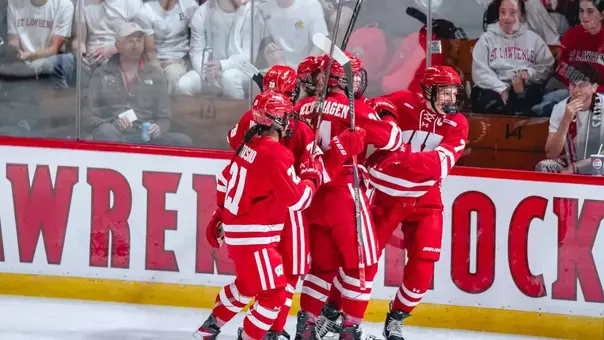
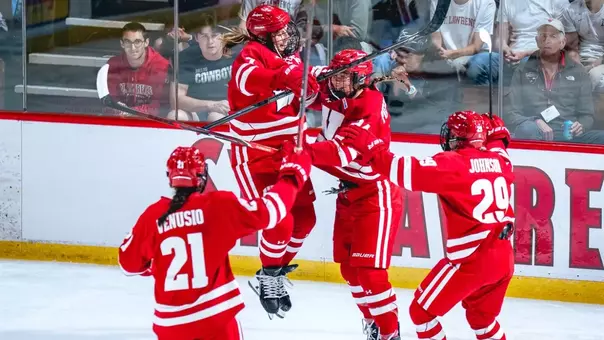
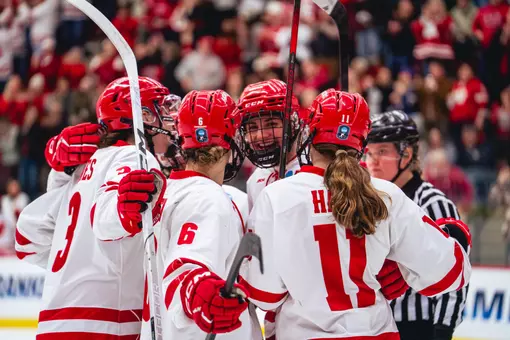
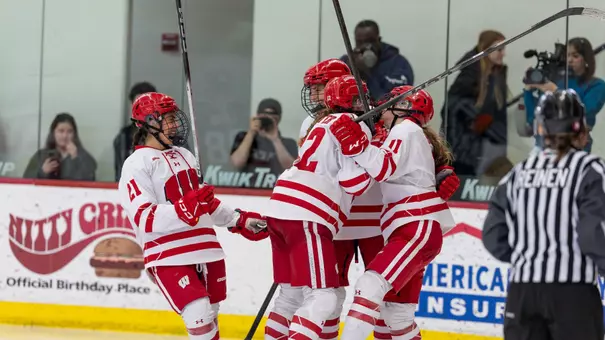
Their efforts, as well as those of local military personnel, will be recognized Sunday at 2 p.m. during the UW women's hockey game vs. Ohio State at the Kohl Center.
The acknowledgements come against a special backdrop that goes beyond a Western Collegiate Hockey Association duel between a pair of top-10 teams.
First responders and military members will serve as honorary captains for what could be a headline-making turnout. More than 12,000 tickets, priced at $2, have been sold for the sixth edition of Fill the Bowl. The defending national champion Badgers are looking to break their NCAA record for the largest single-game crowd, which was set in 2017 at 15,359.
In addition, the Badgers will recognize two-time U.S. Olympian Jessie (Vetter) McConnell for her place in the Wisconsin Legends Walk at the Kohl Center as well as the 20th anniversary of the first women's hockey team at UW.
One of those pioneers is Kathryn (Greaves) Kraft, who came from Mentor, Ohio, to play 135 career games for the UW women's hockey team from 2000 to '04.
She was recently discharged after 12 years in the Army ROTC with the rank of captain. She used her ROTC scholarship to finish UW graduate school with a degree in physical therapy. Kraft's time in the military parallels her experience competing for the Badgers.

"You are part of a team that's bigger than yourself," she said. "When you're a part of any UW team, it's never just about you. It's what's behind that Motion W that you wear on your chest and the team you're working for a greater cause together.
"I think that collaborative effort is like the same thing that goes into all the first responders and the military. You're a part of something that's bigger than you. You're doing it for other people, not just you."
Everybody has a different life story, but a specific theme emerges when you talk to UW student-athletes-turned-first responders.
Price, an outside linebacker who lettered for UW in 1983 and '84 while playing for Dave McClain, said the appeal of being a firefighter was obvious to him once he became aware of its demands.
"It was the only career that resembled, for me at the time, an athletic team," he said.
Price noted how firefighters respond in units, each with their sections of responsibility and work flow; how there are practices where those units come together and rehearse techniques; how there's a command system that mimics a head coach and his defensive and offensive coordinators; how there's a playbook in the form of policies and procedures; how each unit member is responsible for learning their part in how they fit in the total picture.
"That was the allure," Price said. "As a firefighter, you're like a team member."
A host of UW programs are represented on the local first responder roll call, including baseball, football, golf, hockey, rowing, swimming, volleyball and wrestling.
How does one go about being a good teammate in this setting?
Have a sense of humanity. Dibble said 90 percent of the job is dealing with people.
"You deal with your work people and you deal with your community," he said. "If you're not a people person you should find another line of work."
Have a standard of excellence. Roman said everyone is expected to bring their "A" game to the moment.
"There's an expectation of maintaining a certain level of high performance under stressful situations," she said.

Have a passion for the job. Graf said children look up to you and first responders are typically viewed as the good guy.
"It's really important work," she said. "You're helping a lot of people."
Have an appreciation for the stakes. Johnson recalled riding to campus with his dad, UW women's hockey coach Mark Johnson, on Sept. 11 of last year.
"When everyone's at their worst," Patrick said, "we have to be at our best."
Have an awareness for the greater good. Price, who came to UW from Newport News, Virginia, said he learned something new and important as soon as he joined the fire department in 1990.
"I didn't realize how big community service was to me until I was actually doing it," he said. "I realized how important it was to give back and be able to help people."
Dibble spent 34 years with the Madison Fire Department before retiring as division chief in 2016. He said the first order of business is paying your dues.
"So, the big, old hockey player is coming over here to be a fireman," he said, recounting his introduction to the job. "That was my first day. Once you get out on a call and start proving yourself, you build respect like anyone else."
Roman will sing the National Anthem on Sunday, just as she did back during her days with the Steve Lowe-coached Badgers from 1984 to '88. She came from Barrington, Illinois, majored in English at UW and eyed a career in journalism before a volleyball friend suggested she apply for a job with the Madison Police Department. That was in 1990. She was sworn in as UWPD chief in 2017.
"I certainly did not set out with this in mind," Roman said.
Graf, an EMT paramedic, grew up in Madison and has been on the job for 25 years. She competed in volleyball, track and field and rowing at UW in the mid-1980s. One of the things that attracted her to the life of a first responder is her co-workers.
"We have a lot of well-educated people from other careers who could be doing other things," she said. "They don't want to sit at a desk."
Patrick Johnson grew up in Madison and skated as a winger for the Badgers from 2007 to '11. He began his firefighting career as a volunteer in Middleton and fell in love with the atmosphere and challenge.
"You have no idea what's coming," he said. "It could be a house fire or an accident. It might be 2 in the morning or it might be at dinner."
Video: Mike Dibble presents firefighters helmet award
Dibble and Roman shared a moment that defines that reality. It was late in the afternoon on Saturday, Oct. 30, 1993, when a call came into Station 10 on the North Side where Dibble was assigned.
"Report to Camp Randall," the intercom blared.
That's where the Badgers had just knocked off Michigan 13-10 in an epic Big Ten Conference game before a crowd of 77,745.
"We were actually watching the end of the game on TV," Dibble said. "Then we heard, 'Multiple pulse-less non-breathers.'"
As they rode to the scene, Dibble and his co-workers wondered aloud if people had fallen from top rows of the East Side grandstands to sidewalk below or if a wall had collapsed.
No. It was a stampede, a horrific crush of humanity in the northeast corner of the stadium. People were trapped, trampled and suffocating along a metal railing near the field.
"I think we were the second ambulance there," Dibble said. "When I jumped out and saw the paramedics in the stands, I asked who was most critical and got all different responses."
How stressful was it?
"It happened so fast you didn't have time to think about it," Dibble said.
Roman, meanwhile, was stationed outside the south end of Camp Randall, directing the flow of ambulances as they came, went and returned to the stadium.
"I never saw the inside," she said.
Dibble said there were 73 total calls that day and that he made seven different trips to the hospital. He said in-house paramedics and UW players who waded into the post-game chaos and saved lives "are the true heroes."
In all, 69 people were injured. Ten were unconscious and not breathing when first treated at the scene.
"It was absolutely phenomenal that nobody died," Dibble said.
It's a day no one who was there will ever forget. Dibble will remember it as part of something much bigger.
"Best job I ever had," he said.