Lucas: Badgers have clear commitment amid a world of unknowns
July 27, 2020 | Football, Mike Lucas
Awaiting answers to many questions, football team’s collective focus remains on preparation for season
 |
||
|
BY MIKE LUCAS
UWBadgers.com Senior Writer
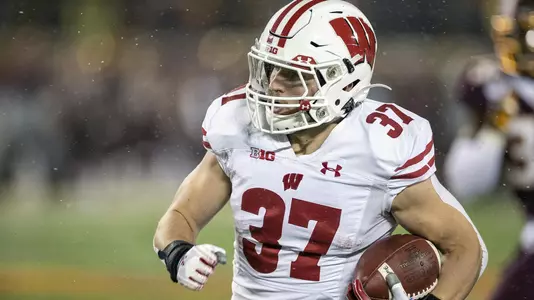
MADISON, Wis. — The fill-in-the-blank question was first posed to Garrett Groshek, a nose-to-the grindstone, ear-to-the-ground, mullet-wearing, fifth-year UW senior.
If anyone can take the pulse of a team — or the temperature, as the case may be — it's Groshek, a multi-faceted tailback from Amherst Junction, a small farming community in Central Wisconsin.
"Since mid-March, the last four-and-a-half months have been …."
Blank.
"Challenging ... fun ... surprising … almost enlightening," Groshek rattled off before explaining further. "You've been forced to focus more on yourself — everything has been more individualized rather than being around the guys — while trying to work towards being the best player that you can be."
Fun? It might sound like the odd word out in Groshek's series of short burst responses. Except it was likely in reference to the highlight of his summer and something unrelated to the challenge of remote schooling and training in the midst of a global pandemic.
Earlier this month, Groshek married his long-time girlfriend Carly. A picture of the couple was taken outside the Camp Randall arch and posted on his Twitter account ("Introducing Mrs. Carly G!"). In concert with his wedding vows, he says his football commitment has never been stronger.
"I've been able to almost self-reflect and focus on different weaknesses," he said. "I've put a little more time towards those (weaknesses) whether it's technique, footwork, or strength, just because we haven't had spring ball or haven't been at the stadium or on campus for a whole summer."
The campus closed in mid-March. All classes went online for the second semester and summer term. A majority of the players who went home for spring break did not return until June. During this unprecedented period, there were many lifestyle changes because of the coronavirus outbreak.
"I've had a few online courses before so that really wasn't difficult for me at all," said Groshek, a personal finance major. "The toughest thing with working out was finding some consistency just because different places (gyms) were getting shut down at different times.
"I was trying to really focus on running a lot more in the beginning, just because there wasn't always a weight room or a weight set available. But there was always space to go and run. A lot of it was positioned-focused and speed-focused stuff."
One of his campus running options was the UW marching band practice field which offered him artificial turf and a Lake Mendota view. But early on, if he was going to shelter-in-place, he decided that there was no better place to do so than in Portage County.
"I decided to come back home to Amherst where there's a lot more space than a 600-square-foot apartment (in Madison)," he said of returning to family and country surroundings. "There's a lot more grass (fields) up north. We don't live on a farm, but there's one a half-mile from our house.
"I worked out with Tyler Biadasz when he was around and a couple of times with Vince Biegel."
Biadasz is a rookie with the Cowboys and Biegel is entering his fourth year with the Dolphins.
Some current UW teammates also joined Groshek for workouts up north.
• • • •
"Since mid-March, the last four-and-a-half months have been …"
Blank.
"A roller coaster; emotionally, physically, everything," said safety Eric Burrell, another fifth-year senior and emerging team leader from Severn, Maryland, a Baltimore suburb. His rise as the "quarterback of the secondary" has landed him on preseason watch lists for the Nagurski and Thorpe awards.
"Honestly," Burrell said of the spring and summer, "you had to be mentally focused at all times.
"And you had to take control of yourself and handle the things you needed to handle."

Wisconsin strength coach Ross Kolodziej filled in the blank the same way.
"I would definitely say it's been a roller coaster," he said. "There's highs, there's lows. Some of that is within the day, some of that is within the week. You get really positive and excited and optimistic and then the next day or the next week everything goes negative and it's hard to find a silver lining.
"It's a microcosm of life in general."
Since mid-March, there have been more questions than answers due to COVID-19.
"That's where you fall back on your training," Kolodziej advised. "Whenever you get into challenging situations in life, whatever pressure and adversity hits, we kind of short circuit in a lot of ways and go right to our survival mechanisms.
"Training is what allows you to maintain clarity and focus on what's important. For us, the goal of playing the season is winning the championship and that is first and foremost, regardless if it's an all-Big Ten season, a delayed season, a spring season.
"None of these things we can truly control. All we can control is our preparedness and readiness to practice and play. If we can keep our minds and bodies in that state of preparedness, we're fine. We're all human so there will naturally be degrees of deviation.
"But that's what we're all here for — together as a team — to pick each other up and keep us focused and moving forward."
That next step forward for the Badgers came Monday with the start of their NCAA-approved "enhanced summer access period" that permits up to eight hours each week for weight training and conditioning, six hours for meetings and six hours for on-field walk-throughs (with coaches and a football).
No helmets, no pads, no complaints.
"It's an extended training period," Kolodziej pointed out, "where guys will finally be able to get on the field with coaches and start what I guess you would consider a normal progression or transition to more football-specific work.
"It's a huge step because now you're adding coaching back into the mix, now you're adding meetings back into the mix, so you're getting closer to hopefully establishing a good template for training camp (in early August).
"Monday certainly represents another transition point …"
To what constitutes normalcy, he suggested, in terms of getting back together as a team.
"It will be cool to see how the next couple of weeks go and we'll take it from there," Groshek ventured. "Me and the entire team are prepared to play a full season. And, right now, we're trying to do everything we can to be ready to do it."
• • • •
When the players reported in June, Kolodziej had the utmost confidence in their off-campus commitment. He wasn't disappointed. Each of his assistants were assigned different groups of 10 players, and when he read their daily reports, he realized, "Wow, these guys weren't slacking, they came back ready."
Some individuals naturally stood out above the rest.
"Collectively," he said, "is most impressive; how as a team they have all worked and challenged each other to be ready … while you're pleasantly surprised to see it, there's definitely a part of you that expects and almost in a way would be disappointed or shocked if they came back out of shape."
Safety protocols were in place for regular temperature checks, screenings and testing.
Social distancing was the rule, with no congregating in the locker room or training room.
Welcome to a brave new Badgers world.
"Logistics were probably the biggest hurdle," Kolodziej said. "You're trying to take what is a very close team and now how do you go about training? How do you do it from a social-distancing component? How do you keep guys safe? And the equipment clean?
"It was a whole other level of protocols and layers just to get into the weight room. But our guys handled it tremendously. The strength staff and the athletic trainers did a great job of making it all run incredibly smooth and efficient without really missing a beat.
"Sure, it was a different environment in a way.
"But they were still together training and you could still feel the energy in the room.
"To their credit, they found a way to get it done."
For the second phase of training, beginning in mid-July, the roster was broken down into five groups of 25 to 27 players and one strength coach.
"One guy, one (weight) rack," Kolodziej said, "and everybody is six to 10 feet apart, masked-up.
"The largest group we can accommodate is 27 and one strength coach (in the room at once)."
Speaking to the routine, Groshek said, "You'd go into the weight room and straight to your rack and you'd kind of stay at your rack. It was a little weird for about 10 minutes. But I was able to be in a really good group with a lot of older guys so that energy was always there."
Mason Stokke and Mike Maskalunas were across from him. Jack Coan was to his right.
Former UW All-America offensive guard Kyle Costigan was the group's strength coach.
"We had a lot of energy in that group," Groshek said. "A lot of good leaders."
Burrell had the same things to say about his group headed by Kolodziej and featuring, among others, the Chenal brothers (John and Leo), Kendric Pryor, Faion Hicks and fellow safeties Collin Wilder and Scott Nelson (who suffered an injury in the 2019 opener and missed the rest of the season).
The five groups were expected to remain intact Monday.
"Each group has had to have guys within that group step up and lead," Kolodziej said. "I know Grosh (Groshek) has been active in texting each strength coach to kind of get the daily scoop on where guys are at. Who needs a phone call? And that phone call can go both ways.
"In my group, I've seen Eric Burrell in a lot of ways mature and get into that role of pushing himself but certainly taking on the leadership of trying to get guys working. You've got some guys who are crushing their PRs and having an unbelievable training session.
"What is unique about the environment — one guy, one rack — you have to lead 'you' in a way. When you start hearing a guy's voice who has never really spoke, or spoke at that volume before, it's really encouraging to see that kind of effort and approach.
"I could go down the list of guys who are doing an outstanding job right now.
"But the strength of this program is that it's a collective effort."
In turn, the players have steadily adjusted to the nuances of the work environment.
On the topic of wearing masks while lifting, Groshek said, "It's a little different. You start sweating faster because your face gets so much warmer. Other than, it's one of those things you get used to. It's nothing that will prevent myself or any of the other guys from getting work done."
Noted Burrell, "It's not too bad. You just have to figure out which mask you're going to use."
He favors the neck gaiter-style face coverings worn by Major League Baseball managers and players.
"Certainly, it presents its own challenges," Kolodziej said. "But if that's the alternative — no training or train with a mask — I'll train with a mask any day of the week. You have to get comfortable being uncomfortable. Those are the terms we're under and we'll likely continue to be under."
What about players who might have reservations about their safety and health?
"I feel that's been crystal clear since the onset — and Coach (Paul) Chryst echoed that again today on the team call that it will all be 100 percent voluntary moving forward," Kolodziej said. "Everyone feels really good at where the protocols are at and how we're going about things.
"But certainly, if you don't feel comfortable or safe — and that extends to the staff as well as the student-athletes — you have every right to express that and every right to choose what you want to do. Coach (Barry) Alvarez has echoed that as well.
"Our number one focus and objective above all else is safety and health."
At the same time, the players are accountable for their actions/interactions outside the facility.
"We don't have the luxury of the NBA or WNBA where we have a bubble that we can go to," Groshek said. "So, you just try to make it as bubble-like as you can outside of the stadium. You just have to be smart about where you're going and who you're coming in contact with."
Said Kolodziej, "Everyone knows what's at stake."
Said Burrell, "If you really care about football, you have to be responsible at all times."
That said, it's not just about being unselfish, according to Groshek. On the contrary.
"At some point, you've got to be selfish," he said, "because everybody wants to play football, everybody wants to play the season. And even though some of your friends want to hang out and it is summertime and the weather is nice, you have to realize what's important."
It's partly why Groshek has been so active in calling and texting his teammates.
"The big thing right now is being able to communicate with people just because we don't have as many face-to-face interactions as we're used to at this point," he said. "You don't get to see guys in the locker room and we're just trying to see where we are as a team and how guys are doing."
Prior to Monday's next step, he went on, "I think right now we're in good shape. But then again, it's tough to tell. I don't get to see the whole team like a usual summer. But in communicating with guys everybody seems to be good where they're at physically as far as endurance, strength, and speed."
Everybody has been trying to make the best out of anything but a usual summer.