Lucas: ‘We all get a win when one of us gets a win’
August 03, 2020 | Men's Basketball, Mike Lucas
Men’s basketball alumni finding success in coaching ranks
 |
||
|
BY MIKE LUCAS
UWBadgers.com Senior Writer
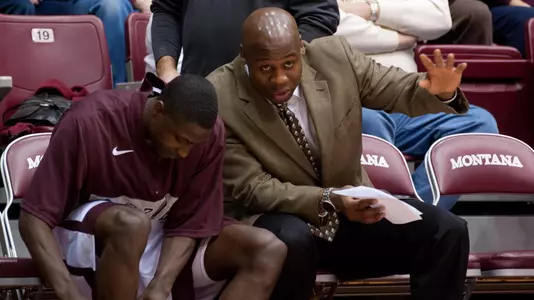
MADISON, Wis. — Less than two weeks after Freddie Owens was named to Will Ryan's basketball staff at Green Bay, one of Owens' closest friends in the coaching profession, Sharif Chambliss, was recognized as the top assistant in the Horizon League at Wright State.
Tanner Bronson couldn't have been happier with the fast-breaking news in July. Especially since it was a reminder of what he and others experienced as student-athletes in the Badger program and how those lessons learned, friendships and team-generated bonds have endured all these years later.
"The first thing that always sticks out is teammates, those relationships that you build and the people you're around," said Bronson, an assistant coach at Chattanooga. "There's a big group of us that are in contact and still talk very frequently and those relationships are strong to this day.
"There will always be a fraternity of Badgers. You're always pulling for people that you know are good people, especially from your group. To see Freddie get back to the state and Sharif get that recognition, it makes me happy to see them getting into spots that they feel good about.
"It's like we all get a win when one of us gets a win."

The wins have been adding up for more than a dozen former UW players in the coaching ranks — ranging from the Minnesota Timberwolves (Greg Stiemsma) to Madison College (Roy Boone) and from 2019 NCAA champion Virginia (Kirk Penney) to Division III University of St. Thomas (Tim Jarmusz).
It spans different Wisconsin coaching generations, too, from Steve Yoder's (Wingate University head coach Brian Good) to Stu Jackson's (UW assistant Howard Moore) to Dick Bennett's (Boone, Penney, Western Kentucky assistant Hennssy Auriantal and Georgia Tech assistant Julian Swartz).
And then, of course, there's the Bo Ryan alumni contingent from Wisconsin. Besides Joe Krabbenhoft and Alando Tucker, who are assistants on Greg Gard's staff, the list includes Owens, Chambliss, Bronson, Stiemsma, Penney, Jarmusz and IUPUI women's assistant coach Latrell Fleming.

Most of the former teammates have stayed in touched over the years.
"We have a pretty open communication and we talk quite a bit," said Bronson, who started off as student manager in 2003, made the team as a walk-on, earned a scholarship and graduated in consumer science in 2008. "It's the community part of Wisconsin that is so impressive and makes it so special."
Owens and Chambliss talk nearly every day.
"We've just been through a lot together," admitted Chambliss. "When you go through all those practices — and you spend most of your time practicing — along with all that time spent in the locker room after practice and late nights hanging out together, you'd better be around good people."
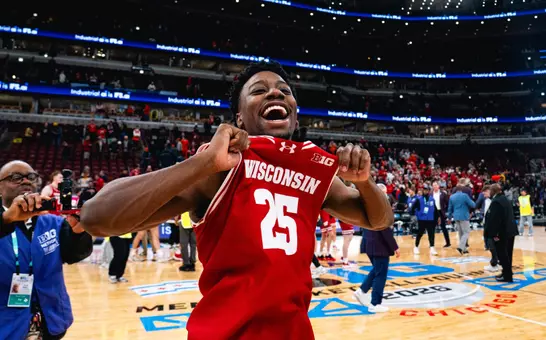
The implication? Owens (pictured at top) is good people. That was understood.
"Sharif and I have a unique relationship as well as I have with my other friends, Ike (Ukawuba) and Latrell," Owens said. "It's one of those deals where we talk a lot and go wherever the conversation takes us. It could be about a number of things. But it's not all basketball. It's about life in general."
Long after leaving the UW locker room, the players have sustained a locker room camaraderie.
"I feel like we're a big family," Fleming said. "Everybody stays in contact with each other."
A few months ago, Chambliss was driving to Florida with his family and stopped in Chattanooga to see Bronson who couldn't have been a more hospitable host to the degree that precautions were taken on their interaction given understandable concerns due to the coronavirus pandemic.
"He and his wife laid out all the toys in the yard for my two boys so the kids could just run around and get the energy out of them," Chambliss said. "Those are the stories on why you have relationships that people don't get. Our (former) teammates really look out for each other."
In April, Owens coordinated Zoom calls to link different eras of Wisconsin basketball.
"It's a credit to Coach Ryan … his coaching tree is pretty cool," Owens said. "I talk to Duffy Conroy (Louisiana Tech assistant), I talk to Rob Jeter (Western Illinois head coach) and I talk to Tony Bennett (Virginia head coach) every now and then. There are so many branches to this thing.
"And it's always interesting to find out who knows who. You're always one or two people removed from somebody. That's why your reputation as a person is everything. Words travels. If you're in this thing for the right reasons — to help student-athletes — then the opportunities are limitless."
• • • •
How did playing at Wisconsin influence their career path in coaching? What did they learn from their time on the Madison campus that still applies today? During the natural ebb and flow of the profession, what can they draw on from their Badger upbringing?
A lot, it would seem.
"What you kind of strive for as a coach is to find how you can create that environment where guys really like being around each other and they can forge friendships and they're driving towards a cause," said Bronson, who was passing along examples from the Bo Ryan model.
"Also, from a basketball and competitive standpoint and the way I was specifically treated at Wisconsin, I always felt was pretty unbelievable. At a lot of places, you have walk-ons that don't participate in certain drills or are just rebounders or don't do a lot of things.
"I was given a fair opportunity to compete every single day for minutes, a fair chance to take on extra responsibilities to be a part of what we were doing. That drove me as player to try and compete with players who were athletically better than I was and more talented than I was.
"So, I knew I had to bring it every day, right? And that helped those other guys because they knew that they had to bring it every day in order to stay ahead. Ultimately that competition in practice between us ended up creating a really good winning culture in our program.
"Good guys who are extremely competitive and now are life-long friends."
Bronson still clings to one of Ryan's foundational blocks in dealing with highs and lows.
"Coach Ryan constantly talked about being consistent," he said. "Taking every day and doing your best in that opportunity and then the next game is the one that matters. And it doesn't matter if it's an exhibition or you're playing Marquette or Duke in the national championship game.
"It's just on to the next game … You have to be solid in what you're doing and what you're about and who you are as a person ... I can't control if we have three guys injured in a year and we're expected to in the league and we finish seventh. You can't control those things.
"But you can control your preparation on a daily basis and what you expect out of your players … Everybody would describe Wisconsin teams from the last two decades as solid, 'They're so solid.' That lesson learned as a player in the program has really translated well to coaching.
"You've just got to be solid and then manage the ebbs and flows the best you can."
On coaching with Paris, he said, "He's solid in everything that he does which is reminiscent of Wisconsin in general … he knows what he wants to do, the system he wants to run, how he wants to do it, and the type of people that he wants to be around. He's been a great mentor and resource for me.
"We both go back to a lot of things we learned in Madison. As we're talking through some of the challenges with our own team — why things worked, why things maybe aren't working as well — it always comes back to the same thing. Being solid."
Bronson has been tracking his friends in the business.
On Jarmusz, "He has talked a lot about how much he likes it. It will be interesting to see what he ends up doing with coaching. He's very capable. If this is what he wants to do, he'd be very good at it."
On Stiemsma, "I had a chance to coach him in the D-League along with Joe (Krabbenhoft) and Kirk (Penney). He's always been a real smart player and understands the game at a high level."
On Penney, "Kirk is one of the best there is as far as people are concerned. And Tony (Bennett) is also that way, so it's a natural fit. He's a great addition to Tony's staff."
As it was, Owens was able to reconnect with Penney, among others, on the Zoom call.
"He logged on from New Zealand, it was very cool," he said. "A couple of those guys on the call I haven't talked to in a while and we were able to catch up and kind of give everybody an update on where everybody was in their lives. It was good to see everybody was doing well."

Meanwhile, the irony wasn't lost on Owens.
He's now assisting Will Ryan, the 42-year-old son of Bo Ryan.
And it was Bo Ryan who first planted the coaching seed with Owens.
"I always loved working with kids in summer camp at Wisconsin," Owens said. "Going into my senior year, I remember Coach Ryan saying to me that he could see me being a coach. I looked at him like he was crazy and thought, 'No way. Never.'
"I went and played in Europe and had a great experience. But coaching started coming to the forefront and when I was finished playing, I started thinking about it a lot more. So, I decided that I was going to move back (to the States) and give it a shot and see where it took me while still young.
"It is kind of funny: I played for Coach Ryan and here I am working with his son. Will is his own person. But he takes a lot from his dad. As he should. His dad is a Hall of Fame coach. All the basic things are the same as far as the beliefs and how Will goes about his business from a coaching standpoint."
Reflecting on his own beliefs and value system as a coach, Owens cited a lot of "life lessons" on and off the court from his UW playing days. At that, he's still best remembered for his game-winning three-pointer that capped a furious late rally against Tulsa in the 2003 NCAA tourney.
"When I came to college, I was exposed to a lot of different things that I wasn't used to which was a good thing and it's helped me up to this point in my life," said Owens, a Milwaukee native. "No matter where I go and what room I walk into, I'm going to be comfortable interacting and dealing with people from various backgrounds and races.
"I just look at my experiences, if it wasn't for the game of basketball, who knows where I would be. I was fortunate to have good parents and good mentors. But basketball has allowed me to travel the world and interact with people from different cultures. It helped me be a well-rounded person.
"When you go into it (coaching) you have to have an open mind and be willing to pretty much relocate wherever, whenever. It's just part of the deal. If you're not willing to do those things, it's going to be really hard for you to progress because you don't know where the opportunities are coming from.
"It doesn't matter how good you are as a coach or how much you think you may know, you just have to be able to deal with the ebb and flows because the more you can adapt to the better off you will be. Jobs are hard to come by … things can work in your favor or against you in a drop of the hat."
Nobody knows that better than Chambliss.
"They say you're not coaching until you get fired and we got fired after 20 wins at Milwaukee," said Chambliss, who was then a member of Jeter's coaching staff. "If you don't have thick skin, you'd better learn how to have it because you're not going to be in it (coaching) long otherwise."

That same spring (2016), Wright State's Scott Nagy hired Chambliss who was the top voter in a recent Stadium Sports poll ranking the top Horizon League assistants. Chambliss' ability to "foster relationships" was singled out along with his outgoing personality ("He has never met a stranger").
"It's not why I do what I do," Chambliss said of the individual recognition. "My thing has always been about relationships and trying to cultivate relationships. That's just bigger than basketball. When I have former players hit me up, they say, 'Coach, I see what you were saying now.'
"That's the biggest thing for me because at a certain point the air is going to come out of the ball for every kid you coach. There are a few things we are guaranteed. Did you serve and help people? Did you have meaningful relationships in those moments you knew would leaving lasting impressions?
"Just remember why you're coaching. It's not about you, it's about the kids."
Chambliss had an accelerated learning curve to Bo Ryan's methodology. After playing his first three seasons of college basketball at Penn State, the Racine, Wis., native elected to return to his home state for his final year of eligibility at Wisconsin. That necessitated sitting out a full season.
"One of the biggest learning experiences for me was when I was on the scout team," he said. "Basically, I was the captain of the scout team. I was the point guard, so I had to make sure I knew where everybody was and I had to know the other team's offense. I had to pay attention to the details.
"When you have a winning culture like Wisconsin does, those are things that are passed down through the system. You're always going to have walk-ons on the scout team. And you need everybody to win. That's big If they accept those roles to help the team get better and prepare."
If he were to share any advice with someone contemplating getting into coaching, he said, "You need to figure out why you want to be in the business. You need to have a mentor who's going to be honest with you and tell you the truth so you can figure out how to get stuff done."
As a UW freshman, Fleming, who had been recruited by Dick Bennet, had much to figure out after he was diagnosed with hypertrophic cardiomyopathy, a heart disorder that forced him to give up basketball. Ryan subsequently didn't hesitate to embrace him on his staff as a student assistant.
"Coach Ryan did an unbelievable job, he treated me like I averaged 30 points, he treated me like I was Devin Harris and I never touched the court for him," Fleming said. "We have a young lady here at IUPUI, who's a medical redshirt, like I was. And I've tried to make her feel special and appreciated."
On the former Badgers in coaching, he said, "Relationships are the most important thing. We talk to each other all the time. And nobody talks about the wins and losses. Instead, everybody talks about the experiences we had at Wisconsin, on the court and off the court."
There's another common thread running through Fleming, Owens, Chambliss, Bronson, et al.
Howard Moore, who's on a leave of absence from coaching.
On May 25, 2019, a car accident claimed Moore's wife Jennifer and their 9-year-old daughter Jaidyn. Moore survived the crash along with his 13-year old son Jerell.
"He stays in my prayers and thoughts constantly," Chambliss said.
"I bet I think about him every other day," Bronson said.
"You have to cherish every second of every day because you just never know," Owens said.
"You can't take life for granted, you have to live every day to the fullest," Fleming said.
Bronson began to choke up when Moore's name came up in the conversation.
"It's hard to even talk about," he said. "I've got a picture on my desk. It's of my wife and my two kids. And I have a Post-it note and it says 'Howard' and it's on their picture. It hit me so hard. He's such a good person and he would do anything for you.
"When I was struggling to get into coaching, he was at UIC (University of Illinois at Chicago) at the time. I had nothing. I called him up and asked him if I could just spend the day with him. He took time with me the entire day. He took me to lunch. I spent time with him in his office.
"He was just always there if you needed him."
As they climb the coaching ladder, it's something these former Badgers have tried to be for each other.