Lucas: Bortolini’s flexibility leads to permanent role
October 14, 2022 | Football, Mike Lucas
Sophomore has become fixture on Badgers’ offensive line
BY MIKE LUCAS
UWBadgers.com Senior Writer
MADISON, Wis. – As an undersized lineman from a small community on Lake Michigan and Division 5 high school, not known for producing D-1 prospects, Tanor Bortolini was honest about his intentions to play college football. "I never really thought that it was an actual possibility," he admitted.
To hear Bortolini talk about his formative years in the sport, you have a greater appreciation for his work ethic and perseverance. Especially given how far he has come. Today, he's one of the more valued and versatile pieces on Wisconsin's offensive line. He has career starts at four different spots.
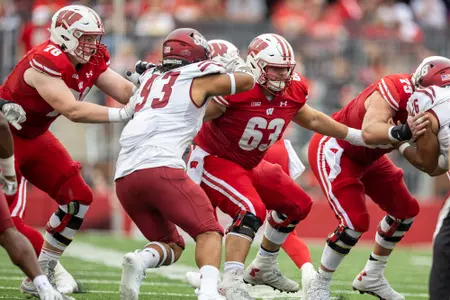
Last Saturday, for instance, he made his first start of the 2022 season at left guard, where he also started last season's Rutgers' game. His other two starts this year have been at right guard. As a freshman, he started once at center. Three of his five starts in 2021 were at right tackle.
For the record, he played left tackle as a prep. Flexibility has been an asset. Bortolini adapts.
Getting here was the challenge, though.
"When you come from a small town, I guess you don't know how good you are until someone tells you how good you are," said Bortolini, who's from Kewaunee (pop: 2,813), 25 miles from Green Bay. "Not a whole lot of guys from our area went D-1. it wasn't a very common thing to happen."
Not a lot went professional, either. Bortolini's grandparents might remember Stan Kuick, who played one season (1926) for the Milwaukee Badgers, a short-lived pro franchise. From a significantly more contemporary standpoint, Jack Novak and Colin Cochart have represented Kewaunee in the NFL.
In the '70s, Novak was a hard-nosed UW tight end. He went on to play for Cincinnati and Tampa Bay. Cochart, also a tight end, played at South Dakota State and with the Bengals and Cowboys (2011-12).
"No one since then," Bortolini sighed. "It's pretty much a rarity from where I'm from."
As an active teenager, he played whatever sport was in season. And there was plenty of overlap. "That was just how it was, I was running around doing stuff all the time," he said. "You're not just training for football … you're training for basketball, for track and field, for baseball."
Consistent with his jack-of-all-trades offensive line resume, Bortolini played "wherever we needed someone" on the diamond. Catcher. First base. Third base. It was during his junior year of high school that he switched over to track in the spring. By then, he was eyeing football as a path to a scholarship.
At the 2018 UW summer camp, he was advised to put on weight. He scaled about 240.
"I was going to football camps, seeing out it would go, and I ended up going to Iowa," said Bortolini, picking up the storyline. "Things were actually going pretty good. We had some one-on-ones, and I won my first one and I went to the back of the line and some other kid got in line.
"The defender was a guy who committed that day, and he just blows up this kid and drives him five yards back. I'm like, 'Whew, thank-God, I'm not that guy.' And the coach goes, 'Hey, Kewaunee, get up here.' I think, 'That's me. I've got to go against this guy who just smoked the other kid.'"
Suitably motivated, Bortolini said, "First play, I drive him back five yards. I go up and do it again. Same thing, I drive him back. Shoot, I'm thinking, that went really well. I got a tour of Iowa that day and that's when it hit me that this whole thing could become a possibility. Could become a reality for me."
Tim Polasek, then an Iowa coach, told him the same thing that Joe Rudolph had told him at Wisconsin. "If you get bigger,' he said, 'we'd definitely look at you,'" Bortolini recalled. "From that point on, I was lifting a lot more, bulking up and paying attention to what I ate a lot more.
"In six or seven months, I went up by about 30 pounds. I felt faster, I felt stronger. It wasn't like it was bad weight. Obviously, it's not all going to be muscle. But I felt I was doing a good job of packing it on and eating lean enough so that it was quality weight."
Bortolini summarily attracted recruiting offers from Air Force, the MAC and some Ivy League schools. Among Power 5 programs, Iowa, Wisconsin, Syracuse and Miami expressed interest. The 'Canes O-line coach, Butch Barry, was from Sturgeon Bay, which is how Bortolini got on his radar.
Ultimately, the Badgers won out. Bortolini was the fifth offensive lineman taken in the 2020 class joining Jack Nelson, Trey Wedig, Dylan Barrett and Ben Barten (who has since moved over to the defensive line). "I loved the coaches, I loved the players, I loved the whole campus here," he said.
Bortolini loved being mobile, too. "I feel like my athleticism was always one of my attributes," he said. "Coming in here, I knew I wasn't quite as heavy, I wasn't quite as big, I wasn't quite as strong as some of the other guys. But I felt like I was faster. I could get to spots quicker."
It was his mobility that had some college recruiters projecting Bortolini for defense.
"I liked defense, I played a little bit of everything – I played stand-up outside linebacker sometimes, I played a little press corner, I played everything but safety in high school," said Bortolini who was immediately questioned on having "played a little press corner" at Kewaunee. Really?
"We had a special game plan for Derik LeCaptain," he said of the former Southern Door star (who ended up at Minnesota). "I shadowed him the whole game. Wherever he went, I went. So, when he went out as a receiver, I pressed on him. I had a little help over the top. It was fun. I really liked it.
"You put your best on their best. And go from there. I was the best athlete."
Until he wasn't. Bortolini had a painful flashback to his first training camp with the Badgers.
"I remember it was one of our first days in camp and I had to go against Matt Henningsen," he said. "All I had to do was cut him off. I did it a thousand times in high school and never failed. But I just remember getting smoked by him. It's that kind of adjustment that you learn from.
"You pick up tips from the guys around you – who mentor you, who show you the ins and out. And you learn that football is more detailed than you thought it was in high school. There's definitely a transition period where you go from being the biggest, strongest, fastest guy on the field to one of 22."
Rehabbing from an injury constitutes another transition period. During training camp, Bortolini injured his knee and missed the first two games of the season. "I heard a pop," he recalled. "That's always a scary thing. You hear a pop in your knee and there are never many good outcomes to that.
"When I found out it was my meniscus, I was ecstatic. My first thought was, 'What if I just tore my ACL? Now I'm not going to play this season, I'm not going to be back until next summer, the rehab process is going to be brutal.' It's scary when you think about it that way. I was really fortunate."
Bortolini saw his first action of 2022 in Game 3 against New Mexico State. "I was a little rusty," he said. "There's a lot of missed time in there where you haven't done any footwork and you're just getting back to the reactions – if this happens, you have to make this adjustment on this play."
Bortolini and Trey Wedig were subbed into the game at right guard and tackle, respectively. "At the beginning of fall camp, Trey was working at guard, and I was working at center, so we were playing next to each other then and he was just kicked down a spot to tackle, and I was at guard," Bortolini said.
Since then, Wedig has become a fixture at right tackle. At Northwestern, Bortolini started at left guard for the injured Tyler Beach, who was on the trip and took snaps during the pregame warmup. A lack of continuity has characterized the offensive line throughout the first six weeks of the season.
It has made it more difficult to jell as a unit. But what does that mean? Jell? Or jelling?
"It's when everybody knows what to do, everybody knows what to expect from the guy next to him to where, 'I trust him to do this, this, this,'" Bortolini said. "The guy next to you is going to do their job. You're going to do your job. Everyone is helping each other succeed. We're getting close to that."
How close? The next phase in that discovery will be Saturday at Michigan State.
UWBadgers.com Senior Writer
MADISON, Wis. – As an undersized lineman from a small community on Lake Michigan and Division 5 high school, not known for producing D-1 prospects, Tanor Bortolini was honest about his intentions to play college football. "I never really thought that it was an actual possibility," he admitted.
To hear Bortolini talk about his formative years in the sport, you have a greater appreciation for his work ethic and perseverance. Especially given how far he has come. Today, he's one of the more valued and versatile pieces on Wisconsin's offensive line. He has career starts at four different spots.
Last Saturday, for instance, he made his first start of the 2022 season at left guard, where he also started last season's Rutgers' game. His other two starts this year have been at right guard. As a freshman, he started once at center. Three of his five starts in 2021 were at right tackle.
For the record, he played left tackle as a prep. Flexibility has been an asset. Bortolini adapts.
Getting here was the challenge, though.
"When you come from a small town, I guess you don't know how good you are until someone tells you how good you are," said Bortolini, who's from Kewaunee (pop: 2,813), 25 miles from Green Bay. "Not a whole lot of guys from our area went D-1. it wasn't a very common thing to happen."
Not a lot went professional, either. Bortolini's grandparents might remember Stan Kuick, who played one season (1926) for the Milwaukee Badgers, a short-lived pro franchise. From a significantly more contemporary standpoint, Jack Novak and Colin Cochart have represented Kewaunee in the NFL.
In the '70s, Novak was a hard-nosed UW tight end. He went on to play for Cincinnati and Tampa Bay. Cochart, also a tight end, played at South Dakota State and with the Bengals and Cowboys (2011-12).
"No one since then," Bortolini sighed. "It's pretty much a rarity from where I'm from."
As an active teenager, he played whatever sport was in season. And there was plenty of overlap. "That was just how it was, I was running around doing stuff all the time," he said. "You're not just training for football … you're training for basketball, for track and field, for baseball."
Consistent with his jack-of-all-trades offensive line resume, Bortolini played "wherever we needed someone" on the diamond. Catcher. First base. Third base. It was during his junior year of high school that he switched over to track in the spring. By then, he was eyeing football as a path to a scholarship.
At the 2018 UW summer camp, he was advised to put on weight. He scaled about 240.
"I was going to football camps, seeing out it would go, and I ended up going to Iowa," said Bortolini, picking up the storyline. "Things were actually going pretty good. We had some one-on-ones, and I won my first one and I went to the back of the line and some other kid got in line.
"The defender was a guy who committed that day, and he just blows up this kid and drives him five yards back. I'm like, 'Whew, thank-God, I'm not that guy.' And the coach goes, 'Hey, Kewaunee, get up here.' I think, 'That's me. I've got to go against this guy who just smoked the other kid.'"
Suitably motivated, Bortolini said, "First play, I drive him back five yards. I go up and do it again. Same thing, I drive him back. Shoot, I'm thinking, that went really well. I got a tour of Iowa that day and that's when it hit me that this whole thing could become a possibility. Could become a reality for me."
Tim Polasek, then an Iowa coach, told him the same thing that Joe Rudolph had told him at Wisconsin. "If you get bigger,' he said, 'we'd definitely look at you,'" Bortolini recalled. "From that point on, I was lifting a lot more, bulking up and paying attention to what I ate a lot more.
"In six or seven months, I went up by about 30 pounds. I felt faster, I felt stronger. It wasn't like it was bad weight. Obviously, it's not all going to be muscle. But I felt I was doing a good job of packing it on and eating lean enough so that it was quality weight."
Bortolini summarily attracted recruiting offers from Air Force, the MAC and some Ivy League schools. Among Power 5 programs, Iowa, Wisconsin, Syracuse and Miami expressed interest. The 'Canes O-line coach, Butch Barry, was from Sturgeon Bay, which is how Bortolini got on his radar.
Ultimately, the Badgers won out. Bortolini was the fifth offensive lineman taken in the 2020 class joining Jack Nelson, Trey Wedig, Dylan Barrett and Ben Barten (who has since moved over to the defensive line). "I loved the coaches, I loved the players, I loved the whole campus here," he said.
Bortolini loved being mobile, too. "I feel like my athleticism was always one of my attributes," he said. "Coming in here, I knew I wasn't quite as heavy, I wasn't quite as big, I wasn't quite as strong as some of the other guys. But I felt like I was faster. I could get to spots quicker."
It was his mobility that had some college recruiters projecting Bortolini for defense.
"I liked defense, I played a little bit of everything – I played stand-up outside linebacker sometimes, I played a little press corner, I played everything but safety in high school," said Bortolini who was immediately questioned on having "played a little press corner" at Kewaunee. Really?
"We had a special game plan for Derik LeCaptain," he said of the former Southern Door star (who ended up at Minnesota). "I shadowed him the whole game. Wherever he went, I went. So, when he went out as a receiver, I pressed on him. I had a little help over the top. It was fun. I really liked it.
"You put your best on their best. And go from there. I was the best athlete."
Until he wasn't. Bortolini had a painful flashback to his first training camp with the Badgers.
"I remember it was one of our first days in camp and I had to go against Matt Henningsen," he said. "All I had to do was cut him off. I did it a thousand times in high school and never failed. But I just remember getting smoked by him. It's that kind of adjustment that you learn from.
"You pick up tips from the guys around you – who mentor you, who show you the ins and out. And you learn that football is more detailed than you thought it was in high school. There's definitely a transition period where you go from being the biggest, strongest, fastest guy on the field to one of 22."
Rehabbing from an injury constitutes another transition period. During training camp, Bortolini injured his knee and missed the first two games of the season. "I heard a pop," he recalled. "That's always a scary thing. You hear a pop in your knee and there are never many good outcomes to that.
"When I found out it was my meniscus, I was ecstatic. My first thought was, 'What if I just tore my ACL? Now I'm not going to play this season, I'm not going to be back until next summer, the rehab process is going to be brutal.' It's scary when you think about it that way. I was really fortunate."
Bortolini saw his first action of 2022 in Game 3 against New Mexico State. "I was a little rusty," he said. "There's a lot of missed time in there where you haven't done any footwork and you're just getting back to the reactions – if this happens, you have to make this adjustment on this play."
Bortolini and Trey Wedig were subbed into the game at right guard and tackle, respectively. "At the beginning of fall camp, Trey was working at guard, and I was working at center, so we were playing next to each other then and he was just kicked down a spot to tackle, and I was at guard," Bortolini said.
Since then, Wedig has become a fixture at right tackle. At Northwestern, Bortolini started at left guard for the injured Tyler Beach, who was on the trip and took snaps during the pregame warmup. A lack of continuity has characterized the offensive line throughout the first six weeks of the season.
It has made it more difficult to jell as a unit. But what does that mean? Jell? Or jelling?
"It's when everybody knows what to do, everybody knows what to expect from the guy next to him to where, 'I trust him to do this, this, this,'" Bortolini said. "The guy next to you is going to do their job. You're going to do your job. Everyone is helping each other succeed. We're getting close to that."
How close? The next phase in that discovery will be Saturday at Michigan State.
Players Mentioned
OL
/ Football
DE
/ Football
OL
/ Football
OL
/ Football
DE
/ Football
OL
/ Football
OL
/ FootballMonday, May 04
Thursday, April 30
Saturday, April 25
Friday, April 24