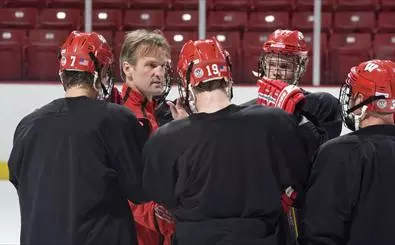
Osiecki makes media appearance
November 24, 2008 | Men's Hockey
Wisconsin men's hockey assistant coach Mark Oseicki appeared at the Kohl Center for the UW's weekly Monday news conference, filling in for Head Coach Mike Eaves. A full transcript follows.
To view the archived video footage of the news conference, mid=2767"> --> click here .
QUESTION #1: Mark, you've had all these road games, now you get a big stretch at home. Do you feel like this is a stretch where your team can really establish itself and start climbing back up the rankings a little bit'
MARK OSIECKI: Yeah. We were just talking about it this morning, and it's interesting, you know, to say before Thanksgiving that you only have three more road trips left is pretty incredible. But I think the best thing that we've had is to go on the road and play some tough opponents in tough situations.
Really, it's an opportunity for a team to come together and spend a lot of quality time together, whether it's good, bad, indifferent, and have to fight through some of the situations that we've fought through. So now coming home, I think that it's an opportunity for us not only to be at the Kohl Center and play in front of our fans, but also to be able to spend a little bit more time in your bed and familiar surroundings. And I think that's going to be something that I think towards the end of the year is going to help us out.
QUESTION #2: Mark, between, I know the season isn't even half over yet, but your penalty killing numbers are almost off the charts, especially compared to last year. What's been the biggest difference'
OSIECKI: Well, I think a little bit is, you hate to say it, but sometimes it's the bounce of a puck. You watch that game on Saturday night against St. Cloud, and they had some opportunities and it just didn't bounce right for them. So sometimes it's the bounce of a puck. But I'd like to think that it's more of our effort and work ethic, and putting our mind to it.
We've taken a lot of time during practice, grabbed a core group of players, and have stuck with them, and trying to get guys on the power play and some guys on the penalty kill. A few guys do both. Obviously, all the defensemen, for the most part, do a little bit of both. But it's been something that's been a focus starting this summer, and I think it's paying off right now.
I think our goaltenders, in terms of their focus towards the penalty kill, have really helped. Knowing what the situation is and being on the same page, I think that's been fun to be a part of. I think that both the defensemen and the goaltenders are on that same page in terms of what are we doing will the kill, and they're buying into it.
QUESTION #3: How important was it for you as coaches to see this relatively young team show the mental toughness to bounce back from a tough loss on Friday'
OSIECKI: It was obviously very important, because Friday night was not one of our better performances. After that first period on Friday night, we actually felt like we played pretty well in the first period, but then the second and third got away from us. And you just didn't feel like we left our best effort on the ice on Friday night.
But to be able to turn around. We didn't have to say too much to the players, other than, if you're going to work for each other and play hard for one another, so when you come back in the locker room you can sit down and look on the left and the right of you, and you feel good, you're not going to feel like I'm leaving my teammate down. And I don't think any one guy would be able to do that on Friday night, but Saturday night was a different story. And I think everyone came in, they could look around the room and feel good about their effort.
QUESTION #4: Getting back to the penalty kill, what are the primary teaching points for a good one' You oversee this unit and, as I said, the numbers are pretty amazing at this point. What things do you focus in on during a week like this with Michigan State and Michigan coming in'
OSIECKI: Well, it's interesting. You come into this weekend, and a couple of opponents that you don't see, obviously you can get some video on. You have a different opponent Friday and Saturday night, which is going to be something different for a young team, that we're not used to that.
But our keys, for the most part, are forecheck, something that we can control and somewhat dictate to the other team. They go through their power-play breakout, and it might a little bit different, but our forecheck doesn't change too much on what we're trying to do. And then once we get into the defensive zone, we do a couple things there that we really focus on, and we can be very aggressive in certain areas. And those two aspects are something that if, you know, you're around, you see us working on that. It's something that we do and really talk about a lot, that we can control those two things.
I think the third element then is just how hard and what are you going to do in a penalty kill situation. If someone is shooting, are you going to get in that shooting lane and block a puck or get a stick on a puck' If you're not going to do those sort of things, you can't be on the penalty kill.
QUESTION #5: I know some penalties you'll accept because they away scoring chances, but there's been seven too many men penalties, and I know that's something that kind of nags you after a while that it keeps happening. Is there anything you guys do or plan to do or harp on to try and get guys to change lines, you know, in the right manner when they got, when you know there's a guy right there kind of looking at you now knowing that you guys have been called for that'
OSIECKI: Well, it's a frustrating thing from a coaching standpoint, because it's something that we talk about on a daily, if not, well, a weekly basis if not a daily basis. And so those situations that have happened, certain circumstances that have arose from that, but it's something that's very frustrating from a coaching staff, because we do talk about it nonstop.
But you know, I think Coach Eaves made a mention of it the other night that if we continue to have those situations, the guys are going to sit out. They're not going to play, because you can't afford to move forwards, and as we're getting better in terms of our team play, you can't afford to have penalties like that. Those are mental lapses by our players, not knowing what the situation is, and who are you taking as they come off the ice.
QUESTION #6: Mark, after kind of a slow start to the season, you guys have only lost once now in your last seven. I mean is it just looking at who you've played, is it just the opponents that you're playing, or is this team, you know, starting to really gel together '
OSIECKI: Well, I think they're gelling. I think it's more of a confidence thing than anything. Obviously you're going to gel as a team as the season goes along. That's any program, any team kind of concept. But you know, if you look at our first four to six games, there are games, out of six games, there was three games that could have gone either way. We played well enough in some of those games that they could have gone either way.
So now all of a sudden you're in those situations, is there a lack of confidence. I think now that you're in a situation where it's a 1-0 game against St. Cloud, in their barn killing a penalty off with four minutes left, and there's confidence. I think the first or second game of the year, I don't think we had that confidence and the young players are trying to figure that out. Our older guys are trying to be leaders in a situation like that, and that's something that takes time. And unfortunately, we had to go through some of the growing pains being on the road in tough situations, but I certainly think that has helped our confidence. And you saw it Saturday night in a 1-0 game in a tough environment, and arguably one of the better power plays in the league, and we did a pretty good job doing that.
QUESTION #7: It's kind of a Catch-22 with your penalty kill that you're getting a lot of practice. How much . . .
OSIECKI: You mean in practice or in the game'
QUESTION #7: In games. But seriously, that probably factors into this in an odd way, correct'
OSIECKI: It does. Unfortunately you take a lot of penalties or you have to kill off a lot of different situations, that you are going to get confidence. You can work on it all you want in practice, but it's really game time that is going to matter, and situations where you can't prepare for in a practice. If somebody is winding up and has some time and space, is someone going to get in the shooting lane and block it' In practice, you may not see that. There's only a few guys that are going to do that. In a game, most of the guys are going to lay their life in the line of that puck.
So, yeah, to answer your question, unfortunately we've had probably too much of a situation where we're killing penalties, but it's definitely helped us.
QUESTION #8: Jake Gardiner had a bunch of different guys next to him, Ryan Little, Eric Springer, Craig Johnson this last weekend. How has he handled that' I mean, I'd imagine you'd like to have something where you'd be able to, especially with a freshman, build some stability. How has he been able to maybe to use that and play off of that '
OSIECKI: Well obviously, he's handled it pretty well. I think Jake is a confident player, a confident person. I think any top-level player has to have some sort of self-confidence, and to an extent it's almost over self-confidence. Jake certainly has that. Jake's been very coachable.
We've talked about the situation that he's going to be in in terms of giving him the right amount of time, and certain times we're going to put him on the ice where he's going to have success. You don't want to put him out there, especially early in the season, where he's going to struggle, flounder, and all of a sudden his confidence is gone. That's the one thing you don't want to take away from a kid like that, to lose his confidence. And the best thing that Jake's been able to do is, not matter who he plays with, you rotate him in, in and out, different players, power play penalty kill, he's handled it. But I think that speaks to his character and his ability to understand the situation, but also being very coachable.
QUESTION #9: Do you think your young defensemen took a step forward on Saturday night with just how disruptive they were to an offense as good as St. Cloud's'
OSIECKI: Well, yeah. Defense as a team defense, not just our, not our defensive core. I think it was more of a team defense than our defensive core. Our defensive core, in terms of our defensemen, they played pretty well on Friday night, if you watch the film. I go away thinking, well, they played awful. You go back and watch the film, well, it wasn't so much just the six guys that were in the lineup, you know, it's a group of five that's on the ice, and then a sixth with a goaltender.
I think on Saturday night it was more of a team defense, how hard our forwards are coming back to disrupt things. Are we taking care of the puck' Our defensemen, I think, on Saturday night where we got, when we were down, our defensemen were thinking, well, we got to score some goals to try to turn this around. We have the capability of doing that with Brendan Smith or Ryan McDonagh and Jake Gardiner and Jamie McBain and so forth. But, you know, all of a sudden, they were taking chances that caused us to give up a breakaway or a 2-on-0.
I think on Friday night they were playing a little bit more within themselves, understanding the situation a little bit more calm, and provided offense as a secondary offense rather than trying to lead the rush.
QUESTION #10: Mark, Shane's performance on Saturday, that was important for him, no doubt. How important was it'
OSIECKI: I don't think he knows how important, to be honest with you, because I think this was somewhat, it could have been a make-or-break game for him. His performance on Friday probably was below par, and us putting him back in was extremely important for him to go in. He did not have to pitch a shutout for us to think, or his teammates to think, that he's the guy, but he had to do it for himself and his own confidence.
And I think we wanted to put him back in that situation. I think he handled it pretty well, obviously very well. But our players played extremely well in front of him, and I think that speaks volume of our team.
QUESTION #11: One of the things that was floated in the NHL, and they talked about it a little bit for this, for the college level, is not allowing you to leave your feet to block shots. As someone who did that a lot in college'
OSIECKI: Yeah, I'm not a big fan.
QUESTION #11: You're not a big fan.
OSIECKI: I guess you'd have to define that. Now you're teaching guys to go down on one knee. So they are maintaining one skate on the ice, so if someone, like a Mark Johnson is going fake a shot, can I react. I know as a player, I always went down, and you leave your feet. Now a guy fakes it, he's going to walk you and go score a goal.
So, you know, what's that definition' If it is a guy going down on one knee trying to block a shot, but can he react because he has one blade on the ice' Are they going to allow that or disallow it' If that's the case, fine, I'm in favor of it. If you have to leave your feet to block a shot, I'm in favor of it. But if it's to block any shot by going down on one knee, I'm not in favor of it.