Together Apart: Academic staff adapt to provide real support for virtual studies
April 30, 2020 | Football, Mike Lucas
Advisors, learning specialists commend players for commitment to classwork despite challenging circumstances
 |
||
|
BY MIKE LUCAS
UWBadgers.com Senior Writer
MADISON, Wis. — Near the end of Wisconsin football practices, spring and fall, Danielle Straw will usually show up on the sidelines and greet some of the players on their way off the field.
As a UW learning specialist, Straw's intention is to keep open the lines of communication and answer any questions that some of them may have before heading to classes that day.
The messaging hasn't changed. But, logistically, everything else has.
"I'm still seeing their faces," Straw acknowledged, "but it's different."
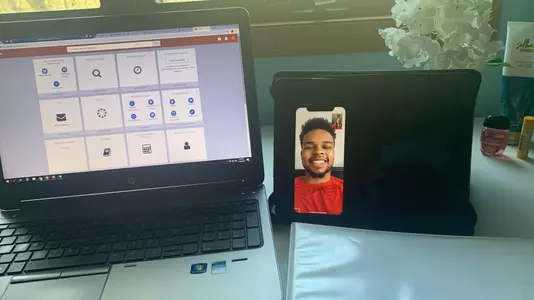
Different because FaceTime has replaced any personal interaction on an all but empty campus. Straw's living at home in Janesville, Wisconsin. Her students are spread out across multiple time zones.
Different because UW has suspended in-person instruction and moved all classes online.
Different because the daily routine has been interrupted due to the coronavirus pandemic.

"We're living in a history book," proposed Dan Rohrer, the assistant athletic director for academic services at Wisconsin. "This is unprecedented. Nobody has ever gone through anything quite like this before, so there's no playbook on how to do this."
Resiliency today is expressed through adaptability in the face of a health crisis.
"More than anything else," Rohrer went on, "I've been inspired by how well the students have responded and I'm encouraged on how well I think we'll be doing at the end of the semester with regard to how they complete their classes.
"The biggest concern we had when all of this happened was losing touch with them and them losing the ability to complete classes or even losing the interest to complete classes. And that really hasn't happened. They've taken on the challenge to finish out and do really well.
"I believe professors have been extremely accommodating and flexible in what they've been asked to do on campus. And I think it has been a good matchup — the students and the professors — working together to end up in a good place at the end of all of this."
Two weeks into March, after the students left for spring break, there was a new norm.
"Obviously, all of this happened really quickly just like everything with regard to COVID-19," Rohrer said. "So, we worked really hard at the onset to come up with a plan on how to transition literally all of our services into virtual services.
"A lot of what we do — at the time — we thought was important to do face-to-face.
"And we were having to learn how to do it a different way."
Necessitating guidelines and guardrails in transitioning their advising, tutoring and mentoring.
"So far, I would say it has gone exceptionally well," Rohrer said. "We've had staff members who have bought in and students who have bought in — in that they are willing to adjust and adapt and figure out how best to get through this together."
A "one size fits all" mentality or approach was not practical or applicable.
Not in combination with what people are balancing in their everyday lives at home.
"We have people of varying ages and it's just a different challenge for every single person," Rohrer said. "And yet the thing that has united us and pushed us forward is having a purpose — and that purpose is serving our students because we know that they're in the same position that we are.
"Yet our job is to help them. That gives us purpose every day to do what we need to do."
• • • •
The UW football program has two academic advisors (Shawn Wagner and Jared Storrer) and three learning specialists, including Straw, who works exclusively with the sport; Jay Bradbury, who also has men's and women's cross country and track and field; and David Cunningham, who also has men's and women's golf and tennis.
All three have the same "team" objectives — in Straw's words — and that is to specialize in helping with study skills/strategies, time management, organization, reading/comprehension skills and so on. Straw, Bradbury and Cunningham are each working with between 10 and 16 student-athletes. For instance, Straw currently has 16 football players; a number that changes from semester to semester.
"We might work with a student for the first couple of years and, then, not after that. Some we may have their whole career," Straw explained. "If everybody is on campus, I'm seeing these guys, some of them daily, coming out from practice; so I constantly know what's going on and we can sit down and look at something together, if I'm not understanding what needs to be done in the class."
When classes resumed online after spring break, Straw said, "It was almost like we had to restart the semester because every class is not running the same way. Some professors are doing a lecture where the students have to get online at that time and watch live. In other classes, they post a lecture and the students just do it at their leisure …
"We've had to do a lot of communicating within our staff."
The full academic services staff, 17 strong, have a virtual meeting on Wednesdays.
"The five of us who work with football will talk multiple times during the week and FaceTime," said Straw. "Mondays are heaviest for me, I do 10 FaceTimes with students, right in the row, because I like to see everybody between Monday and Tuesday … Every meeting is different. Every single time that we check in, we'll check on what they've accomplished and what they have left to do in the week."
Since the players are scattered throughout the country, Straw has to be conscious of time zones — "What time is that for you? I always ask them. What time do you have to turn that in?" — while building habits and establishing a routine for the players who are also training on their own at home.
"They're having to fit a lot of stuff into their day," she said, "even though they're not on campus."
At the end of the semester, because of the mitigating circumstances, students will have the option to change letter grades to pass/fail. Finals week begins Sunday.
"Our students are no different than anybody else," Rohrer said, "and they have varying circumstances that are affecting their abilities to complete the classes the way they would have otherwise. We will be intentional and strategic with each and every one of our students on how to navigate the pass-fail situation.
"They have the same graduation requirement as any other student.
"But we have the extra layer of NCAA eligibility that we'll be cognizant of."
The latter falls into the wheelhouse of academic advisors like Storrer and Wagner.
They split the roster in half.
"We're aware of NCAA benchmarks each semester and each year," said Wagner, who expanded on his job description. "If I were to compare an advisor versus a learning specialist, the advisor might be a little more big picture in a way. We're helping declare a major, certificates or minors.
"We're trying to keep the plan that they have in place to graduate and kind of get them on that track. We're working with people on campus to get them on that path. Learning specialists are a little more intensive on the day-to-day. They have a lot more of the day-to-day grind if you will."
Straw agreed that advisors are more into planning for the future and kind of mapping out the whole thing, while offering, "We're very focused on the right now. What classes are you in, right now? What assignments do you have going, right now? What do you need help with, right now?"
If it sounds more personal, it is.
"I see some of these students we work with every day of the week when we're on campus," Straw said. "It's a lot of school, a lot of life conversations. Getting my guys to answer FaceTimes and work with me has not been an issue because I do think I have a really good relationship with them."
Wagner has had many of the same conversations. He's picked up on some things, too.
"I think we've seen a little bit of burnout in terms of screen burnout having to look at computer screens, their phones, their emails all day," he said. "Even when we're FaceTiming to talk and check in, they're still on their phones. They see it and, as academic people, we see it, too."
Part of the transition has been to the logistics involving summer school and fall enrollment.
"Right when all of this virus stuff began, it was right during our class advising and registration for the summer and fall," Wagner said. "Typically, we would have one-on-one student meetings and maybe at least one or two different meetings to talk about classes and put them in their shopping carts and get them ready to enroll.
"We didn't get that opportunity to have that this year.
"Things are always changing, too. We've already enrolled for classes in the summer. Obviously, we update with the coronavirus, we're always monitoring for any changes or adjustments that we have to make. It makes it interesting planning for fall classes because a lot of the classes we're taking in the summer are now preparing them for prerequisites for fall classes. It's definitely a challenge.
"Looking ahead to our newcomers who are coming in this summer, their first adjustment in taking classes will be online, which I don't know if we've ever had before. It's a new adjustment for everyone at the university. But a lot of innovative ideas are coming out of it, too."
Rohrer was pragmatic.
"I don't know that we could have predicted how this spring would have gone and I don't know how to predict how the summer will go," he said. "At least in the spring, we have students who know what it's like to be in college. In the summer, we have high school students who will be taking classes and they don't know what it's like to be in college yet.
"We're working really hard at this point to figure out how best to orient them to what they have not experienced yet and, honestly, what we don't know yet. It will be a different environment this summer than we've ever had before."
Meanwhile, Wagner identified another ongoing challenge, the "Groundhog Day" syndrome.
"I was talking with one student, in particular, and he said the biggest thing was trying to keep his own individual focus on school because the deadlines can approach and every day kind of feels the same," Wagner said.
"For them, it's about trying to keep some sense of the normal structure and routine. I know with our advisor check-ins and our learning specialist calls; we try to keep a normal time each week so that's a little bit of normality for them. But it has been a transition."
And an adjustment period for everyone. From what was … to what is.
"It's hard not being in my office," Straw said, "not having them come in, laugh, smile, hug."
She still sees their faces on video chats. It's different, but she's adjusting.
"I'm doing student FaceTimes," she said, "all day, every day and even into the night, too."
It's just part of doing the job nowadays.
"I love my job," she confided, "because I love working with the students."
Making her no different than any of the other learning specialists and advisors. Or Rohrer, who concluded, "We feel really good it's going in a positive direction academically."