Together Apart: Human connections help Rudolph and O-line see big picture
May 18, 2020 | Football, Mike Lucas
Keeping teammates engaged outside virtual meeting rooms, Badgers aim to build real camaraderie
 |
||
|
BY MIKE LUCAS
UWBadgers.com Senior Writer
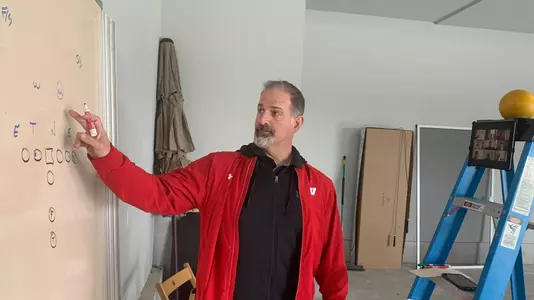
MADISON, Wis. — By hanging a large dry erase board and positioning his iPad on a step ladder across from it, Wisconsin offensive coordinator Joe Rudolph has accessorized his garage to create a remote teaching environment to best replicate his O-line meeting room at Camp Randall Stadium.
"It's just like you're standing in the front of the room and coaching in your meeting," marveled Rudolph, who connects with his linemen via video conferencing. Also in the picture, literally, is graduate assistant coach Micah Kapoi, a former UW offensive guard.
"The number one thing is setting direction for your position players," Rudolph went on. "There are so many guys to hit when you have to hit them remotely. Anyone who has worked on remote meetings has realized pretty quickly the limitations in the volume of people that you have.
"Sometimes you have me and Micah and 15 to 17 guys on a call. But when you call someone out and they speak the answer, everyone hears them. It's been pretty good. You get used to the format a little bit. Right now, they're probably pretty darn comfortable in that learning aspect."

The teachers are getting to that point, too, in their virtual classrooms.
"The position coaches have been awesome and Coach (Paul) Chryst has done an amazing job of bringing everyone together in meetings and talking about how guys are doing," Rudolph said.
On top of two video meetings with the entire offensive line each week, Rudolph also has individual sessions with the centers, guards and tackles. "I get in front of them in different ways," he said. "I call them each once a week and they get a video message or picture every morning."
Everything is predicated on keeping open the line of communication. Together apart.
"Positionally," he said, "it started off where I would send them my daily schedule. Then they'd all send their daily schedules to a group chat. 'When are you getting up? When are you getting your academics in? When are you doing your workouts?'
"If you have a plan of attack and a vision of where you want to get to, you've got a good shot to have a good day."
Rudolph has seen benefits from the staff collaboration, a show-and-tell, if you will, of what each assistant is doing. Maybe outside linebackers coach Bobby April is engaging his players a certain way. Maybe inside linebackers coach Bob Bostad is doing something different, but getting positive feedback.
"Guys have been sharing different things," Rudolph said. "And every guy has had something to where it's like, 'Oh, that's pretty cool. I'm going to try it.' Coach (John) Settle and Coach (Mickey) Turner were talking about having the guys in their position groups reaching out to different position groups."
Rudolph liked the idea so much — "It's amazing how resourceful the guys (assistants) are sharing things from their journeys" — that he adopted it for his offensive linemen. "They will call different players on offense one week," he said. "The next week, they will call different players on defense."
In such an exchange, he has been banking on the players learning from each other.
"I had them take a picture of where they were studying, where their academic setup was," Rudolph said. "And I had them take a picture of their (conditioning) equipment and where they were doing their weightlifting. It's amazing how many guys spurred an idea.
"Boom, they put it out there and it inspires someone else.
"I told them to be imaginative in the different ways to do stuff."
It complements how strength and conditioning coach Ross Kolodziej has reached out.
"Coach K and the guys in the weight room have done a great job of communicating with the guys and sending them ideas," said Rudolph, who personally cited some examples of linemen splitting logs or pushing cars. "They've found ways to connect together and get things done.
"A lot of times when I'm connecting with them, it's as much to motivate them as it is to have that connection with them. I think they feel that about each other … they're also letting the group know that they're working and trying to motivate them at the same time."

Understandably, a virtual model has limitations. Especially for a position group like the O-line that relies on timing and reps — chemistry, continuity, cohesiveness — five reacting as one on the snap.
"The one thing you don't have is the actual repetitions," Rudolph acknowledged. "You're going to miss the muscle memory of the repetitions of going through stuff. Right now, virtual workouts aren't something that we're permitted to do.
"But what I can do, is we've had more time to meet. And in the meetings, what you can create is a better understanding for everyone. I would say as a group, it's probably as complete of an understanding as they've had because that's what they've had to work on.
"I can assign them drill work to do and they know those drills inside and out. I've got confidence they're doing the drills along with their workouts.
"But doing those drills in a reactionary sense, in a competitive sense, those will always be a little different. That's the only area where you feel, 'Okay, that's something we need to catch up on.'"
So much is out of their control. So much is unknown moving forward.
As a result, it would stand to reason that some of the strongest leaders have emerged.
"They have," confirmed Rudolph, a former UW team captain. "But what they've learned is that everyone can lead in different ways. For some guys, they may not be seen as a leader in the group, but there are guys on this team that they can lead.
"We've got older guys talking to younger guys on the O-line. And when they start reaching outside of the walls of the O-line room that excites me.
"That's when they're kind of seeing the whole picture. Those things can be powerful. There's definitely leadership emerging and it's not always 100 percent where you expected it. What this showed more than anything is that they all have the ability to lead."

Rudolph must replace three starters: unanimous All-America center Tyler Biadasz and guards Jason Erdmann and David Moorman. Cole Van Lanen and Logan Bruss are the returning starters at tackle. Meanwhile, Josh Seltzner, Kayden Lyles and Tyler Beach each have starting experience.
The lack of a spring practice may hurt some players more than others; potentially sophomore Michael Furtney and redshirt freshmen Logan Brown and Joe Tippmann. Everybody could have used the reps, but particularly the younger, inexperienced linemen.
But the calendar brings context. It's May, after all. The second semester just ended.
"You always want to have a snapshot back into what they would normally be doing," Rudolph agreed. "At this time, they would be taking off from campus and working out at home essentially for probably a three-week period before their summer (conditioning) would start around June 8 or so."
To this end, Rudolph doesn't feel like anything has to be ramped up more.
"I feel like we've got it ramped up pretty darn good," he said. "Coach Settle always writes on his board the one thing for that practice or for that week that you're going to get better at. We do that a lot with the O-line. Each guy has their one thing. Whether it be physically — maybe it's strength, maybe it's flexibility, maybe it's some technique.
"The idea is you can lock in on that one thing and kind of own something to make yourself better. Before you know it, some guys can make jumps."
John Schaefer, video coordinator for the UW football program, is responsible for the technical mechanics behind the messaging; he's the troubleshooter for the video conferencing.
"John has done a great job of helping us out remotely," Rudolph said.
As it is, everybody has a little bit different situation. How different?
"It's hard to know because I'm not allowed to go there," said Schaefer, breaking out into laugher. His living room couch is part of his workstation. "For a couple of them on FaceTime, I've seen their office setups. It's truly across-the-board very different how everyone is working."
Whereas Rudolph has converted his garage into an office, Schaefer said, "Pretty much every coach has a little different setup … for what works best for them at home. We tried to find out what all they needed to accomplish and the best way to do that. I've customized for every coach."
In sum, he has a greater appreciation for techs who operate solely over the phone.
"If we had issues before, we'd just go up to their office and walk through it there," he said. "Now it's a matter of having to go step-by-step with the coach in helping him try to figure out what he needs to do or trying to figure out what's going on if something is not working properly."
As you might expect, "Everyone's baseline of knowledge is different."
At the same time, he hasn't had any trouble getting players up to speed with the technology.
"Most of the athletes have actually been pretty good," he said. "They've really been tech-forward with their iPads. The biggest shift has been for the coaches who are used to working out of their office for 16 hours a day and now they don't have that option anymore."
As for the video conferencing, he added, "You can have one coach presenting and you can have as many attend as you want. For a lot of the stuff, it can be very effective for teaching overall concepts to the players."
Volunteered Rudolph, "When you get bigger and bigger with certain groups, you lose some of the detail … We haven't gotten to the point where we have 50 guys meeting. It has been a lot more productive with individual coaches detailing the work for each of their groups."
In this regard, reviewing the outcomes, Schaefer observed, "Hats off to the coaches because they're finding a way to keep the players engaged. I'm sure everyone can attest that it's hard to stay dialed in at different points as this has gone on."
But he has witnessed how the assistants have "kept these kids interested and interacting with each other" while building camaraderie without football in its truest form for players. "At least, you're together and communicating with each other," Schaefer said, "and just hanging out virtually."
Unity can be an integral building block, a starting point. Even remotely. Even in May.
"That's why I like the guys reaching out and connecting across the (meeting) rooms and those coaches reaching out and connecting across the position groups," Rudolph said. "Those things continue to bring you closer as a team and as a staff.
"We have a great group of coaches that really value student-athletes when it comes to character and work ethic. Those are the things that you lean on in a time like this. It's a great group to be around. But you challenge them in areas that made them stand out to us to begin with.
"Those are the things that you keep stressing."