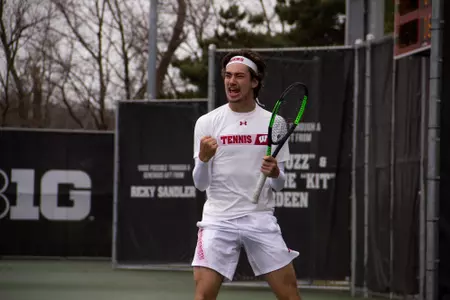
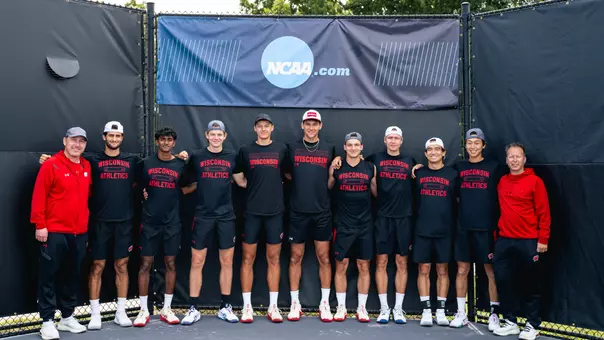
Photo by: Suvir Grover
Wisconsin’s backbone is as tough as they come
April 09, 2023 | Men's Tennis, Andy Baggot
Childhood scoliosis and constant back pain make Jared Pratt’s position at No. 1 singles all the more impressive
BY ANDY BAGGOT
UWBadgers.com Insider
MADISON, Wis. -- You could sit for hours watching Jared Pratt do his thing on behalf of the Wisconsin men's tennis team and not notice his immense handicap.
"When I recruited him I had no idea he had this issue," UW coach Danny Westerman said. "You'd never be able to tell at the level he's playing at."
Pratt has gone from blue-chip national recruit in 2018 to the No. 1 singles player for the Badgers in 2023 despite experiencing some level of pain every practice, every conditioning session and every one of his nearly 200 career matches.
There have been occasions where playing the sport he's loved since he was 5 has brought him to tears. There have been times where the discomfort has triggered thoughts of calling it quits.
"The issues that I have with my back can present in many different ways," Pratt said. "I can have direct pain in my back, which is common. I've learned to live with it. If it's bad on game day, you take some Advil, you roll it out and do the best you can.
"My back is usually hurting. If you see me on or near a tennis court, it's usually in a little bit of discomfort. But I'm used to it."
Pratt was 8, living in Middleton, when he was diagnosed with scoliosis – curvature of the spine – during a routine wellness exam. He spent the ensuing three years wearing a hard plastic brace covering his torso while he slept in the hope it would address the condition.
But after Pratt and his parents, Diane and Philip, moved to Charleston, S.C., he experienced a growth spurt between 10 and 13 that made the problem worse. When another exam measured the curve at 40 degrees, it was decided that fusion surgery was needed.
The procedure typically lasts four to six hours. It involves removing the joints between the vertebrae to loosen them up. The vertebrae are then roughened up so that the body responds by producing new bone. The new bone eventually bridges the gaps between the vertebrae and makes them fuse together. Metal implants – rods, screws, hooks or wires – are put in to hold the spine still while the vertebrae fuse.
Pratt had two rods inserted and his spine was fused from the T-2 (thoracic) vertebrae to the L-2 (lumbar) vertebrae a year before he entered high school. According to his mother, a decision was made to halt the fusion process at the L-2 vertebrae, which would afford him more mobility in his lower back and hips to play tennis.
Pratt spent nearly nine months on the shelf, limited to walks around the block with friends and, later, swimming as his mom watched from the deck.
"There's not much you can do but take it slowly," Diane said.
"It's hard because, as a parent, you want to take on the hurt and you want it to go away as quickly as possible," Philip said.
"I think going into surgery and being so young, I wasn't really conscious of what the risk was," Jared said. "I heard this was a pretty big surgery and things could go wrong – you can come out paralyzed if it doesn't go well – but I didn't really know what would happen."
Jared said at one point he heard doctors say that he'd be lucky to return and play tennis at full speed.
"That was a painful time period," he said. "The progress was so slow and I was so stiff, that was a challenge for sure.
"I think the adjustment period and what it forces you to do is so extreme. I had to re-go through everything."
Did Pratt beat the odds?
"When I look back at it, it doesn't seem like a longshot for me because tennis is something I was going to always do," Jared said.
It took a while for Pratt to get back up to speed. He had to relearn some skills. He had to adjust to his limitations. He had to become more patient and creative. He had to regain his stamina.
"I never saw a give-up attitude," Diane said.
While attending Bishop England High School in Charleston, Jared compiled a 56-14 record on the national circuit and wound up placing sixth in singles and second in doubles in the U.S. Tennis Association national championships. He also helped lead Bishop England to the South Carolina state title in 2015.
Pratt was the No. 20 recruit in the nation when he decided to sign with Wisconsin.
"We don't really have a lot of success recruiting kids out of South Carolina," Westerman said. "If they're at the levels he's at, they're typically looking at the SEC or high level ACC.
"His Wisconsin connections definitely put us at the front of the line."
In five seasons with the Badgers, Pratt has never missed a match due to his back issues. Westerman, who describes Pratt as an "old school, low maintenance, blue collar, get to work kind of a kid," loves his toughness.
"He's never complained," Westerman said. "You go through something like this it's pretty easy to say, 'It's just too tough. I don't want to deal with the pain and being uncomfortable and all the work that it takes to stay healthy.' Jared doesn't wear his emotions on his sleeve or share too much, but he's a lot grittier than he looks."
Pratt said his back issues affect his overall agility and he feels stiffness on his serve. High balls give him trouble.
"I would say I've become accustomed to living with it, but the lack of mobility I have is always noticeable," he said.
Pratt said he's had some challenging back-related matches during his time at UW, but one in particular stands out. It was a 2020 encounter with DePaul in which the pain was so bad he was moved to tears. He gutted out a doubles win with Jason Hildebrandt.
"There were definitely a few performances that he really just stepped up, grinded his teeth and got through it," Westerman said.
Pratt lost his sophomore season and part of his junior season to COVID, but said the last two years have been great. The Badgers finished third in the Big Ten Conference last year and they have their gaze trained on an NCAA tournament berth.
"We're right on the border," he said.
Pratt was an all-Big Ten Conference second-team selection and recognized as an academic all-Big Ten in 2021-22. He's pursuing a degree in chemistry with an eye toward getting a Ph.D.
"I expected him to be right where he's at," Westerman said. "It's nice to see him fulfill his end of it."
Pratt said he's maximized the opportunities he's received at UW.
"I think I got out of college tennis what I set out to," he said. "I'm very happy with my career."
Pratt said his time as a tennis player is coming to an end, though.
"I have to be realistic," he said. "This will probably be the last step."
Diane said her only child has far exceeded her expectations, especially post-surgery.
"He's done a tremendous job with it," she said. "I'm sure there were times when he did want to quit or he did want to say, 'Why is this happening?'"
Philip was asked if he's surprised by what Jared has been able to accomplish.
"The resilience. The mental outlook. The perseverance. Always being willing to take the pain," Philip said. "I'm very, very proud of what he's able to do."
Jared has a daily challenge that he must deal with for the rest of his life. He's up for the task.
"It made me step back and look at everything," he said. "It was a setback, but it taught me a lot for sure."
UWBadgers.com Insider
MADISON, Wis. -- You could sit for hours watching Jared Pratt do his thing on behalf of the Wisconsin men's tennis team and not notice his immense handicap.
"When I recruited him I had no idea he had this issue," UW coach Danny Westerman said. "You'd never be able to tell at the level he's playing at."
Pratt has gone from blue-chip national recruit in 2018 to the No. 1 singles player for the Badgers in 2023 despite experiencing some level of pain every practice, every conditioning session and every one of his nearly 200 career matches.
There have been occasions where playing the sport he's loved since he was 5 has brought him to tears. There have been times where the discomfort has triggered thoughts of calling it quits.
"The issues that I have with my back can present in many different ways," Pratt said. "I can have direct pain in my back, which is common. I've learned to live with it. If it's bad on game day, you take some Advil, you roll it out and do the best you can.
"My back is usually hurting. If you see me on or near a tennis court, it's usually in a little bit of discomfort. But I'm used to it."
Pratt was 8, living in Middleton, when he was diagnosed with scoliosis – curvature of the spine – during a routine wellness exam. He spent the ensuing three years wearing a hard plastic brace covering his torso while he slept in the hope it would address the condition.
But after Pratt and his parents, Diane and Philip, moved to Charleston, S.C., he experienced a growth spurt between 10 and 13 that made the problem worse. When another exam measured the curve at 40 degrees, it was decided that fusion surgery was needed.
The procedure typically lasts four to six hours. It involves removing the joints between the vertebrae to loosen them up. The vertebrae are then roughened up so that the body responds by producing new bone. The new bone eventually bridges the gaps between the vertebrae and makes them fuse together. Metal implants – rods, screws, hooks or wires – are put in to hold the spine still while the vertebrae fuse.
Pratt had two rods inserted and his spine was fused from the T-2 (thoracic) vertebrae to the L-2 (lumbar) vertebrae a year before he entered high school. According to his mother, a decision was made to halt the fusion process at the L-2 vertebrae, which would afford him more mobility in his lower back and hips to play tennis.
Pratt spent nearly nine months on the shelf, limited to walks around the block with friends and, later, swimming as his mom watched from the deck.
"There's not much you can do but take it slowly," Diane said.
"It's hard because, as a parent, you want to take on the hurt and you want it to go away as quickly as possible," Philip said.
"I think going into surgery and being so young, I wasn't really conscious of what the risk was," Jared said. "I heard this was a pretty big surgery and things could go wrong – you can come out paralyzed if it doesn't go well – but I didn't really know what would happen."
Jared said at one point he heard doctors say that he'd be lucky to return and play tennis at full speed.
"That was a painful time period," he said. "The progress was so slow and I was so stiff, that was a challenge for sure.
"I think the adjustment period and what it forces you to do is so extreme. I had to re-go through everything."
Did Pratt beat the odds?
"When I look back at it, it doesn't seem like a longshot for me because tennis is something I was going to always do," Jared said.
LET'S GOOOOO
— Wisconsin Tennis (@BadgerMTennis) April 9, 2023
Pratt with an epic celebration after his 6-3, 7-6 (8-6) victory 🙌 pic.twitter.com/F8w0sLaRpj
It took a while for Pratt to get back up to speed. He had to relearn some skills. He had to adjust to his limitations. He had to become more patient and creative. He had to regain his stamina.
"I never saw a give-up attitude," Diane said.
While attending Bishop England High School in Charleston, Jared compiled a 56-14 record on the national circuit and wound up placing sixth in singles and second in doubles in the U.S. Tennis Association national championships. He also helped lead Bishop England to the South Carolina state title in 2015.
Pratt was the No. 20 recruit in the nation when he decided to sign with Wisconsin.
"We don't really have a lot of success recruiting kids out of South Carolina," Westerman said. "If they're at the levels he's at, they're typically looking at the SEC or high level ACC.
"His Wisconsin connections definitely put us at the front of the line."
In five seasons with the Badgers, Pratt has never missed a match due to his back issues. Westerman, who describes Pratt as an "old school, low maintenance, blue collar, get to work kind of a kid," loves his toughness.
"He's never complained," Westerman said. "You go through something like this it's pretty easy to say, 'It's just too tough. I don't want to deal with the pain and being uncomfortable and all the work that it takes to stay healthy.' Jared doesn't wear his emotions on his sleeve or share too much, but he's a lot grittier than he looks."
Pratt said his back issues affect his overall agility and he feels stiffness on his serve. High balls give him trouble.
"I would say I've become accustomed to living with it, but the lack of mobility I have is always noticeable," he said.
Pratt said he's had some challenging back-related matches during his time at UW, but one in particular stands out. It was a 2020 encounter with DePaul in which the pain was so bad he was moved to tears. He gutted out a doubles win with Jason Hildebrandt.
"There were definitely a few performances that he really just stepped up, grinded his teeth and got through it," Westerman said.
Pratt lost his sophomore season and part of his junior season to COVID, but said the last two years have been great. The Badgers finished third in the Big Ten Conference last year and they have their gaze trained on an NCAA tournament berth.
"We're right on the border," he said.
Pratt was an all-Big Ten Conference second-team selection and recognized as an academic all-Big Ten in 2021-22. He's pursuing a degree in chemistry with an eye toward getting a Ph.D.
"I expected him to be right where he's at," Westerman said. "It's nice to see him fulfill his end of it."
Pratt said he's maximized the opportunities he's received at UW.
"I think I got out of college tennis what I set out to," he said. "I'm very happy with my career."
Pratt said his time as a tennis player is coming to an end, though.
"I have to be realistic," he said. "This will probably be the last step."
Diane said her only child has far exceeded her expectations, especially post-surgery.
"He's done a tremendous job with it," she said. "I'm sure there were times when he did want to quit or he did want to say, 'Why is this happening?'"
Philip was asked if he's surprised by what Jared has been able to accomplish.
"The resilience. The mental outlook. The perseverance. Always being willing to take the pain," Philip said. "I'm very, very proud of what he's able to do."
Jared has a daily challenge that he must deal with for the rest of his life. He's up for the task.
"It made me step back and look at everything," he said. "It was a setback, but it taught me a lot for sure."
Players Mentioned

/ Men's Tennis

/ Men's Tennis
Tuesday, January 13
Thursday, December 04
Tuesday, January 14
Tuesday, July 02